Garage door opener frequency is one of those topics most homeowners never think about — until the remote stops working, the door opens randomly, or interference becomes a problem. In this guide, we’ll clearly explain what frequency garage door openers use, why it matters, and how to identify or change it if needed.
- What Is the Frequency of a Garage Door Opener?
- What Frequency Do Garage Door Openers Use?
- Garage Door Opener Frequency by Brand (Typical)
- How to Find the Frequency of Your Garage Door Opener
- 1. Check the Remote Control
- 2. Check the Opener Motor Unit
- 3. Check the Manual or Manufacturer Specs
- Garage Door Opener Frequency Change — Is It Possible?
- Garage Door Opener Frequency Interference — Common Causes
- Garage Door Opener Frequency Chart (Quick Reference)
- Why Frequency Matters More Than You Think
- When Should You Replace Instead of Troubleshoot?
- Final Thoughts
- Author
What Is the Frequency of a Garage Door Opener?
The frequency of a garage door opener is the radio signal (measured in MHz) used for communication between the remote, keypad, and the opener itself.
In simple terms:
- You press a button on the remote
- The remote sends a radio signal at a specific frequency
- The opener receives it and activates the motor
Different systems use different frequencies to avoid interference and improve security.
What Frequency Do Garage Door Openers Use?
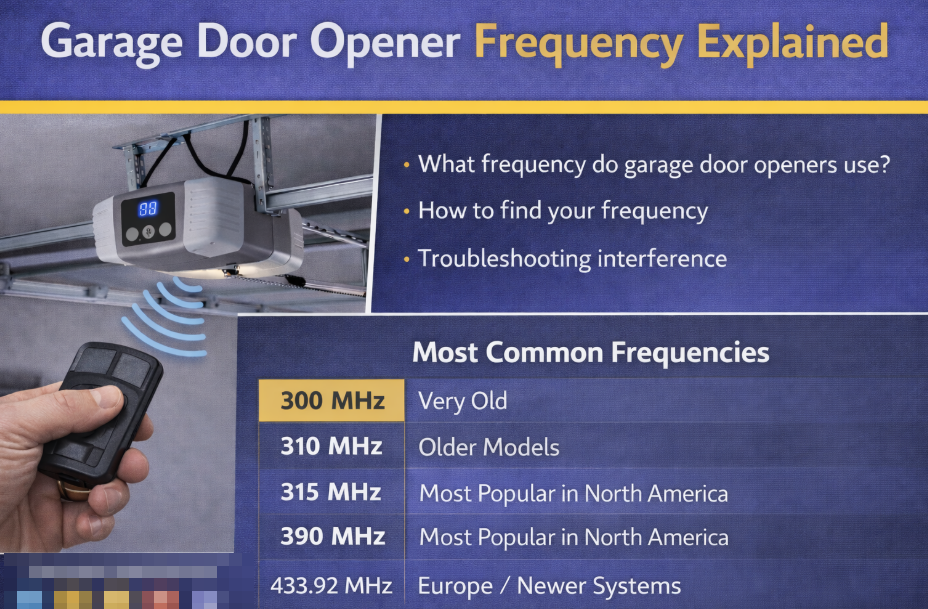
Modern and older garage door openers typically operate on one of these frequencies:
| Frequency (MHz) | Common Use |
|---|---|
| 300 MHz | Very old openers (mostly discontinued) |
| 310 MHz | Older LiftMaster / Chamberlain models |
| 315 MHz | Widely used in North America |
| 390 MHz | Common for many remotes and receivers |
| 433.92 MHz | Popular in Europe and newer systems |
So if you’re asking “what frequency does a garage door opener use?”, the most common answers today are 315 MHz or 390 MHz, depending on the model and age.
Garage Door Opener Frequency by Brand (Typical)
| Brand | Common Frequency |
|---|---|
| LiftMaster | 315 MHz / 390 MHz |
| Chamberlain | 315 MHz / 390 MHz |
| Craftsman | 315 MHz / 390 MHz |
| Genie | 315 MHz / 390 MHz |
| Linear | Varies (often 318 MHz or 300 MHz) |
This is why remotes are not universally compatible unless they support multiple frequencies.
How to Find the Frequency of Your Garage Door Opener
If you’re wondering “what is the frequency of my garage door opener?”, here are the easiest ways to check:
1. Check the Remote Control
Most remotes list the frequency on:
- The back label
- Inside the battery compartment
Look for numbers like 315 MHz, 390 MHz, or 433 MHz.
2. Check the Opener Motor Unit
The frequency may be printed on:
- The opener’s label
- The logic board inside the housing
3. Check the Manual or Manufacturer Specs
Searching the model number usually gives an exact frequency.
Garage Door Opener Frequency Change — Is It Possible?
In most modern systems, you cannot manually change the frequency. Instead, manufacturers use:
- Rolling code technology
- Encrypted signals
- Auto-paired remotes
However, older openers with DIP switches did allow frequency and code changes manually.
So if you’re searching for garage door opener frequency change, the realistic solution is usually:
- Replace the remote
- Replace the receiver
- Upgrade the opener
Garage Door Opener Frequency Interference — Common Causes
Frequency interference is a common reason for unreliable operation.
Typical sources include:
- Nearby garage door openers using the same frequency
- LED bulbs not rated for garage door openers
- Wi-Fi routers or smart devices
- Baby monitors or security cameras
If your opener works intermittently or only at close range, frequency interference is a likely cause.
Garage Door Opener Frequency Chart (Quick Reference)
| Era | Typical Frequency |
|---|---|
| Pre-1995 | 300 MHz |
| 1995–2005 | 310 / 390 MHz |
| 2005–Present | 315 / 390 MHz |
| EU / Smart Systems | 433.92 MHz |
This chart helps identify compatibility when buying a replacement remote.
Why Frequency Matters More Than You Think
The garage door opener frequency affects:
- Remote range
- Security level
- Interference resistance
- Compatibility with universal remotes
Using the wrong frequency remote simply won’t work — even if it looks identical.
When Should You Replace Instead of Troubleshoot?
Consider replacing components if:
- Your opener uses an obsolete frequency
- Interference persists after troubleshooting
- Remotes are no longer available
- Security is outdated
Upgrading often solves multiple issues at once.
Final Thoughts
Understanding garage door opener frequency helps you:
- Buy the correct remote
- Fix range and signal issues
- Avoid interference problems
- Make smarter upgrade decisions
If your garage door opener behaves unpredictably, frequency is one of the first things worth checking.
