Garage door openers operating at 433 MHz (433.92 MHz) are widely used, especially outside North America. However, compatibility at this frequency is often misunderstood. This guide explains how 433 MHz garage door openers work, which remotes and systems are compatible, and what to check before buying or pairing a new device.
- What Is a 433 MHz Garage Door Opener?
- 433 MHz vs 433.92 MHz – Is There a Difference?
- Why Frequency Alone Does Not Guarantee Compatibility
- Garage Door Opener Compatibility Chart (433 MHz)
- Are 433 MHz Garage Door Openers Compatible With MyQ?
- RF Garage Door Openers – What “RF” Really Means
- Common Compatibility Problems With 433 MHz Systems
- What About 5 GHz Garage Door Openers?
- How to Check If Your Garage Door Opener Is 433 MHz
- Key Takeaways
- Author
What Is a 433 MHz Garage Door Opener?
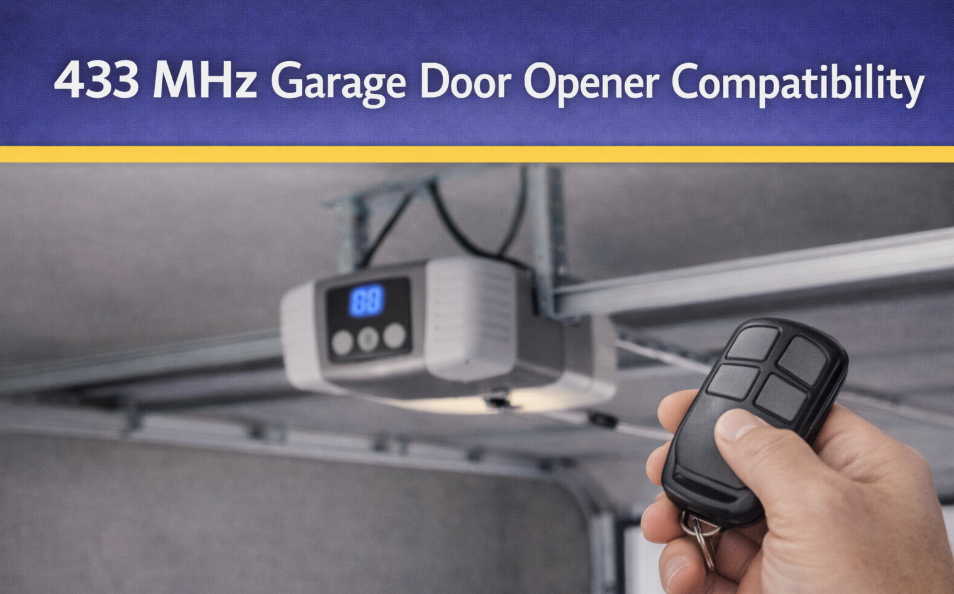
A 433 MHz garage door opener uses radio frequency (RF) signals around 433.92 MHz to communicate between the remote, keypad, or wall control and the opener unit.
This frequency is common in:
- Europe and the UK
- Australia
- Parts of Asia
- Newer multi-frequency or international models
It is less common in older North American-only systems, which typically use 315 MHz or 390 MHz.
433 MHz vs 433.92 MHz – Is There a Difference?
In practice, 433 MHz and 433.92 MHz refer to the same RF band.
- 433 MHz = simplified name
- 433.92 MHz = precise operating frequency
Manufacturers often list one or the other, but compatibility depends on protocol and security, not just the number.
Why Frequency Alone Does Not Guarantee Compatibility
Two devices can both use 433 MHz and still not work together.
Compatibility also depends on:
- Rolling code or fixed code system
- Encryption protocol
- Brand-specific firmware
- Learn button support
- Receiver type (built-in vs external)
This is why many users struggle when pairing a 433 MHz garage door remote that “should work” but doesn’t.
Garage Door Opener Compatibility Chart (433 MHz)
| System / Brand | 433 MHz Support | Notes |
|---|---|---|
| Generic RF openers | Yes | Often fixed-code only |
| European gate openers | Yes | Usually 433.92 MHz |
| LiftMaster (US models) | No | Uses 315 / 390 MHz |
| LiftMaster (EU models) | Yes | Depends on model |
| Chamberlain (EU) | Yes | MyQ varies by region |
| Genie | Rare | Mostly 315 / 390 MHz |
| Universal RF receivers | Yes | Must match protocol |
A garage door opener compatibility chart is useful, but always verify the model number and region.
Are 433 MHz Garage Door Openers Compatible With MyQ?
In most cases, 433 MHz openers are NOT directly compatible with MyQ.
MyQ compatibility depends on:
- Specific LiftMaster or Chamberlain models
- Built-in MyQ hardware
- Supported frequency AND protocol
If your opener is 433 MHz:
- You may need an external MyQ-compatible receiver
- Or a bridge/controller, not direct pairing
RF Garage Door Openers – What “RF” Really Means
An RF garage door opener simply means it uses radio frequency.
It does NOT guarantee:
- Universal compatibility
- Smart app support
- Rolling-code security
Always check:
- Frequency
- Code type (fixed vs rolling)
- Manufacturer protocol
Common Compatibility Problems With 433 MHz Systems
- Remote transmits but opener does not respond
- Learn button pairing fails
- Door opens intermittently
- Works only at very short range
Most issues are caused by:
- Incompatible rolling code systems
- Wrong receiver type
- Interference from other 433 MHz devices
What About 5 GHz Garage Door Openers?
A 5 GHz garage door opener does not exist for RF control.
- 5 GHz applies to Wi-Fi, not remotes
- Garage door remotes use sub-1 GHz frequencies
- Smart openers may use 2.4 GHz Wi-Fi for apps, but RF control remains separate
How to Check If Your Garage Door Opener Is 433 MHz
- Look at the opener or receiver label
- Check the remote control FCC / CE marking
- Review the manual or manufacturer specs
- Identify the region the opener was sold in
If unsure, assume frequency alone is not enough and verify compatibility before buying accessories.
Key Takeaways
- 433 MHz garage door openers are common internationally
- 433 MHz and 433.92 MHz are effectively the same band
- Compatibility depends on protocol, not just frequency
- Most US LiftMaster and Chamberlain models do NOT use 433 MHz
- MyQ compatibility is limited and model-specific
