Imagine wearing the same watch from a workday into a weekend trip. That transition exposes the difference between Seiko and Tissot quickly.
Seiko and Tissot are two of the most popular watch brands for buyers looking to move beyond fashion watches and into serious watchmaking.
Both brands offer excellent value, strong heritage and a wide range of watches, but they take very different approaches.
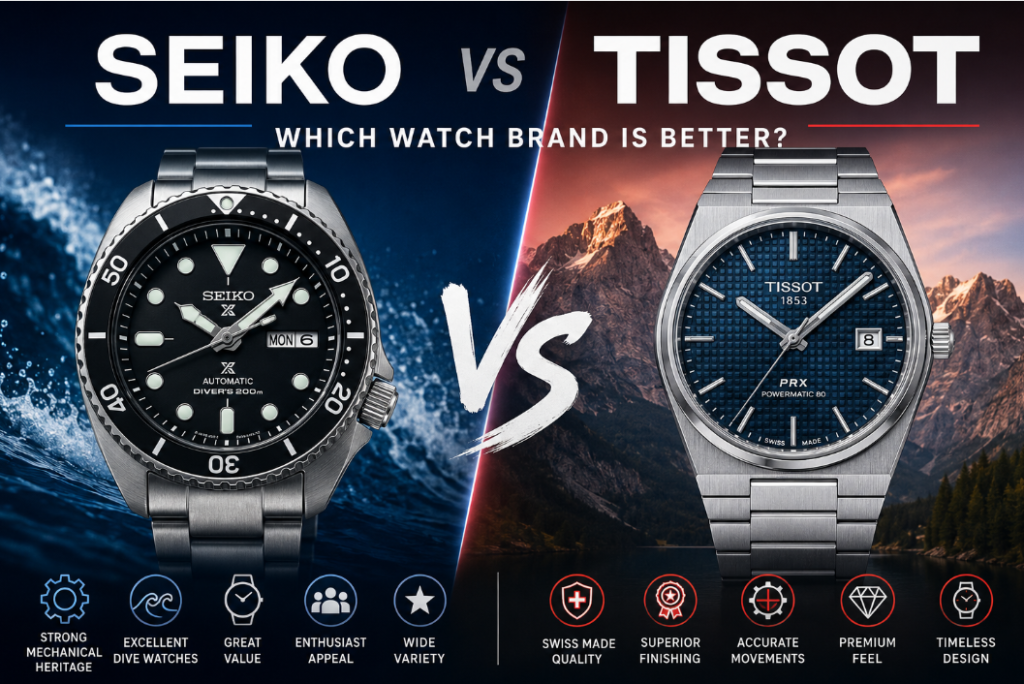
Seiko focuses on Japanese engineering, strong mechanical watches and enthusiast appeal.
Tissot focuses on Swiss-made prestige, refined finishing and strong value within the Swiss watch market.
The simple answer is this:
Buy Seiko if you want stronger value, better dive watches and a more enthusiast-focused experience.
Buy Tissot if you want Swiss-made prestige, better finishing and a more premium overall feel.
If you’re buying with your heart, Seiko often wins.
If you’re buying with your head and want Swiss heritage, Tissot is usually the safer choice.
The Practical Question Behind Seiko vs Tissot
Across Reddit and watch forums, several opinions appear repeatedly:
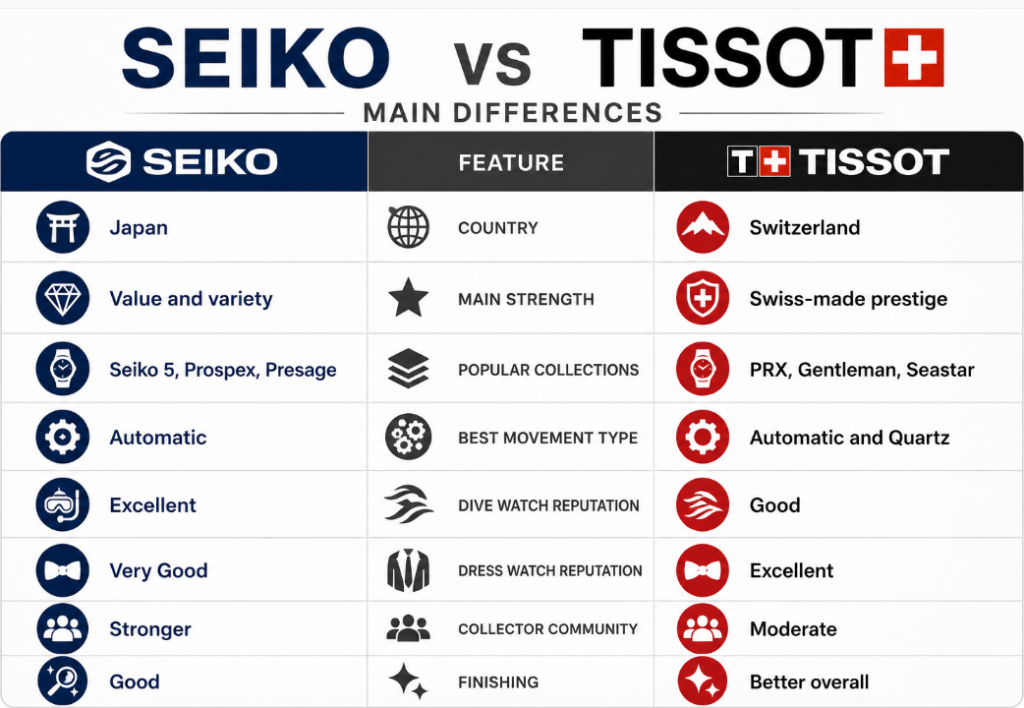
- Seiko makes better dive watches.
- Tissot offers better finishing.
- The PRX changed Tissot’s position in the market.
- Seiko has a stronger enthusiast culture.
- Tissot feels more premium out of the box.
- Seiko offers more personality.
- Tissot offers more refinement.
These opinions are surprisingly consistent among collectors.
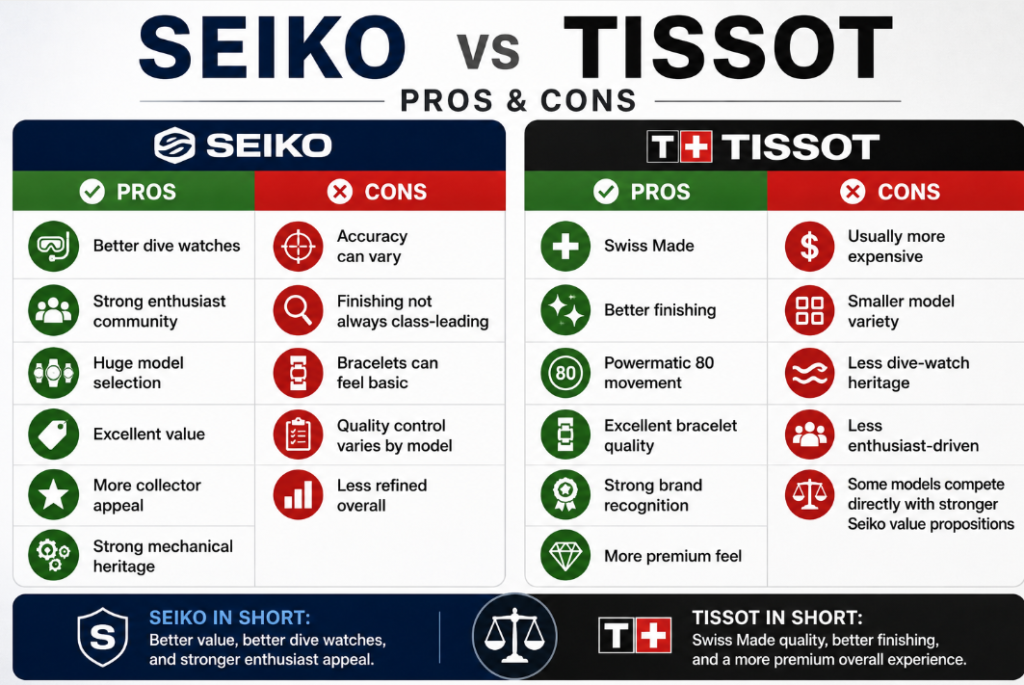
Seiko Pros ✅
- Better dive watches
- Strong enthusiast community
- Huge model selection
- Excellent value
- More collector appeal
- Strong mechanical heritage
Seiko Cons ❌
- Accuracy can vary
- Finishing not always class-leading
- Bracelets can feel basic
- Quality control varies by model
- Less refined overall
Tissot Pros ✅
- Swiss Made
- Better finishing
- Powermatic 80 movement
- Excellent bracelet quality
- Strong brand recognition
- More premium feel
Tissot Cons ❌
- Usually more expensive
- Smaller model variety
- Less dive-watch heritage
- Less enthusiast-driven
- Some models compete directly with stronger Seiko value propositions
What Is Happening Under the Dial: Seiko
Both brands make excellent watches, but the experience differs. Seiko relies heavily on movements such as:
- 4R36
- 6R35
- 6R54 GMT
These movements are durable and proven but not known for exceptional accuracy. Tissot uses ETA and Powermatic 80 movements. The Powermatic 80 is one of the strongest movements in this price category thanks to:
- 80-hour power reserve
- Better factory accuracy
- Strong reliability
- Excellent service network
If movement performance is your priority, Tissot has a slight edge. Tissot wins. A typical Powermatic 80 often runs noticeably more accurately than a standard Seiko 4R36 or 6R35. Many Seiko owners accept wider accuracy ranges because they appreciate the brand’s character and heritage.
If precision matters most, Tissot is usually the safer bet.
This is where Seiko pulls ahead. The Prospex collection has become one of the most respected dive-watch lineups in the industry. Popular models include:
- SPB143
- SPB317
- Samurai
- Turtle
- Sumo
Tissot’s Seastar collection is good, but it doesn’t have the same enthusiast following or dive-watch heritage. If you’re specifically shopping for a diver, Seiko is usually the better choice.
Tissot has the advantage here. Models like the:
- PRX
- Gentleman
- Le Locle
- Carson
look more refined and upscale than most similarly priced Seikos. Seiko Presage offers beautiful dials, but Tissot generally feels more luxurious.
Where the Extra Money Actually Goes: Tissot
This is one of the hardest categories. Under $500, Seiko often delivers more watch for the money.
Between $500 and $1,000, the competition becomes extremely close. Above $1,000, Tissot often feels more premium.
Where the Design Language of Seiko and Tissot Separates
This category depends entirely on taste. Tissot excels at clean Swiss designs. The PRX has become one of the most popular watches under $1,000 because of its integrated bracelet design and premium appearance. Seiko offers significantly more variety.
You can choose:
- Seiko 5 Sports
- Prospex divers
- Presage dress watches
- GMT models
- Field watches
Tissot offers refinement. Seiko offers variety.
This is closer than many buyers expect. Seiko offers excellent construction, especially in Prospex models. Cases are durable, dials are often excellent and reliability is proven.
However, Tissot generally delivers better finishing at similar prices. Brushing, polishing, bracelet quality and clasp quality often feel more refined. Many enthusiasts comparing a Seiko Prospex to a Tissot Gentleman or PRX notice the difference immediately.
How I Would Spend the Money on Seiko Versus Tissot
The final answer is simple. Seiko is the better brand for enthusiasts, collectors and dive-watch buyers. Tissot is the better brand for buyers who want Swiss-made quality, stronger finishing and a more premium experience. Buy Seiko for value, personality and mechanical charm.
Buy Tissot for refinement, finishing and Swiss prestige. If you are buying with your heart, choose Seiko. If you are buying with your head, choose Tissot.