One technical distinction does more work in the Omega versus Rolex decision than the rest of the specification sheet combined.
Omega and Rolex are the two biggest names in Swiss watchmaking. They have competed for decades, share many of the same customers, and produce some of the most recognizable watches ever made.
If you ask watch enthusiasts which brand is better, you’ll often get a heated debate rather than a clear answer.
That’s because Omega and Rolex excel in different areas.
Rolex is the king of consistency, resale value and brand prestige.
Omega is the king of innovation, technology and value for money.
The honest conclusion is that neither brand completely dominates the other. The better choice depends on what you actually want from a luxury watch.
- Omega vs Rolex: The Decision in One Useful Frame
- Where Omega or Rolex Wins a Specific Job
- The Enthusiast Argument Beneath the Specs: Rolex
- Rolex supporters
- Omega supporters
- Rolex criticism
- Omega criticism
- Omega Pros ✅
- Omega Cons ❌
- Rolex Pros ✅
- Rolex Cons ❌
- The Practical Gap Is Smaller Than the Price Gap: Rolex
- The History Behind the Buying Decision: Rolex
- Dive Watch
- Chronograph
- Everyday Luxury Watch
- Explorer-Style Watch
- GMT Watch
- Author
Omega vs Rolex: The Decision in One Useful Frame
This is where personal preference becomes critical. Rolex designs evolve slowly. A Submariner from twenty years ago still looks like a modern Submariner.
That consistency is one reason Rolex watches age so well. Omega takes more risks. The modern Seamaster 300M looks dramatically different from earlier generations.
The Aqua Terra has evolved repeatedly. The Speedmaster has numerous variations. Rolex is conservative.
Omega is more experimental. If you like timeless design, Rolex wins. If you like variety, Omega wins.
Slight Winner: Rolex
Many people assume Rolex is far superior. The truth is more complicated. Modern Omega finishing is outstanding. Rolex finishing is outstanding.
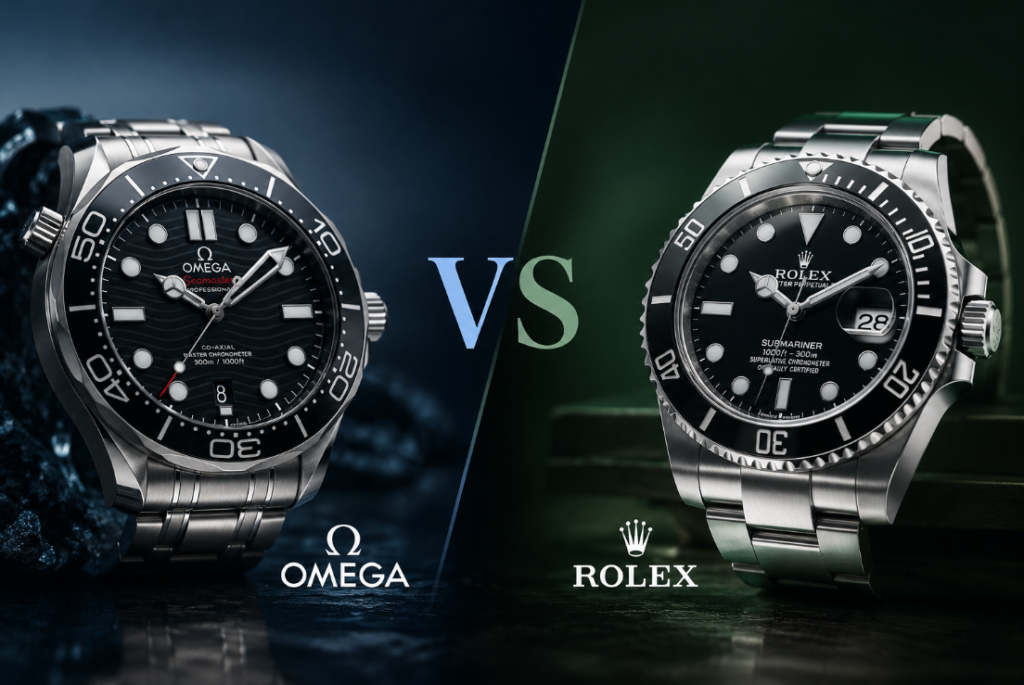
Bracelets from both brands are among the best in the industry. Cases are excellent on both sides. The gap that existed twenty years ago has largely disappeared. If you compare a modern Seamaster Diver 300M and a modern Submariner side-by-side, build quality differences are surprisingly small.
Where Omega or Rolex Wins a Specific Job
This is one of the most famous battles in watchmaking. Pros:
Pros: The uncomfortable truth:
If the logos were hidden, many buyers would choose the Omega. But logos are not hidden.
And that changes everything. Slight Winner: Rolex
This category belongs to Omega. The Speedmaster Professional is arguably the most historically important chronograph ever made.
The Daytona is fantastic. But much of the Daytona’s appeal comes from scarcity and collectability.
The Speedmaster’s appeal comes from history. Many enthusiasts believe the Speedmaster is the more interesting watch.
Rolex wins. The Datejust is one of the greatest everyday watches ever made.
It works with:
- Business attire
- Casual clothing
- Formal events
- Daily wear
Omega has excellent dress watches, particularly the Aqua Terra and De Ville. But the Datejust remains the benchmark.
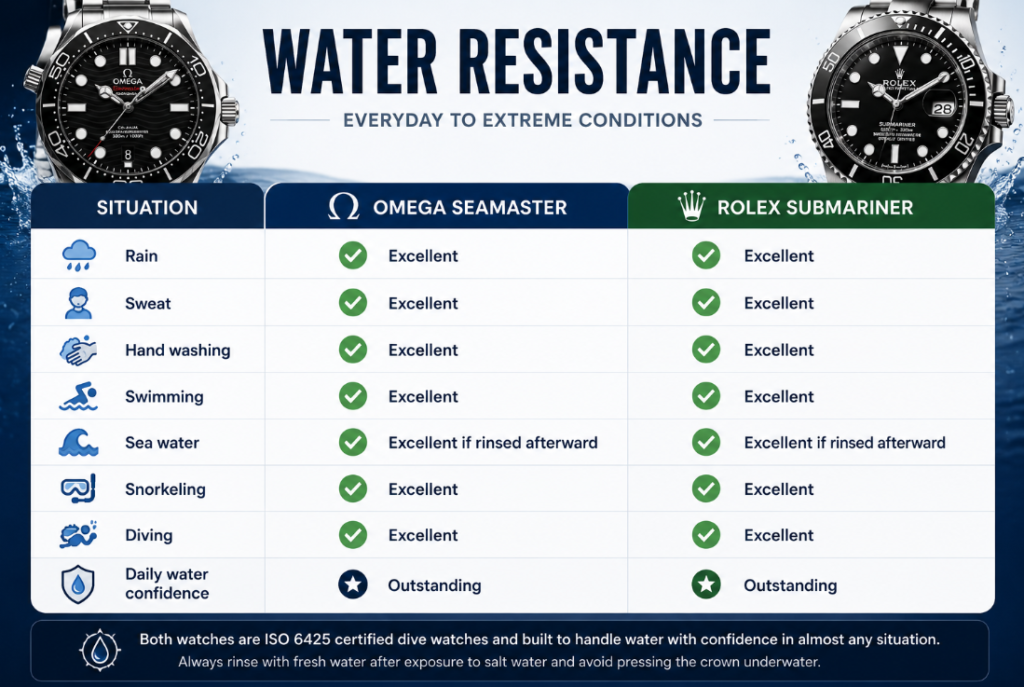
Both brands offer excellent water resistance.
This category is effectively a draw.
This is where Omega takes the lead. Omega has spent the last two decades pushing movement technology forward. Key advantages include:
- Co-Axial escapement
- METAS certification
- Master Chronometer testing
- Anti-magnetic resistance up to 15,000 gauss
- Display case backs on many models
Rolex movements are fantastic. But Rolex tends to prioritize reliability over innovation.
Rolex improves slowly and carefully. Omega experiments more.
From a pure technical perspective, Omega wins. Both brands perform at a very high level.
Rolex Superlative Chronometer:
-2/+2 seconds per day Omega Master Chronometer:
0/+5 seconds per day after METAS testing
Real-world performance often overlaps. The practical difference is tiny.
Most owners will never notice it.
The Enthusiast Argument Beneath the Specs: Rolex
Rolex is not necessarily better because its watches are better. Rolex is better because Rolex successfully became Rolex. The crown logo carries a level of recognition that almost no other watch brand can match.
Many non-watch people know Rolex. Far fewer know Omega. That brand power affects pricing, demand and resale value.
At the same time, Omega enthusiasts often ignore how much brand prestige matters in luxury goods. If status matters, Rolex wins. If watchmaking itself matters, the conversation becomes much closer.
Rolex supporters
- Best luxury sports watches
- Unmatched resale value
- Timeless designs
- Ultimate everyday luxury watch
Omega supporters
- Better technology
- Better value
- More interesting history
- More available
- Less hype-driven
Interestingly, both groups are usually correct. Let’s be honest.
Rolex criticism
- Some buyers are purchasing the logo more than the watch
- Scarcity tactics drive demand
- Retail buying experience can be frustrating
- Premiums are often irrational
Omega criticism
- Too many model variations
- Resale performance is mediocre compared to Rolex
- Discounts can hurt exclusivity
- Marketing sometimes relies too heavily on technology
These are fair criticisms of both brands.
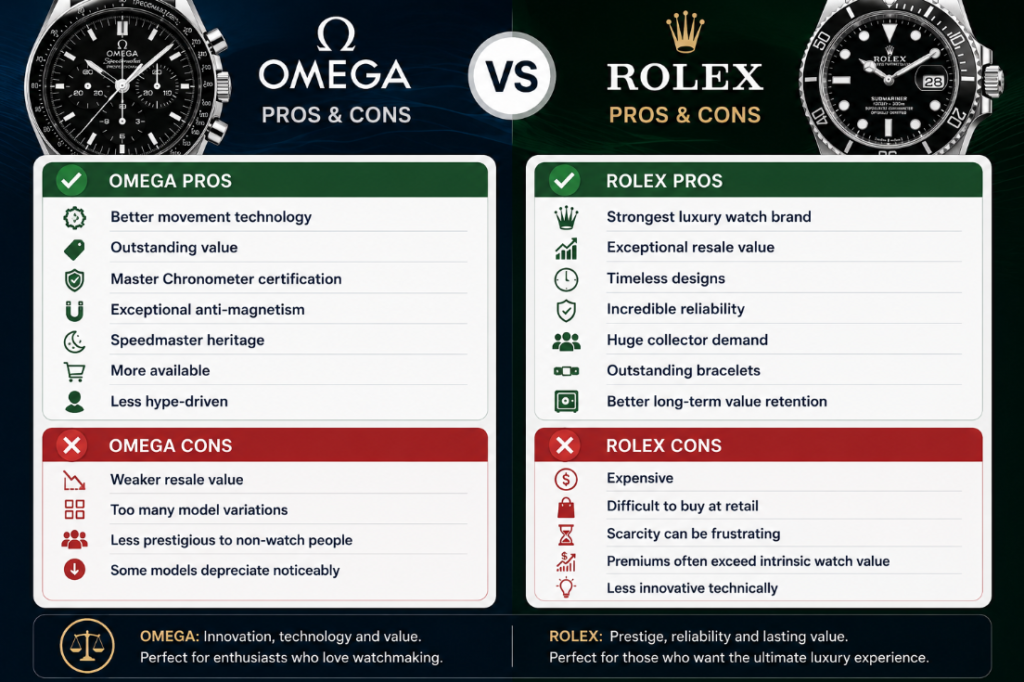
Omega Pros ✅
- Better movement technology
- Outstanding value
- Master Chronometer certification
- Exceptional anti-magnetism
- Speedmaster heritage
- More available
- Less hype-driven
Omega Cons ❌
- Weaker resale value
- Too many model variations
- Less prestigious to non-watch people
- Some models depreciate noticeably
Rolex Pros ✅
- Strongest luxury watch brand
- Exceptional resale value
- Timeless designs
- Incredible reliability
- Huge collector demand
- Outstanding bracelets
- Better long-term value retention
Rolex Cons ❌
- Expensive
- Difficult to buy at retail
- Scarcity can be frustrating
- Premiums often exceed intrinsic watch value
- Less innovative technically
| Feature | Omega | Rolex |
|---|---|---|
| Founded | 1848 | 1905 |
| Country | Switzerland | Switzerland |
| Famous For | Moonwatch, Seamaster, Co-Axial | Submariner, Daytona, Datejust |
| Movement Technology | More advanced | More conservative |
| Resale Value | Good | Excellent |
| Availability | Generally available | Often difficult to buy |
| Innovation | Stronger | More incremental |
| Brand Prestige | Very high | Higher |
| Collector Community | Strong | Massive |
The Practical Gap Is Smaller Than the Price Gap: Rolex
This is where Rolex dominates. The average Rolex owner loses less money.
Many Rolex models appreciate. Many Omega models depreciate after purchase.
This is not because Omega is worse. It is because Rolex demand is extraordinary.
If resale matters, Rolex wins by a huge margin. Now Omega gets its revenge.
A new Omega often gives you:
- More advanced movement
- Better anti-magnetic performance
- Similar finishing
- Similar reliability
- Lower price
In pure watch terms, Omega often delivers more watch per dollar. The problem is that luxury purchases are rarely purely rational.
The History Behind the Buying Decision: Rolex
Both brands have incredible histories. Major achievements include: Major achievements include:
Omega’s history is more adventurous. Rolex’s history is more influential.
Dive Watch
Winner: Depends on priorities. Omega for technology, Rolex for prestige and resale.
Chronograph
Winner: Omega for history, Rolex for collectability.
Everyday Luxury Watch
Winner: Datejust.
Explorer-Style Watch
Winner: Rolex Explorer.
GMT Watch
Winner: GMT-Master II.
Choose Omega if: Choose Rolex if: If we’re judging watches alone, Omega and Rolex are much closer than most people think.
Omega often wins on technology. Rolex often wins on prestige. The watch enthusiast answer is often Omega.
The luxury buyer answer is often Rolex. If I were spending my own money strictly based on what is inside the watch, Omega would be incredibly difficult to ignore. If I were spending my own money considering ownership experience, resale value and long-term desirability, Rolex would probably win.
The most honest conclusion is this: Omega makes some of the most impressive watches in the world. Rolex remains the most complete luxury watch brand in the world.
That is why this debate has lasted for decades and probably will continue for decades more.