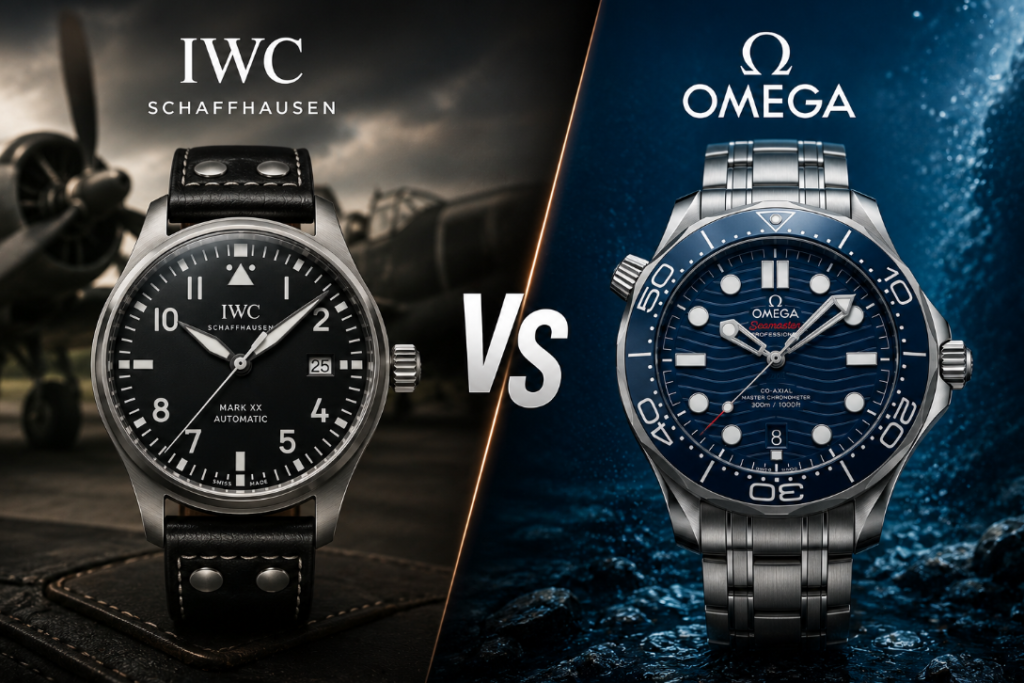
IWC and Omega reached today’s market from different periods and different ideas about what a watch should be.
If you’re looking for the strongest overall luxury watch brand below Rolex, Omega wins. If you’re looking for distinctive design, aviation heritage, and understated luxury, IWC is one of the most compelling brands in Swiss watchmaking. Omega offers more innovation, stronger movements, better value, and greater model diversity.
IWC offers cleaner designs, exceptional pilot watches, and a unique identity that few luxury brands can match.
- The Practical Question Behind IWC vs Omega
- Omega Pros ✅
- Omega Cons ❌
- IWC Pros ✅
- IWC Cons ❌
- The Heritage Gap Is Not What It Seems: Omega
- IWC Big Pilot vs Omega Speedmaster Professional
- IWC Mark XX vs Omega Aqua Terra
- IWC Portugieser vs Omega Globemaster
- What You Notice Before Reading the Specs
- Where Engineering Becomes Practical: Omega
- Who Should Walk Away From IWC or Omega
- Overall Winner: Omega 🏆
- Author
The Practical Question Behind IWC vs Omega
Many buyers assume IWC occupies a higher tier than Omega. Historically, that argument had some merit.
Today, it’s difficult to justify. Omega has spent the last decade investing heavily in movement technology, anti-magnetism, certification standards, and manufacturing capabilities.
The result is that many Omega watches now offer specifications that even some significantly more expensive Swiss brands struggle to match. The uncomfortable truth for IWC is that much of the premium buyers pay today comes from design, brand positioning, and exclusivity rather than superior technology.
The uncomfortable truth for Omega is that despite its technical advantages, many enthusiasts still consider IWC the more interesting brand. Omega often wins with logic.
IWC often wins with emotion. Across Reddit, WatchUSeek, WatchCrunch, and enthusiast communities, Omega generally receives broader support.
Collectors consistently praise:
- Speedmaster
- Seamaster
- Aqua Terra
- Master Chronometer movements
- Anti-magnetic technology
IWC receives praise for: The most common Omega criticism is that the catalog has become overly complicated. The most common IWC criticism is pricing.
Many enthusiasts believe Omega currently delivers more watch for the money. Many enthusiasts believe IWC delivers more personality.
Omega Pros ✅
- ✅ Legendary Moonwatch heritage
- ✅ Industry-leading movement technology
- ✅ Master Chronometer certification
- ✅ Exceptional anti-magnetism
- ✅ Outstanding dive watches
- ✅ Strong resale value
- ✅ Excellent value in luxury segment
Omega Cons ❌
- ❌ Large catalog can be confusing
- ❌ Some models are becoming expensive
- ❌ Seamaster design can be polarizing
- ❌ Less exclusive than IWC
IWC Pros ✅
- ✅ Iconic pilot watches
- ✅ Beautiful minimalist designs
- ✅ Strong aviation heritage
- ✅ Excellent finishing
- ✅ Understated luxury appeal
- ✅ Distinctive brand identity
- ✅ Outstanding Portugieser collection
IWC Cons ❌
- ❌ Higher prices for similar specifications
- ❌ Weaker movement technology
- ❌ Lower resale value
- ❌ Less innovation than Omega
- ❌ Limited dive-watch lineup
This category often surprises buyers. IWC is rarely cheap. Neither is Omega. The difference is what buyers receive for the money.
Omega frequently offers:
- Higher movement technology
- Better certifications
- Greater anti-magnetic protection
- Stronger resale performance
IWC offers exclusivity and design. Omega offers measurable advantages.
When discussing pure value, Omega is difficult to beat.
The Heritage Gap Is Not What It Seems: Omega
Both brands possess remarkable histories. Omega’s influence on modern watchmaking is difficult to overstate. The Speedmaster became the first watch worn on the Moon.
The Seamaster became one of the most successful dive-watch families ever created. Omega has served as the official timekeeper of the Olympics for decades. Few brands have achieved comparable cultural relevance.
IWC’s heritage is narrower but incredibly strong. The company built its reputation around pilot watches, military contracts, and engineering-focused watchmaking. The Big Pilot is one of the most recognizable aviation watches ever produced.
The Portugieser remains one of the most elegant luxury sports watches on the market. IWC’s history is impressive. Omega’s history is iconic.
IWC Big Pilot vs Omega Speedmaster Professional
Verdict: The Big Pilot is one of the greatest pilot watches ever made. The Speedmaster is one of the greatest watches ever made.
IWC Mark XX vs Omega Aqua Terra
Verdict: Mark XX is cleaner. Aqua Terra is more complete.
IWC Portugieser vs Omega Globemaster
Verdict: Portugieser wins hearts. Globemaster wins spec sheets.
What You Notice Before Reading the Specs
This category is where IWC shines. Many luxury brands feel compelled to add complexity. IWC often does the opposite. The Big Pilot is instantly recognizable.
The Portugieser remains one of the cleanest designs in Swiss watchmaking. The Mark XX demonstrates how beautiful simplicity can be. Omega’s catalog is more diverse. The Seamaster has become increasingly bold.
The Speedmaster remains timeless. The Aqua Terra balances sport and elegance exceptionally well. However, some enthusiasts feel Omega occasionally adds too much visual complexity. IWC’s design language feels more focused.
Cleaner. More mature.
This category is essentially a draw. Both brands operate at an extremely high level.
Case finishing is excellent. Bracelet quality is excellent.
Dial execution is excellent. The difference comes down to philosophy.
IWC focuses on refinement and restraint. Omega focuses on precision and detail.
Neither brand has a meaningful advantage in daily ownership.
Where Engineering Becomes Practical: Omega
This is where Omega pulls ahead. Modern Omega movements are among the most technically impressive calibers available anywhere near this price range. Key advantages include:
- METAS certification
- Master Chronometer status
- Exceptional anti-magnetic resistance
- Co-Axial escapement
- Strong power reserves
- Excellent reliability
The anti-magnetic performance alone exceeds what many luxury buyers will ever realistically need. IWC movements are good. Omega movements are industry-leading. That distinction matters.
Omega’s dive-watch expertise gives it a clear edge.
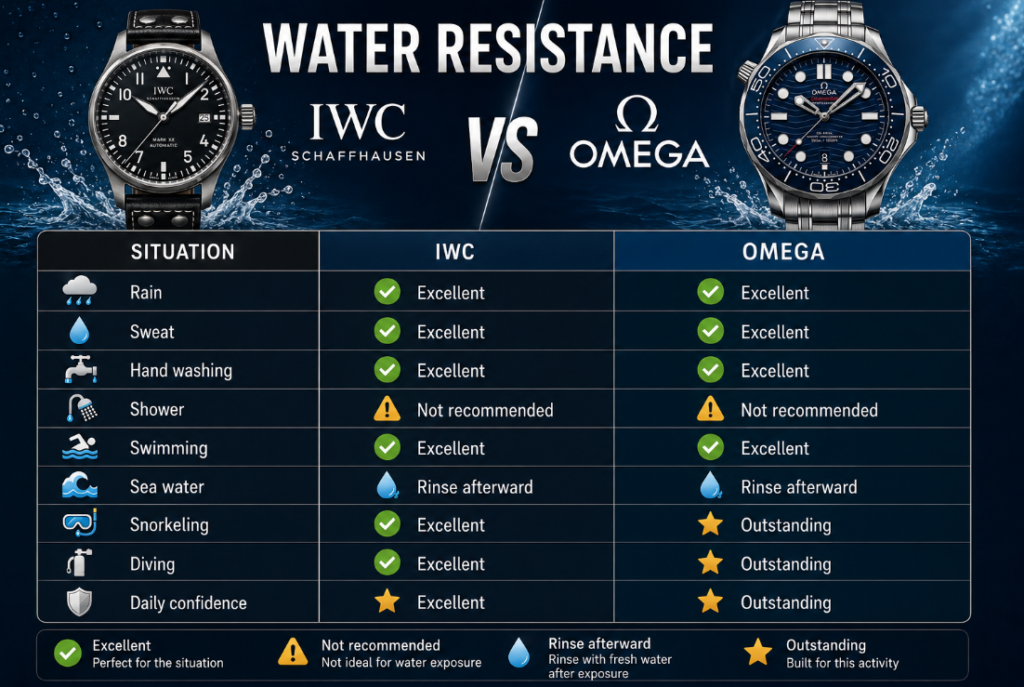
The Seamaster collection remains one of the strongest dive-watch platforms in the world.
Who Should Walk Away From IWC or Omega
IWC and Omega represent two different interpretations of luxury watchmaking. Omega focuses on technical excellence.
IWC focuses on design excellence. If you compare specifications, certifications, movement technology, and value, Omega wins.
If you compare emotional appeal, simplicity, and design purity, IWC becomes extremely attractive. The challenge for IWC is that Omega’s technological advantage has become increasingly difficult to ignore.
The challenge for Omega is that specifications alone do not create passion. If you’re buying your first luxury watch, Omega is usually the safer recommendation.
If you’re building a collection and want something with a stronger personality, IWC may be the more satisfying choice. Objectively, Omega offers more.
Subjectively, many collectors still prefer IWC. For most buyers, Omega remains the stronger overall brand.