- Quick Verdict
- Quick Comparison
- The Reality Nobody Likes to Hear
- Packaging
- LCD Display
- Genuine Casio F91W
- Fake Casio F91W
- Winner: Genuine Casio
- Backlight
- Genuine
- Fake
- Winner: Genuine Casio
- Case and Finishing
- Bracelet Quality
- Genuine
- Fake
- Buttons
- Genuine
- Fake
- Alarm and Beep
- Water Resistance
- Winner: Genuine Casio
- Battery Life
- Genuine
- Fake
- Internal Module
- How to Spot a Fake Casio F91W – 10 Easy Authenticity Checks
- 1. Check the LCD Display
- Genuine Casio F91W
- Fake Casio F91W
- 2. Test the Hidden “CASIo” Screen
- How to perform it
- 3. Look at the Backlight
- Genuine
- Fake
- 4. Inspect the Case Back
- 5. Examine the Screws
- 6. Check the Resin Strap
- Genuine
- Fake
- 7. Inspect the Buttons
- 8. Look Inside the Case (Advanced Check)
- 9. Check the Battery
- 10. Consider the Price and Seller
- Quick Authenticity Checklist
- Final Tip
- What Enthusiasts Usually Say
- Pros and Cons
- Genuine Casio F91W Pros ✅
- Genuine Casio F91W Cons ❌
- Fake Casio F91W Pros ✅
- Fake Casio F91W Cons ❌
- Where to Buy a Genuine Casio F91W
- Final Verdict
- Author
Quick Verdict
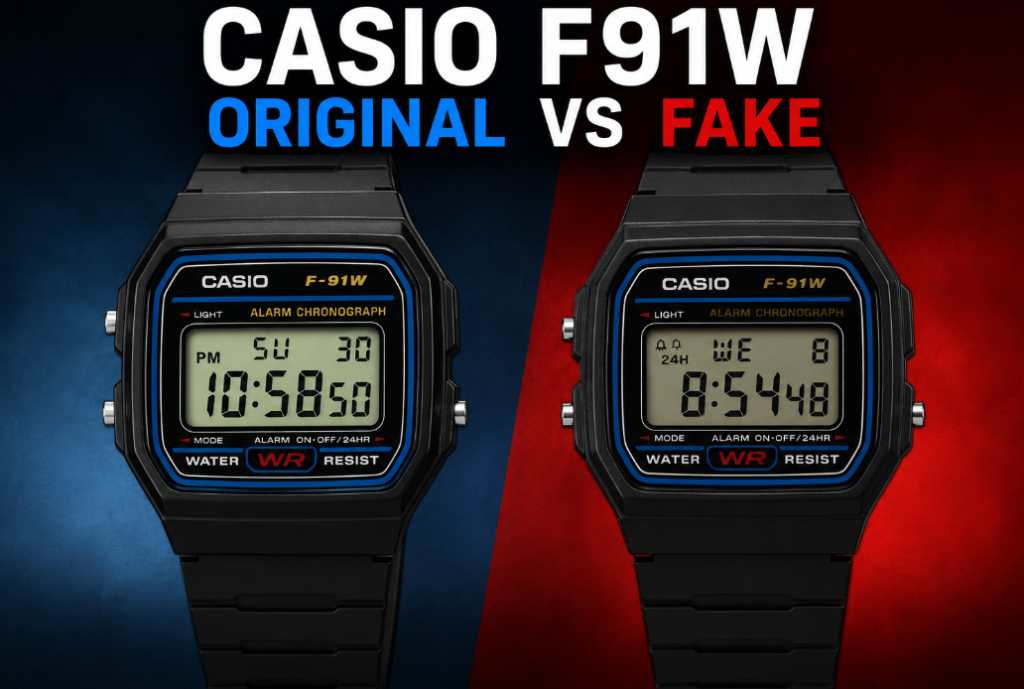
The Casio F-91W is one of the most copied digital watches in the world. Because the genuine model is inexpensive and incredibly popular, counterfeit manufacturers produce thousands of fake versions that often look convincing in online photos.
Fortunately, most fake F-91Ws reveal themselves once you know what to check.
A genuine Casio F-91W offers excellent build quality, reliable electronics, accurate timekeeping, and years of dependable service. A counterfeit may look similar at first glance, but the differences become obvious when you examine the display, backlight, buttons, case finishing, bracelet, and internal module.
If you’re unsure whether your watch is genuine, this guide will walk you through every major difference.
Quick Comparison
| Feature | Genuine Casio F91W | Fake Casio F91W |
|---|---|---|
| Module | Genuine Casio | Cheap generic clone |
| Display | Sharp, high contrast | Often faded or blurry |
| Backlight | Even green illumination | Weak, blue, or uneven |
| Buttons | Crisp and responsive | Mushy or inconsistent |
| Accuracy | Excellent | Can vary significantly |
| Bracelet | Smooth, comfortable | Sharp edges, loose fit |
| Battery Life | Around 7 years | Often much shorter |
| Quality Control | Excellent | Little or none |
The Reality Nobody Likes to Hear
Many people assume that because the F-91W costs only around $20, nobody would bother making counterfeits.
The opposite is true.
Its enormous popularity makes it one of the easiest watches for counterfeit factories to sell. Millions of buyers never compare their watch to a genuine one, allowing low-quality replicas to circulate through online marketplaces and unauthorized sellers.
The good news is that most fakes are surprisingly easy to identify once you know where to look.
Packaging
Packaging alone should never determine authenticity.
Fake watches often copy:
- The blue Casio box
- Paper manuals
- Hang tags
- Warranty cards
Some counterfeit packaging looks almost identical to the genuine version.
Always inspect the watch itself rather than relying on the box.
LCD Display
The display is one of the quickest ways to identify a fake.
Genuine Casio F91W
Features:
- Dark, crisp digits
- Excellent contrast
- Uniform segment thickness
- Easy readability from multiple angles
- Clean background
Fake Casio F91W
Common problems include:
- Gray or faded digits
- Uneven LCD segments
- Lower viewing angles
- Poor contrast
- Pixelated appearance
Place a genuine and fake watch side by side and the difference is immediately noticeable.
Winner: Genuine Casio
Backlight
The famous green side light is another giveaway.
Genuine
The LED produces a soft green glow that consistently illuminates the left side of the display.
Although it doesn’t light the entire screen evenly, it remains readable in darkness.
Fake
Counterfeit watches often use:
- Weak LEDs
- Incorrect blue LEDs
- Dim green LEDs
- Uneven illumination
- Flickering light
Some fakes barely illuminate the display at all.
Winner: Genuine Casio
Case and Finishing
The genuine F-91W has a surprisingly high level of finishing considering its low price.
You’ll notice:
- Clean case molding
- Consistent resin texture
- Sharp printed lettering
- Well-finished edges
Fake watches often have:
- Soft molding lines
- Uneven paint
- Misaligned printing
- Rough resin texture
These differences become more obvious after a few weeks of wear.
Bracelet Quality
The resin strap is another important clue.
Genuine
- Flexible resin
- Comfortable fit
- Smooth buckle operation
- Consistent texture
Fake
- Stiffer plastic
- Sharp flashing around edges
- Inferior buckle finish
- Faster cracking over time
Counterfeit straps often become brittle after months rather than years.
Buttons
Button feel tells you a lot about the internal quality.
Genuine
- Firm click
- Consistent travel
- Reliable operation
Fake
- Mushy feel
- Sticky buttons
- Uneven resistance
- Occasionally missed presses
Poor button quality usually indicates a low-quality internal module.
Alarm and Beep
Original Casio modules produce a clean, consistent beep.
Counterfeit watches often have:
- Lower volume
- Distorted tone
- Inconsistent alarm duration
While this isn’t the easiest test to perform, it can help confirm other signs.
Water Resistance
This is one of the biggest differences between a genuine Casio and a fake.
A real F-91W is rated Water Resistant, making it suitable for rain, sweat, and accidental splashes. While Casio does not recommend swimming or showering with the watch, its seals and case construction are manufactured to consistent standards.
Counterfeit watches frequently copy the “Water Resist” marking without duplicating the engineering behind it. Many use poorly fitted gaskets, low-quality pushers, and inconsistent assembly, making even light moisture a potential problem.
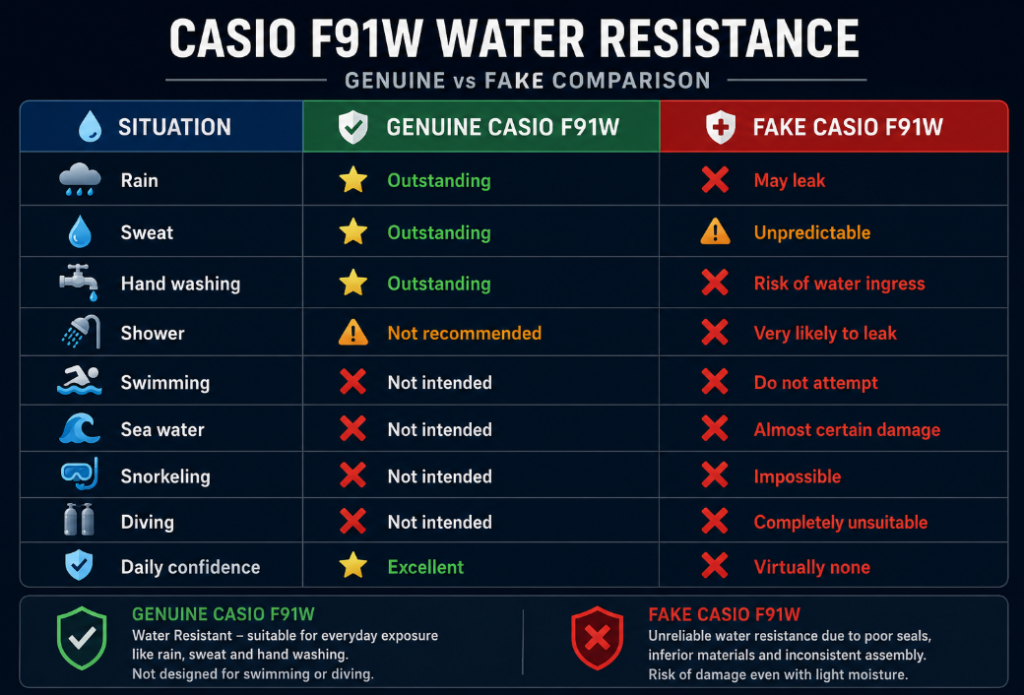
| 🌧️ Situation | Genuine Casio F91W | Fake Casio F91W |
|---|---|---|
| 🌧️ Rain | ⭐ Outstanding | ❌ May leak |
| 💦 Sweat | ⭐ Outstanding | ⚠️ Unpredictable |
| 🚰 Hand washing | ⭐ Outstanding | ❌ Risk of water ingress |
| 🚿 Shower | ⚠️ Not recommended | ❌ Very likely to leak |
| 🏊 Swimming | ❌ Not intended | ❌ Do not attempt |
| 🌊 Sea water | ❌ Not intended | ❌ Almost certain damage |
| 🤿 Snorkeling | ❌ Not intended | ❌ Impossible |
| 🧭 Diving | ❌ Not intended | ❌ Completely unsuitable |
| 🛡️ Daily confidence | ⭐ Excellent | ❌ Virtually none |
Winner: Genuine Casio
Battery Life
One reason the F-91W became legendary is its impressive battery life.
Genuine
- Approximately 7 years
- Stable voltage
- Reliable module
- Predictable performance
Fake
Battery life varies widely.
Many counterfeit watches last only:
- 6-24 months
- Sometimes even less
Some arrive with partially depleted batteries.
Internal Module
The internal electronics separate the original from the counterfeit more than anything else.
A genuine Casio module delivers:
- Excellent accuracy
- Reliable alarms
- Stable timekeeping
- Long battery life
- Consistent performance
Counterfeit modules are generic, inexpensive copies that prioritize low production cost over durability.
This is the main reason fake watches often fail long before genuine ones.
How to Spot a Fake Casio F91W – 10 Easy Authenticity Checks
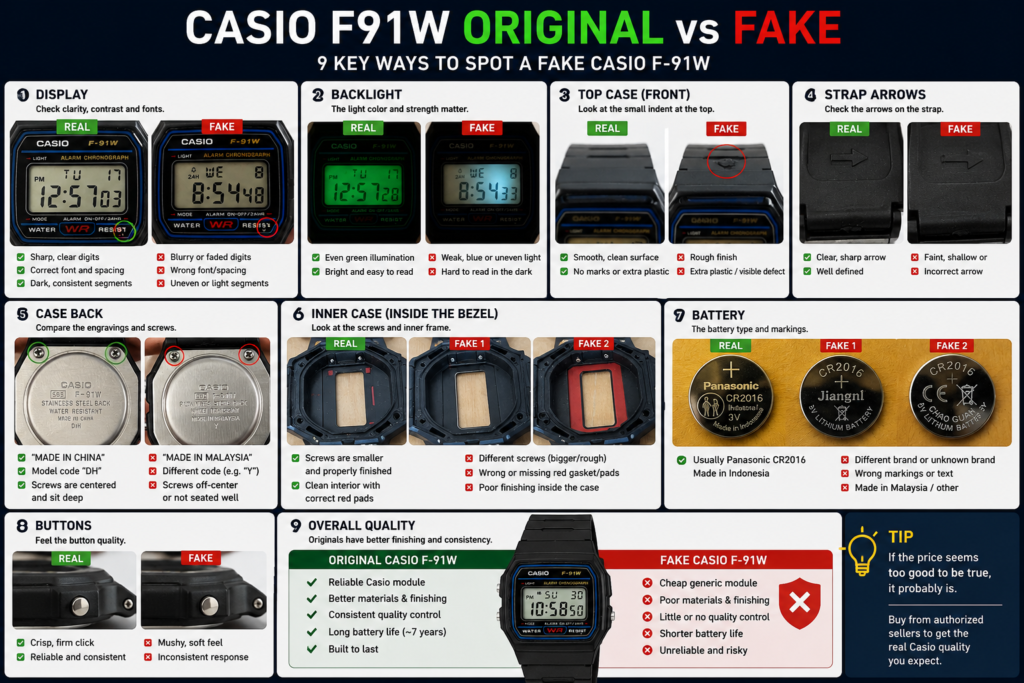
Counterfeit Casio F91W watches have become increasingly common, especially on online marketplaces. Fortunately, you don’t need to open the watch or be an expert to identify most fakes. By checking a few key details, you can quickly determine whether your Casio F91W is genuine.
1. Check the LCD Display
The display is one of the easiest giveaways.
Genuine Casio F91W
- Sharp, dark digits
- Excellent contrast
- Even LCD segments
- Easy to read from different angles
Fake Casio F91W
- Gray or washed-out display
- Uneven digit thickness
- Poor viewing angles
- Blurry numbers
Tip: Compare the watch under bright light. Genuine Casio displays remain crisp, while fake LCDs often appear faded.
2. Test the Hidden “CASIo” Screen
This is the most famous authenticity test.
How to perform it
- Hold the bottom-right button.
- While holding it, press the bottom-left button three times.
A genuine Casio F91W should briefly display:
CASIo
(with the lowercase “o” on most authentic modules).
⚠️ Keep in mind that some newer, higher-quality replicas have copied this test, so it should never be your only method of authentication.
3. Look at the Backlight
Casio uses a distinctive green side LED.
Genuine
✅ Soft green light
✅ Even illumination
✅ Consistent brightness
Fake
❌ Weak illumination
❌ Blue or white LEDs
❌ Flickering
❌ Uneven lighting
4. Inspect the Case Back
The stainless-steel back should have clean, deep engravings.
Check for:
- Sharp “CASIO” logo
- Correct model number (F-91W)
- Proper module number (593)
- Clean font spacing
- Well-centered engraving
Many counterfeit watches have shallow or blurry engraving with incorrect spacing or inconsistent fonts.
5. Examine the Screws
Original Casio watches use properly finished Phillips screws.
Counterfeit watches often have:
- Rough screw heads
- Poor machining
- Off-center installation
- Damaged finish straight from the factory
This small detail is surprisingly reliable.
6. Check the Resin Strap
The strap quality is noticeably different.
Genuine
- Soft flexible resin
- Smooth finish
- Clean molding
- Crisp directional arrows
Fake
- Hard plastic feel
- Flashing around the edges
- Uneven texture
- Poorly molded arrows or symbols
Many fake straps also crack much sooner than original Casio straps.
7. Inspect the Buttons
Original buttons have a firm, positive click.
Fake buttons usually feel:
- Mushy
- Loose
- Sticky
- Inconsistent
If one button feels noticeably different from the others, that’s a warning sign.
8. Look Inside the Case (Advanced Check)
If you’re replacing the battery, inspect the inside carefully.
A genuine Casio typically has:
- Clean internal molding
- Proper battery insulation
- Consistent gasket placement
- High-quality assembly
Counterfeit watches often show:
- Rough plastic
- Different screw locations
- Missing insulating pads
- Poor gasket installation
- Glue residue
9. Check the Battery
Many original Casio F91W watches use a quality Panasonic CR2016 battery.
Counterfeit watches frequently contain:
- Generic batteries
- Unknown brands
- Low-quality cells
- Shorter battery life
While batteries can be replaced over time, a generic battery in a “new” watch purchased from an unauthorized seller can be another indication that it’s counterfeit.
10. Consider the Price and Seller
This is often the biggest clue.
If someone is selling a “brand-new” Casio F91W for half the normal retail price, be cautious.
To minimize the risk:
- Buy from authorized Casio dealers.
- Purchase from reputable watch retailers.
- Avoid unknown marketplace sellers with little feedback.
- Check customer reviews before ordering.
Saving a few dollars simply isn’t worth ending up with a counterfeit watch.
Quick Authenticity Checklist
| Check | Genuine Casio F91W | Fake Casio F91W |
|---|---|---|
| LCD display | ✅ Sharp and high contrast | ❌ Faded or blurry |
| Hidden CASIo test | ✅ Works correctly | ⚠️ May fail or be copied |
| Backlight | ✅ Bright green LED | ❌ Weak or incorrect color |
| Case back | ✅ Deep, clean engraving | ❌ Shallow or inconsistent engraving |
| Screws | ✅ Well-finished | ❌ Rough or misaligned |
| Strap | ✅ Soft, quality resin | ❌ Hard plastic with poor molding |
| Buttons | ✅ Firm click | ❌ Mushy or inconsistent |
| Internal finish | ✅ Clean assembly | ❌ Rough construction |
| Battery | ✅ Quality branded cell | ❌ Generic battery |
| Overall quality | ✅ Consistent | ❌ Highly variable |
Final Tip
Never rely on just one authentication method. Some modern counterfeit F91W watches successfully imitate individual features such as the hidden “CASIo” LCD test or the case-back engraving. The safest approach is to evaluate the watch as a whole – display quality, backlight, buttons, strap, engravings, internal construction, and overall finishing. When several small details don’t match what Casio is known for, there’s a strong chance the watch is counterfeit.
What Enthusiasts Usually Say
Across Reddit, WatchUSeek, and Casio enthusiast forums, owners consistently report that genuine F-91Ws feel noticeably better in everyday use.
Common observations include:
- Better display clarity
- More consistent backlight
- Higher-quality buttons
- Longer battery life
- Better strap durability
The most frequent complaint about fake models is that they may look convincing initially but quickly reveal poor quality after regular wear.
One opinion appears repeatedly:
“The real F-91W costs so little that buying a fake simply isn’t worth the risk.”
That sums it up perfectly.
Pros and Cons
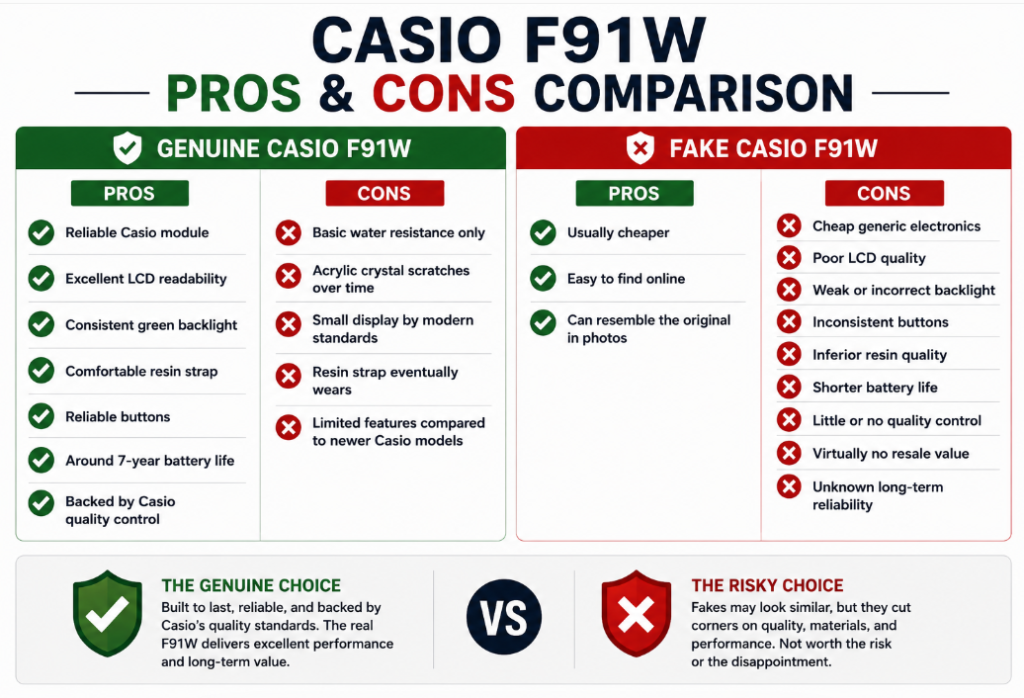
Genuine Casio F91W Pros ✅
- ✅ Reliable Casio module
- ✅ Excellent LCD readability
- ✅ Consistent green backlight
- ✅ Comfortable resin strap
- ✅ Reliable buttons
- ✅ Around 7-year battery life
- ✅ Backed by Casio quality control
Genuine Casio F91W Cons ❌
- ❌ Basic water resistance only
- ❌ Acrylic crystal scratches over time
- ❌ Small display by modern standards
- ❌ Resin strap eventually wears
- ❌ Limited features compared to newer Casio models
Fake Casio F91W Pros ✅
- ✅ Usually cheaper
- ✅ Easy to find online
- ✅ Can resemble the original in photos
Fake Casio F91W Cons ❌
- ❌ Cheap generic electronics
- ❌ Poor LCD quality
- ❌ Weak or incorrect backlight
- ❌ Inconsistent buttons
- ❌ Inferior resin quality
- ❌ Shorter battery life
- ❌ Little or no quality control
- ❌ Virtually no resale value
- ❌ Unknown long-term reliability
Where to Buy a Genuine Casio F91W
To reduce the risk of receiving a counterfeit:
- Buy directly from Casio or authorized retailers.
- Purchase from reputable watch stores with strong customer reviews.
- Be cautious of prices that seem too good to be true.
- Check seller ratings on online marketplaces.
- Inspect the watch immediately after delivery using the checks above.
Saving a few dollars isn’t worth ending up with a counterfeit that may fail within months.
Final Verdict
The Casio F-91W has earned its legendary reputation through decades of dependable performance, outstanding reliability, and exceptional value. Despite its modest price, it is built to standards that many counterfeit manufacturers simply cannot match.
While fake F-91Ws may look convincing in online photos, the differences become clear once you examine the LCD display, backlight, button feel, case finishing, strap quality, water resistance, and internal module. Counterfeit watches almost always cut corners where it matters most, resulting in poorer durability, inconsistent performance, and a much shorter lifespan.
The genuine F-91W isn’t just the better watch – it’s one of the best-value watches ever made.
Considering the relatively small price difference between an authentic model and a counterfeit, there is no good reason to buy a fake. Spending a little more ensures you receive the quality, reliability, and longevity that have made the Casio F-91W an icon for more than three decades.