
An Audemars Piguet price makes sense only after you name the collection and the buying channel. A Code 11.59 that trades near $20,000 used, a steel Royal Oak that changes hands around $40,000 and a complicated ceramic watch above $100,000 are all normal parts of the same catalog.
Retail access creates another split. A published boutique price for a desirable steel Royal Oak may be lower than its secondary-market price but harder to access. Less-hyped Code 11.59 and Offshore references often sell used below original retail.
Prices checked in August 2026. AP does not expose a clean, stable public price list for every region and reference. Rounded ranges are more honest than false dollar-level precision.
AP Price Map
| Collection | Broad retail territory | Typical secondary-market context |
|---|---|---|
| Code 11.59 | Roughly $25,000-$50,000+ | About $18,000-$30,000 for simpler references |
| Royal Oak | Roughly $25,000-$100,000+ | About $30,000-$70,000 for many popular references |
| Royal Oak Offshore | Roughly $35,000-$100,000+ | About $18,000-$45,000 for many steel/titanium models |
| Royal Oak Concept | Six figures | Roughly $100,000-$200,000+ |
WatchCharts estimated July 2026 collection averages around $49,000 for Royal Oak, $28,000 for Offshore, $26,000 for Code 11.59 and $142,000 for Royal Oak Concept.

Royal Oak: The Price of Access
Current Royal Oaks range from time-only steel references to precious-metal perpetual calendars and openworked complications. The classic steel three-hand watch is the model that distorts casual price discussions.
WatchCharts estimated a steel 15500ST around $40,900 in July 2026. Exact values shift with reference, dial, size, condition and set completeness. A smaller or older Royal Oak is not automatically cheap, and an aftermarket dial or aggressive polish can change value dramatically.
If the shape is what you want rather than the AP name, compare our Royal Oak alternatives. A good integrated-bracelet watch does not reproduce AP finishing, but it may remove the anxiety attached to a five-figure polished bezel.
Offshore: More Watch, Often Less Secondary Premium
Royal Oak Offshore models are larger, sportier and more complicated. Many steel chronographs trade around $19,000-$30,000 used even when their original retail prices were much higher. Gold, ceramic, limited editions and newer references widen the band.
This is where trying the watch is mandatory. Thickness, weight and strap shape can make a bargain unusable on your wrist. A low market price relative to retail is not value if the dimensions caused the discount.
Code 11.59: The Used-Buyer Opportunity
Code 11.59 launched under the shadow of the Royal Oak, and early dial criticism still follows the line. Later references have stronger dials and the cases are technically sophisticated, with an octagonal middle hidden inside a round profile.
Simple gold automatic examples have appeared near $20,000 on the secondary market. That is still serious money, but it can undercut retail and offer more conventional wear than a Royal Oak.
Buy it because you like Code 11.59. Buying any expensive watch as the “affordable way into AP” is a weak reason.
Materials and Complications Blow Up the Range
Steel, titanium, ceramic, carbon and several gold alloys all appear in the catalog. Add chronographs, perpetual calendars, tourbillons, minute repeaters or openworking and the price can move from tens of thousands to several hundred thousand dollars.
At this level, two references with the same collection name may share only a silhouette.
Service Is Part of the Purchase Price
AP’s official US service list showed roughly $950 for standard self-winding work, $1,700 for a chronograph and $2,200 for certain highly complicated calendar services, before unusual damage or parts. Refinishing and water-resistance work are separate line items.
Those published service prices are useful context, not a ceiling. A neglected Offshore chronograph can
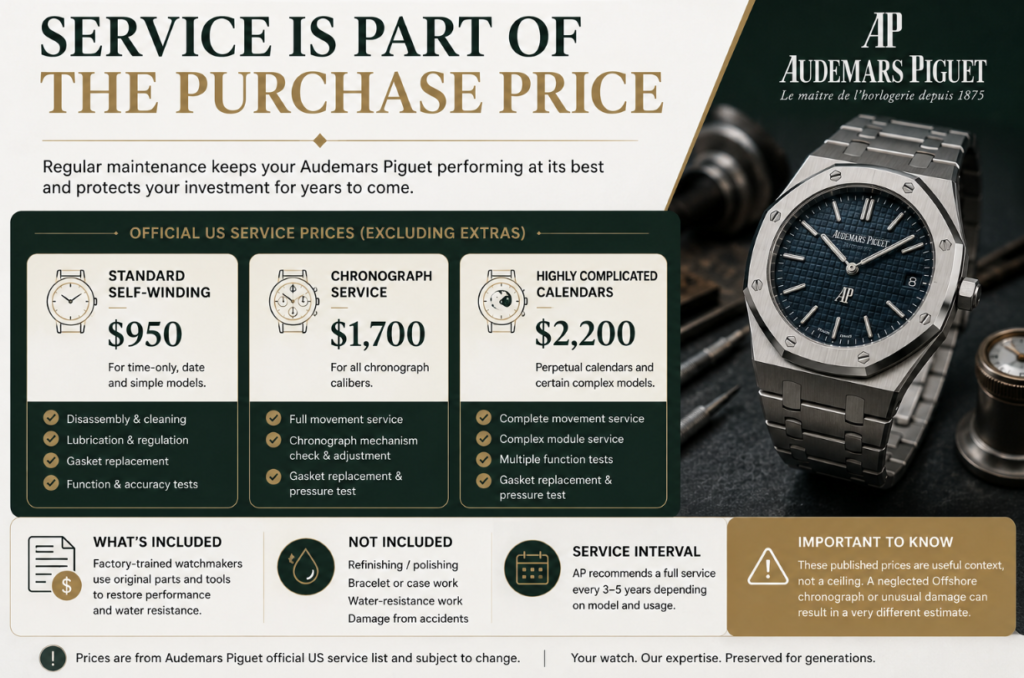
produce a very different estimate.
Buy Retail or Used?
Buy at retail when you value the boutique relationship, want a scarce current reference and understand that availability is not guaranteed. Buy used when the reference trades materially below retail and you can verify condition, service history and originality.
For Code 11.59 and many Offshore models, used is often financially rational. For the hottest Royal Oaks, used buys access and charges for it.
Sources checked
- Audemars Piguet current collections
- Audemars Piguet official US service prices
- WatchCharts Audemars Piguet prices, July 2026