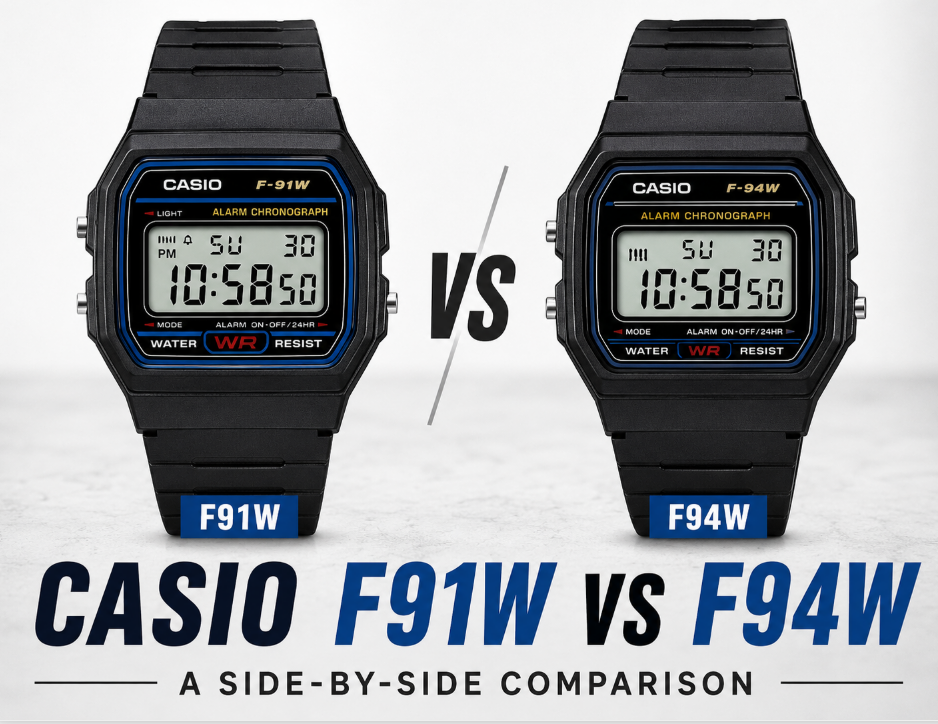
There’s no meaningful technical gap to analyze here — that’s worth saying plainly before anything else. The F91W and F94W share the same size class, the same CR2016 battery good for around seven years, the same basic LED, the same stopwatch-and-alarm feature set, and the same resin build. Whatever decides this comparison for you, it isn’t going to be specs.
What actually separates them is identity. The F91W is the cheap digital Casio — the blue outline, red WR mark, and yellow text combination that’s become genuinely iconic, recognizable even to people who couldn’t name another watch on earth. The F94W runs the same basic formula but swaps in a different face layout, most noticeably a round indicator on the left side of the display that gives it a distinctly less “default” look.
My honest read: the F91W is the smarter first buy for almost everyone. The F94W only starts making sense once you’re specifically looking for a second one.
Quick Verdict
| Buyer type | Better choice | Why |
|---|---|---|
| Best first cheap Casio | Casio F91W | More iconic, easier to recognize and safer choice |
| Best alternative design | Casio F94W | Similar formula with a different dial layout |
| Best collector interest | Casio F94W | More niche and less common than F91W |
| Best historical icon | Casio F91W | Stronger cultural status |
| Best for small wrists | Both | Both are very small and light |
| Best everyday comfort | Both | Both weigh about 21 g |
| Best value | Casio F91W | Usually easier to find and often cheaper |
| Best if you hate common watches | Casio F94W | Less predictable choice |
| Best if you want the classic look | Casio F91W | The design is more recognizable |
| Best overall for most buyers | Casio F91W | More iconic, more available and easier to recommend |
The Only Difference That Actually Matters
Strip away the marketing and you’re left with a case that’s essentially identical — 38.2mm wide either way, both around 8.5mm thick, both 21 grams, both resin on resin. The F94W trims a couple millimeters off the case length, a difference you’d need calipers to notice on the wrist. Everything functional — stopwatch, alarm, hourly chime, LED light, basic water resistance — is a straight match between the two.
That leaves the face design carrying the entire weight of this decision, and it really is a matter of taste rather than merit. The F91W’s layout has a kind of accidental perfection to it — the proportions between the blue border, the red mark, and the yellow text just work, and four decades of cultural ubiquity haven’t hurt its case any. The F94W’s round indicator adds a bit of visual interest that some people genuinely prefer specifically because it isn’t the watch everyone’s seen a thousand times. I lean toward the F91W’s cleaner look, but I wouldn’t argue hard against someone who picks the F94W for exactly that reason — wanting something adjacent to the icon without being the icon itself.
Where People Actually Land on This
Watch forums and enthusiast threads tend to converge on roughly the same read I have: since the two watches perform identically, the entire debate collapses into a preference call, and most people frame it that way rather than pretending one is objectively superior. F91W defenders usually point to its status as the reference point for this entire category, its easier availability, and the fact that it’s the safer recommendation if someone’s buying their first ultra-cheap Casio. F94W fans tend to be people who already own an F91W and specifically wanted a change — the round indicator reads as fresh precisely because it isn’t the watch they (and everyone else) already have.
Neither camp is wrong. It’s a genuinely low-stakes decision either way, unlike watch debates where one option carries a real functional cost.
What Neither Watch Solves
It’s worth being upfront that buying the F94W over the F91W doesn’t fix any of the F91W’s actual limitations, because it doesn’t have any that the F91W lacks either. Both have a backlight that’s charitably described as “usable” — fine for glancing at the time in a dark room, unimpressive by any modern standard. Both carry a basic water-resistant rating that means rain and hand-washing are fine, swimming is not, regardless of the F91W’s semi-mythical reputation for surviving more abuse than its rating suggests. Neither is remotely rugged in the G-Shock sense.
If any of those specific weaknesses actually bother you — light quality, water confidence, real durability — neither watch here is the fix. The F105W solves the backlight complaint, the W59 solves the water-resistance one, and a G-Shock DW-5600 solves durability outright. The F91W-vs-F94W decision only matters if you’ve already accepted those trade-offs and are purely choosing a face.
Availability Is the One Practical Factor
The F91W’s ubiquity isn’t just cultural — it’s genuinely easier to find and typically cheaper, since it’s stocked essentially everywhere that sells watches at all. The F94W is less consistently available depending on your market, and where it is stocked, it doesn’t always undercut the F91W on price the way you might expect from the “less popular” option. If the two are priced close to each other wherever you’re shopping, picking based on which face you prefer is entirely reasonable. If the F94W costs noticeably more or requires ordering from somewhere less convenient, that tips things back toward the F91W pretty decisively — there’s no functional upside to justify paying a premium for the alternative face.
Water Resistance
Both watches are officially Water Resistant. That means they are fine for normal daily moisture, but they are not watches I would buy specifically for swimming.
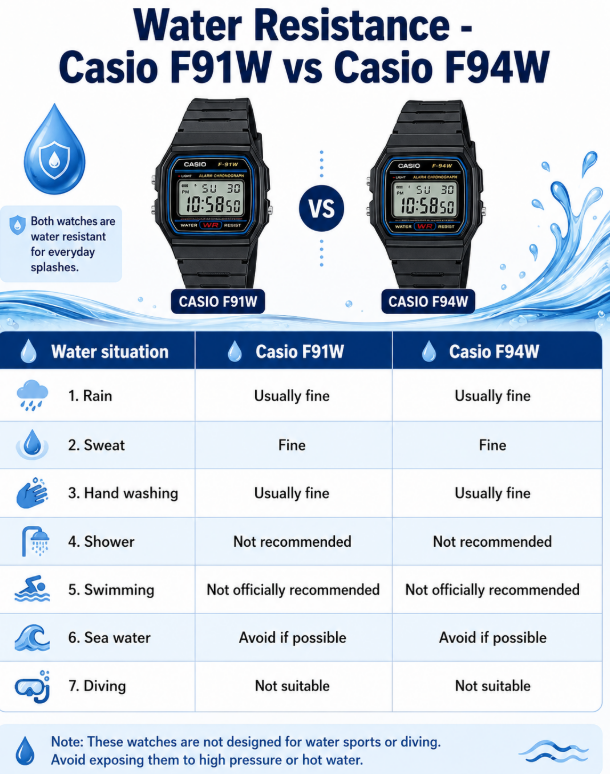
The F91W has a reputation for surviving more water abuse than the official rating suggests, but the safe recommendation is the same: treat both as basic water-resistant watches.
My Actual Recommendation
For a single watch, buy the F91W. It’s the reference point of this entire category for good reason, it’s the design most people will actually prefer, and it’s the one you can replace anywhere without a second thought.
For a small collection of cheap Casios, buy both — but buy the F91W first. The F94W works much better as a “now that I own the classic, here’s something adjacent” pickup than as a standalone first purchase. There’s nothing wrong with owning the F94W; it just isn’t pulling its weight as anyone’s only tiny Casio.
If You Want Something That Actually Improves on Either
Since neither watch upgrades over the other, here’s where I’d point you if a genuine improvement (not just a different face) is what you’re after: the F105W for meaningfully better backlight, the W59 if water resistance is your priority, the W217H for bigger, easier-to-read digits, and the A168 or A158 if you want the same basic idea dressed up with a metal bracelet. For anyone who actually needs to abuse a watch daily, none of this category applies — go straight to a G-Shock DW-5600.
Pros and Cons
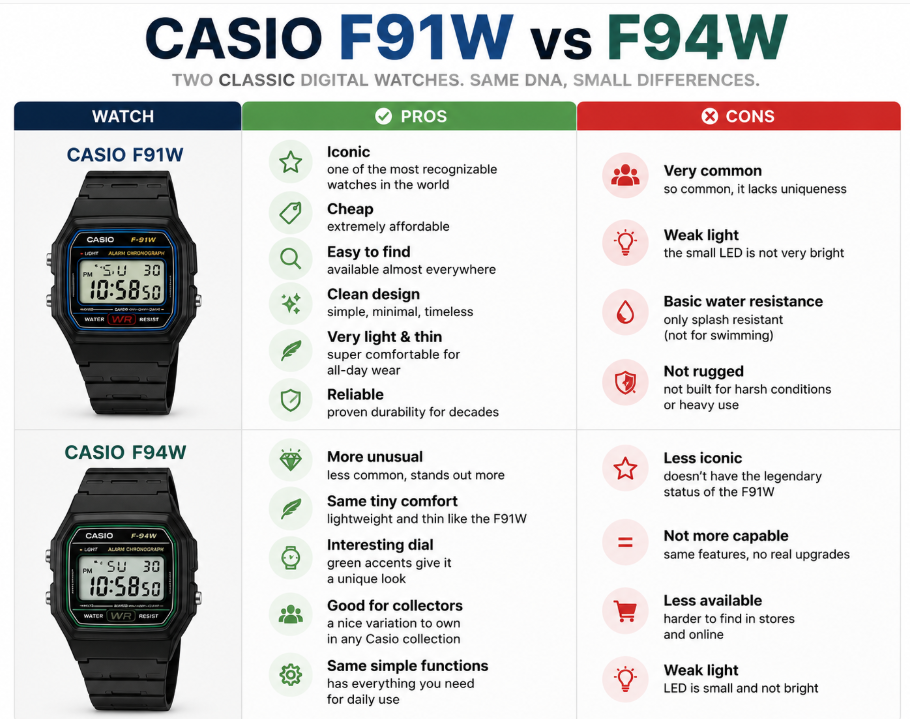
| Watch | Pros | Cons |
|---|---|---|
| Casio F91W | Iconic, cheap, easy to find, clean design, very light, thin, reliable | Very common, weak light, basic water resistance, not rugged |
| Casio F94W | More unusual, same tiny comfort, interesting dial, good for collectors, same simple functions | Less iconic, not more capable, less available, weak light |
| Both | Affordable, simple, reliable, 7-year battery life, comfortable, classic Casio digital charm | Not G-Shocks, not swim |
Bottom Line
This comparison doesn’t really have a loser, because there’s nothing at stake beyond which face you’d rather look at every day. The F91W is the better default recommendation — more iconic, easier to find, and the design most people will genuinely prefer on its own merits. The F94W isn’t a worse watch in any measurable sense; it’s simply the same watch wearing a different face, which is exactly the right pitch for someone who already owns the original and wants a change of scenery, not for someone buying their first one.
FAQ
Is the F94W actually different from the F91W under the hood, or just cosmetically? Purely cosmetic. Same case dimensions within a couple of millimeters, same battery, same functions, same backlight, same water resistance. The face layout is the entire difference.
Which one should I buy if this is my first cheap Casio? The F91W. It’s more iconic, more available, and there’s no functional reason to start with the alternative face instead.
Is the F94W rare or hard to find? Not rare exactly, but noticeably less consistently stocked than the F91W depending on where you’re shopping — and it doesn’t always come cheaper despite being the less common option.
Does the F94W fix any of the F91W’s known weaknesses — light, water resistance, durability? No. It shares every one of those limitations exactly. If any of them actually bother you, look at the F105W, W59, or a G-Shock instead — not the F94W.
Which looks better? Genuinely a matter of taste. The F91W’s classic layout has a cleaner, more balanced look to most eyes; the F94W’s round indicator appeals specifically to people who want something a step away from the most common design.
Should I buy both? If you’re building a small collection of cheap Casios, sure — just get the F91W first. The F94W makes more sense as a second, related purchase than as a standalone one.
Do they use the same battery and last the same amount of time? Yes — both run on a CR2016 and are rated for roughly seven years under normal use.