- The G-Shock Price Ladder
- Under $150 Is the Real G-Shock Experience
- Why Some 5600 Models Cost Three Times More
- CasiOak Prices: Resin, Metal-Covered and Full Metal
- Mudmaster and Master of G
- Full-Metal GMW-B5000: Paying for Construction
- MT-G and MR-G Are Luxury Purchases
- Where I Would Spend My Own Money
- Sources checked
- Author
The G-Shock Price Ladder
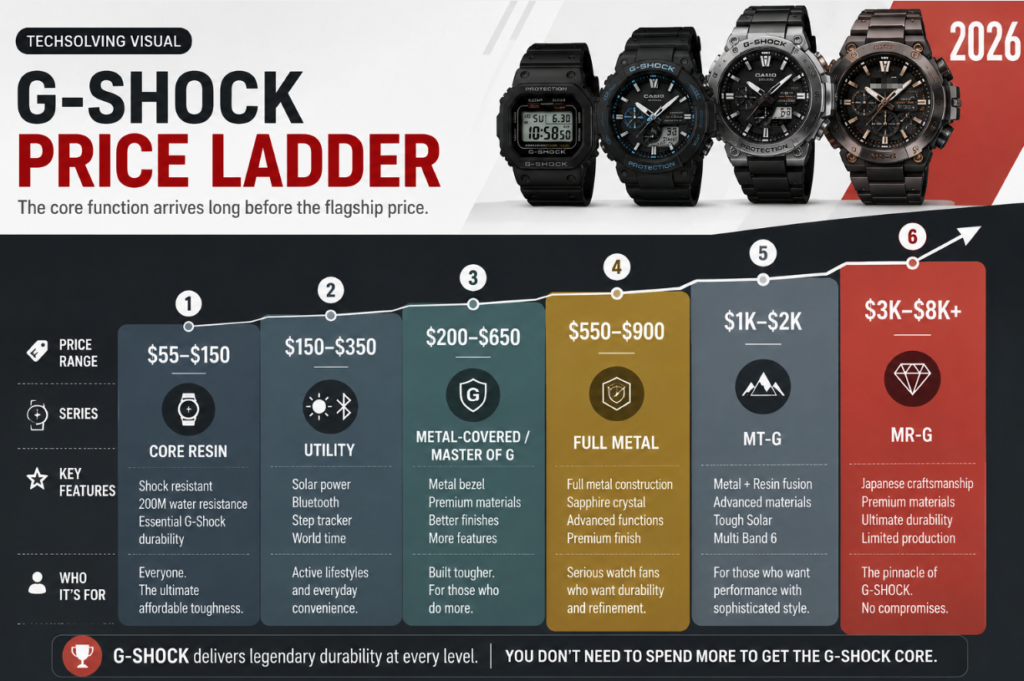
$55-$150 — Core resin: DW-5600, DW-6900, GA-100 and standard GA-2100 models.
$150-$350 — Solar, Bluetooth and sensors: GW-M5610-style squares, GA-B2100, GBD models and selected Master of G references.
$200-$650 — Metal-covered and advanced outdoor models: GM-2100, full-feature Mudman and many Mudmaster configurations.
$550-$900 — Full-metal icons: GMW-B5000 and full-metal 2100 references.
$1,000-$2,000 — MT-G: metal-and-resin construction with premium finishing, solar and radio/Bluetooth time correction.
$3,000-$8,000+ — MR-G: titanium flagships, intricate finishing and specialized Frogman or limited references.
Prices checked in August 2026. Casio runs promotions and colorways move in and out of stock, so street prices can sit well below launch MSRP.
Under $150 Is the Real G-Shock Experience
The inexpensive end is not a watered-down imitation. A basic DW-5600 or DW-6900 delivers the central promise: shock resistance, 200-meter water resistance, stopwatch, timer, alarm and a protected resin case.
The DW-5600 is the clean, compact square. The DW-6900 is larger and more expressive. A standard GA-2100 adds analog hands and the thin octagonal “CasiOak” shape. None requires an app to remain useful.
This tier is where G-Shock is hardest to beat. Our guide to watches like G-Shock includes Timex and rugged smartwatches, but few rivals combine the same price, water resistance, parts availability and cultural recognition.
Why Some 5600 Models Cost Three Times More
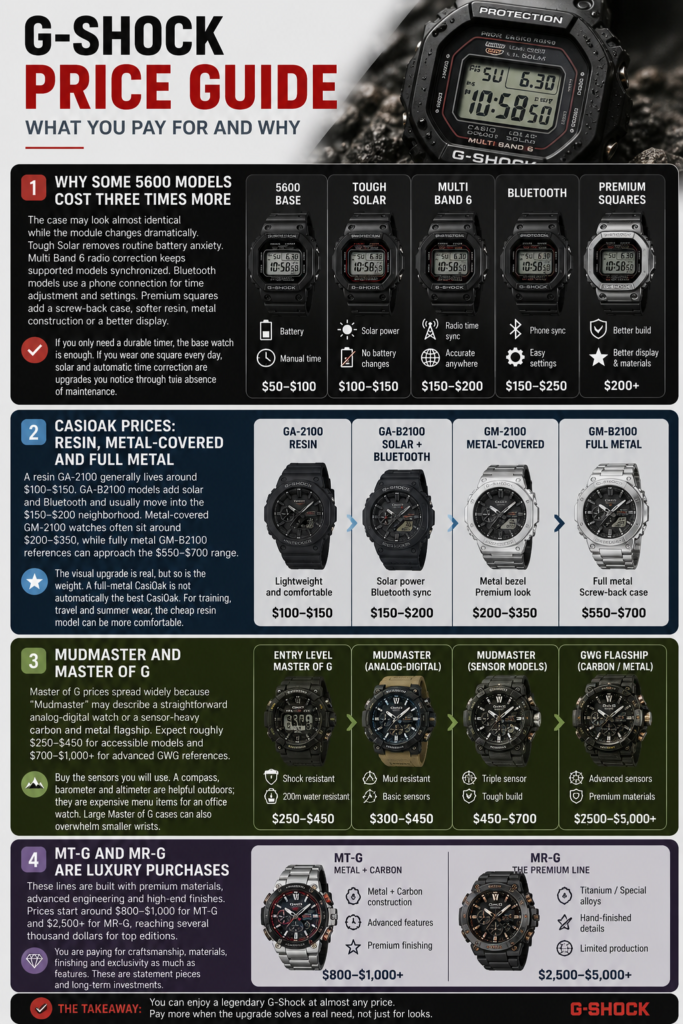
The case may look almost identical while the module changes dramatically. Tough Solar removes routine battery anxiety. Multi Band 6 radio correction keeps supported models synchronized. Bluetooth models use a phone connection for time adjustment and settings. Premium squares add a screw-back case, softer resin, metal construction or a better display.
If you only need a durable timer, the base watch is enough. If you wear one square every day, solar and automatic time correction are upgrades you notice through the absence of maintenance.
CasiOak Prices: Resin, Metal-Covered and Full Metal
A resin GA-2100 generally lives around $100-$150. GA-B2100 models add solar and Bluetooth and usually move into the $150-$200 neighborhood. Metal-covered GM-2100 watches often sit around $200-$350, while fully metal GM-B2100 references can approach the $550-$700 range.
The visual upgrade is real, but so is the weight. A full-metal CasiOak is not automatically the best CasiOak. For training, travel and summer wear, the cheap resin model can be more comfortable.
Mudmaster and Master of G
Master of G prices spread widely because “Mudmaster” may describe a straightforward analog-digital watch or a sensor-heavy carbon and metal flagship. Expect roughly $250-$450 for accessible models and $700-$1,000+ for advanced GWG references.
Buy the sensors you will use. A compass, barometer and altimeter are helpful outdoors; they are expensive menu items for an office watch. Large Master of G cases can also overwhelm smaller wrists.
Full-Metal GMW-B5000: Paying for Construction
Full-metal squares typically begin around the mid-$500s and rise with finishes and limited editions. The module is capable, but much of the money goes into the case, bracelet, finishing and manufacturing.
Owners like the substantial feel and iconic square shape. They also mention weight and visible scratches. Polished surfaces do not remain catalog-perfect if the watch is worn as a G-Shock.
MT-G and MR-G Are Luxury Purchases
MT-G blends metal with protective resin or carbon structures and often lands between $1,000 and $2,000. MR-G is Casio’s flagship territory: titanium, elaborate surface treatments, hand-finished components and prices that can exceed a good Swiss mechanical watch.
MR-G is not “better value” in the way a DW-5600 is. It is a luxury interpretation of the same design language. The buyer is paying for execution, scarcity and finishing, not proportionally greater toughness.
Where I Would Spend My Own Money
For a first G-Shock, I would stay under $200: a solar square or a GA-B2100 is the sweet spot. For a metal watch, I would try the bracelet and weight before paying full-metal money. I would buy MT-G or MR-G only after deciding that the G-Shock design itself—not the spec list—is what I want to collect.
The cheapest G-Shocks already perform the job. Every tier above them is a choice about convenience, material and emotion.