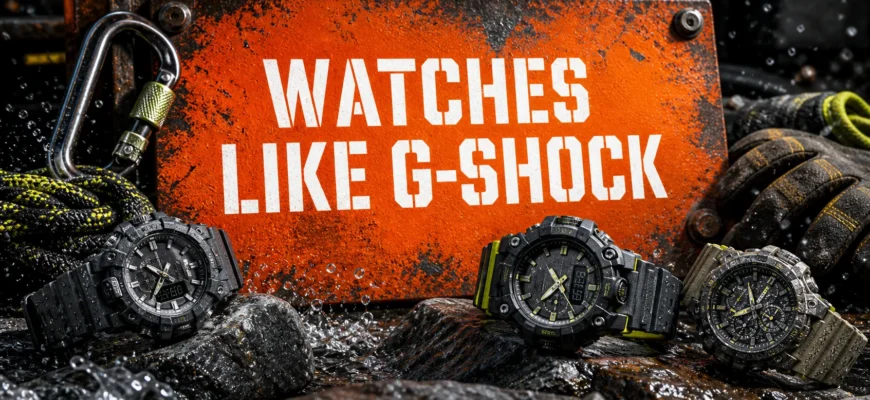
The watch that survives a construction shift, the watch that navigates a trail and the watch that records interval training are three different tools. G-Shock stretches across all three, which is why searching for a single replacement produces bad lists.
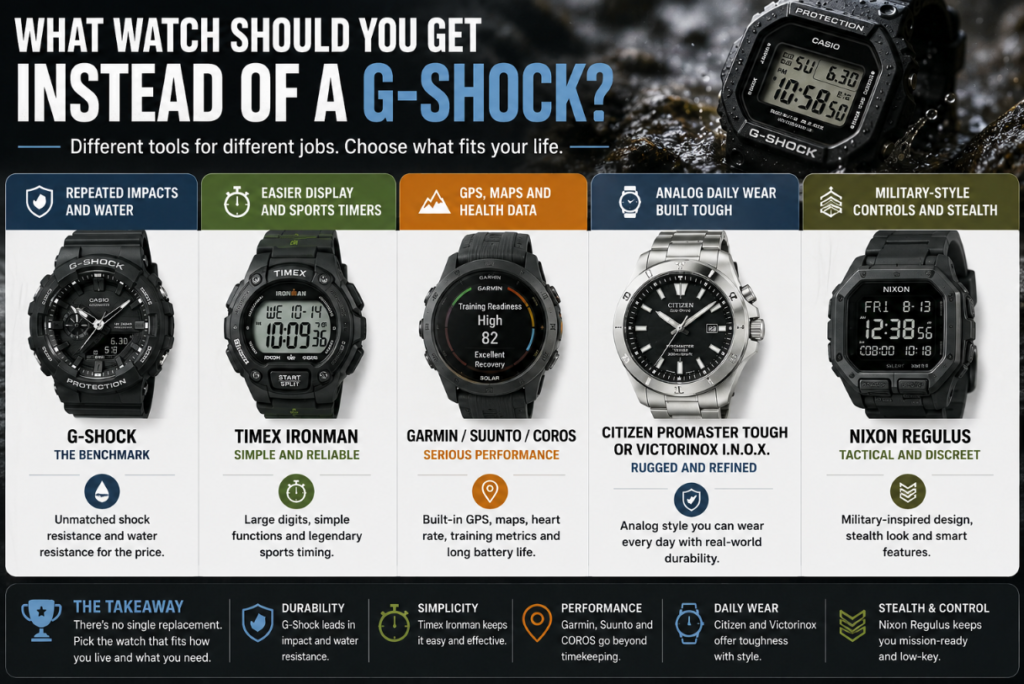
For a cheap digital alternative, buy a Timex Ironman. For outdoor sensors and GPS, choose Garmin Instinct 3 or Suunto Vertical. For a tough analog watch without a screen, consider Citizen Promaster Tough or Victorinox I.N.O.X. The Nixon Regulus has the tactical shape, though its price is hard to defend next to a basic G-Shock.
- Decide What “Tough” Means Today
- Timex Ironman: The Better Sports Timer for Some Buyers
- Garmin Instinct 3: A G-Shock Shape With a Training Brain
- Suunto Vertical: Maps and Long Adventures
- COROS APEX or VERTIX: Battery-First Training
- Citizen Promaster Tough: Analog Durability
- Victorinox I.N.O.X.: Heavy-Duty Swiss Analog
- Nixon Regulus: The Tactical Alternative With a Price Problem
- Cheap Lookalikes and the SKMEI Question
- Where G-Shock Still Wins
- Keep the G-Shock Unless…
- Questions About Rugged Alternatives
- Is Garmin Instinct tougher than G-Shock?
- Community source
- Author
Decide What “Tough” Means Today
- Repeated impacts and water: G-Shock still sets the affordable benchmark.
- Easier display and sports timers: Timex Ironman.
- GPS, maps and health data: Garmin, Suunto or COROS.
- Analog daily wear: Citizen Promaster Tough or Victorinox I.N.O.X.
- Military-style controls and stealth: Nixon Regulus.
Do not pay for GPS when all you need is a countdown timer. Do not buy a resin digital watch and expect it to navigate an unfamiliar trail.
Timex Ironman: The Better Sports Timer for Some Buyers
Ironman watches are light, inexpensive and often easier to read than negative-display G-Shocks. Timex’s Indiglo illumination remains excellent, and interval-focused models make sense for pools, tracks and gyms.
They do not have the same case protection, model depth or enthusiast parts ecosystem. Community comparisons also include accuracy complaints on individual Ironman models. For timing workouts rather than testing impact resistance, the simpler interface can still win.
Garmin Instinct 3: A G-Shock Shape With a Training Brain
The Instinct line is the obvious smart rugged alternative. Physical buttons, long battery life, GPS, health metrics and outdoor tools make it useful well beyond timekeeping. Solar models can extend charging intervals substantially in favorable light.
Its weakness is replacement cost and software complexity. A $100 G-Shock can remain a watch for a decade after its connected features feel old. A Garmin is a rechargeable computer with a finite battery life. Owners in G-Shock communities often describe Garmin as the better tracker and G-Shock as the more satisfying watch.
Suunto Vertical: Maps and Long Adventures
Suunto Vertical is built around offline maps, navigation and endurance battery. It makes more sense than a G-Shock when route guidance could prevent a bad day outdoors.
The app and smartwatch ecosystem are narrower than Garmin’s, and the case is large. Try it with the jacket or pack straps you actually use; a comfortable bare-wrist fit is not the whole test.
COROS APEX or VERTIX: Battery-First Training
COROS appeals to runners and endurance athletes who want long GPS battery life and a cleaner training workflow. It lacks G-Shock’s cheap replaceability and broad style catalog, but it is often better value than an equivalently positioned Garmin.
Buy COROS for training. If you only like the armored appearance, a smart watch is unnecessary maintenance.
Citizen Promaster Tough: Analog Durability
Promaster Tough references use Eco-Drive movements, robust cases and high water resistance without the visual noise of a digital tool. Solar charging and conventional hands make them low-maintenance daily watches.
They cannot time multiple events as efficiently as a digital watch, and the larger analog cases may still feel heavy. The reward is a watch that moves from work clothes to dinner without looking tactical.
Victorinox I.N.O.X.: Heavy-Duty Swiss Analog
The I.N.O.X. was designed around abuse testing and comes in steel, carbon and other variants. It feels substantial and deliberate. Some models are thick and heavy enough that the specification becomes a comfort problem.
If I were wearing it five days a week, I would choose case material and strap before dial color.
Nixon Regulus: The Tactical Alternative With a Price Problem
Large buttons, a protected display and stealthy styling make the Regulus easy to understand. G-Shock owners frequently call it overpriced, and that criticism is fair when a DW-5600 performs the core job for less.
Buy it only if the control layout and design are specifically better for you. Brand difference alone is not a feature.
Cheap Lookalikes and the SKMEI Question
SKMEI and similar watches copy G-Shock shapes for very little money. Some keep time adequately; quality control, water resistance, plastics and long-term parts support are less predictable.
At $20, expectations should be honest. For work where loss or destruction is likely, cheap can be rational. For water exposure or safety-relevant timing, save for a known model and test it.
Where G-Shock Still Wins
A basic square combines 200-meter water resistance, impact protection, replaceable resin, a familiar module and a huge parts/community ecosystem near $100. Connected alternatives add capability but not that kind of simple permanence.
If you want the current price ladder from resin squares through MR-G, see our G-Shock price guide.
Keep the G-Shock Unless…
Choose Timex if display and interval timing matter more than maximum protection. Choose Garmin, Suunto or COROS if GPS and training data are the actual requirement. Choose Citizen or Victorinox if you want analog durability.
Keep the G-Shock when you need a watch that can be ignored until the moment it is abused. That remains its most valuable feature.
Questions About Rugged Alternatives
Is Garmin Instinct tougher than G-Shock?
It offers far more navigation and training capability. A simple G-Shock is cheaper to replace, has no rechargeable battery and is purpose-built for impact resistance. “Tougher” depends on the failure you are planning for.