The right Apple Watch alternative depends on what you want to escape. Daily charging? The square design? Apple’s prices? Or the fact that an Apple Watch is not an option for an Android phone?
Here is the useful short list. Buy a Google Pixel Watch 4 or Samsung Galaxy Watch8 when Android apps and wrist-based communication matter most. Pick a Garmin Venu 4 for fitness depth without giving up a bright touchscreen. Choose a COROS PACE Pro for running value, a Suunto Race S for maps, a Withings ScanWatch 2 for a traditional dial, or an Amazfit Balance 2 when battery per dollar is the priority.
There is no universal Apple Watch replacement. There are several watches that beat it at one specific job.
Good to know: Prices and current product availability were checked in August 2026. Street prices change often, so treat the ranges below as shopping guidance rather than permanent MSRP.
- Start With the Job, Not a Top-Ten Ranking
- Google Pixel Watch 4: The Closest Android Answer
- Samsung Galaxy Watch8: Better When Your Phone Is a Galaxy
- Garmin Venu 4: The Best Middle Ground
- COROS PACE Pro: More Running Watch for the Money
- Suunto Race S: Pick It for Maps, Not Messages
- Withings ScanWatch 2: Health Tracking Without a Tiny Phone on Your Wrist
- Amazfit Balance 2: Battery and Features at an Aggressive Price
- Garmin Instinct 3: The Rugged Alternative
- Fitbit Charge 6: Spend Less and Admit You Do Not Need a Watch
- What None of These Replaces
- My Decision Tree
- Author
Start With the Job, Not a Top-Ten Ranking
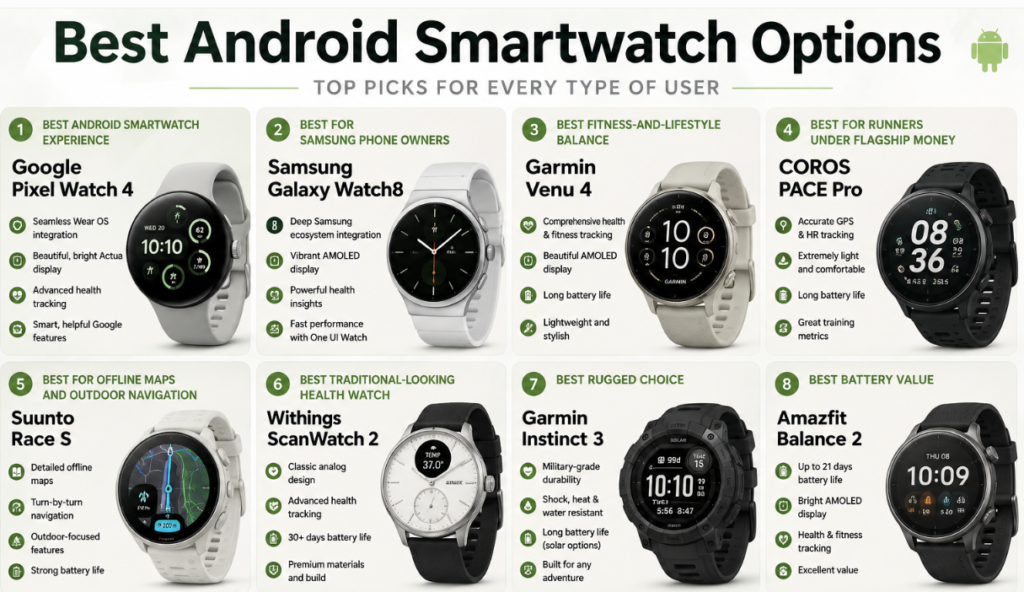
- Best Android smartwatch experience: Google Pixel Watch 4
- Best for Samsung phone owners: Samsung Galaxy Watch8
- Best fitness-and-lifestyle balance: Garmin Venu 4
- Best for runners spending under flagship money: COROS PACE Pro
- Best for offline maps and outdoor navigation: Suunto Race S
- Best traditional-looking health watch: Withings ScanWatch 2
- Best rugged choice: Garmin Instinct 3
- Best battery value: Amazfit Balance 2
- Best cheap fitness tracker: Fitbit Charge 6
That list is deliberately mixed. A Pixel Watch is a small phone companion; a COROS is a training tool; a Withings is an analog watch with sensors hiding underneath. Calling all three “smartwatches” does not make them interchangeable.
Google Pixel Watch 4: The Closest Android Answer
The Pixel Watch 4 is the cleanest Apple Watch alternative for someone who wants a real app platform, payments, calls, messages and tight phone integration—but uses Android. Google offers it in 41 and 45 mm sizes, starting at $349.99. The larger model is the battery pick: Google rates it for up to 40 hours with the always-on display, compared with 30 hours for the 41 mm version.
Its weak point is obvious. This is not the watch to buy because you hate frequent charging. It is the watch to buy because you want the Apple Watch idea translated convincingly to Android. It also does not work with iPhone; Google’s own specifications require Android 11 or newer.
Samsung Galaxy Watch8: Better When Your Phone Is a Galaxy
Samsung’s Galaxy Watch8 starts around $349.99 for the 40 mm Bluetooth model, with the 44 mm version and LTE configurations costing more. Samsung Health, body-composition tools and the broader Galaxy ecosystem make it especially coherent beside a Samsung phone.
I would not pay extra for it merely to count steps. Its value appears when you use the communication features, Samsung services and Wear OS apps. Battery life is still smartwatch battery life, not Garmin battery life. And like the Pixel Watch, it is an Android answer—not a back door into full iPhone compatibility.
Garmin Venu 4: The Best Middle Ground
The Venu 4 is the alternative I would put in front of someone who wants health, workouts and a polished color display but is tired of charging every night. Garmin rates the 41 mm model for up to 10 days in smartwatch mode and the 45 mm for up to 12 days. Real use drops when you enable an always-on display, GPS and music, but the charging rhythm remains much easier than with a mainstream smartwatch.
Garmin’s training and recovery ecosystem is deeper than Apple Fitness for people who actively run, ride or follow structured workouts. The trade-off is software density. Garmin Connect can feel like a filing cabinet assembled by several teams, and some metrics are more interesting than actionable. Buy the Venu for exercise and battery, not because its interface is prettier than Apple’s.
COROS PACE Pro: More Running Watch for the Money
The PACE Pro is a strong answer to both Apple Watch and expensive Garmin models. It combines an AMOLED display, offline maps and a claimed 38 hours of GPS use or up to 20 days in standard use. The hardware is light, and the interface stays focused on training rather than recreating a phone.
Runners repeatedly praise COROS for long battery life and a less cluttered training experience. The other side of that community feedback matters: Garmin still has a broader feature ecosystem, and moving years of training history can make a technically good switch feel expensive. COROS is best for a new runner or someone prepared to leave platform baggage behind.
Suunto Race S: Pick It for Maps, Not Messages
Suunto gives the Race S offline maps, route navigation and multi-band GNSS in a compact sports-watch package. The company rates smartwatch use at up to nine days and its highest-accuracy multi-band training mode at up to 30 hours. At roughly $349, it competes directly with midrange Garmin and COROS models.
The navigation presentation is the reason to buy it. The smartwatch side is secondary. Suunto officially limits predefined message replies to Android, and owners have reported occasional syncing or strap-comfort complaints. If maps are central, those compromises can be acceptable. If wrist communication is central, look elsewhere.
Withings ScanWatch 2: Health Tracking Without a Tiny Phone on Your Wrist
The ScanWatch 2 looks like a conventional analog watch because it mostly is one. A small display handles notifications and health information while the hands preserve a normal dial. It makes sense for sleep, basic activity and passive health monitoring without an illuminated rectangle demanding attention all day.
The compromise is interaction. You do not get a full app store, rich message handling or the on-screen workout experience of Apple, Google or Samsung. That is not a defect if distraction is what you are trying to remove.
Amazfit Balance 2: Battery and Features at an Aggressive Price
Amazfit tends to offer bright displays, long claimed battery life and a wide feature list for less than the major smartwatch brands. The Balance line is appealing if you want notifications, calls, workouts and a polished screen but do not need the deepest third-party app ecosystem.
Be realistic about the software. Health estimates are useful for trends, not medical conclusions, and integrations can feel less predictable than Apple’s or Garmin’s. The value is hardware and charging freedom—not ecosystem permanence.
Garmin Instinct 3: The Rugged Alternative
An Apple Watch in a protective case is still fundamentally a glass-fronted smartwatch. The Instinct 3 is built around outdoor use, physical buttons, long battery life and a display that prioritizes information over animation. It is the better tool for hiking, work sites and people who would rather operate a watch with wet hands or gloves.
It is also visibly utilitarian. If you want a subtle office watch, the ruggedness can become costume. Buy it because your routine benefits from it, not because “tactical” sounds reassuring.
Fitbit Charge 6: Spend Less and Admit You Do Not Need a Watch
The Charge 6 handles steps, workouts, heart rate, sleep and phone notifications in a narrow band that costs far less and feels less intrusive. It is a good choice when the features you actually use on an Apple Watch are activity rings and alarms.
Its small screen is poor for long notifications, and some Fitbit insights sit behind a subscription. Still, it can be the most honest alternative here. A person who checks every serious message on a phone does not necessarily need another full computer on the wrist.
What None of These Replaces
For an iPhone owner, no third-party watch reproduces the complete Apple Watch relationship with Messages, Apple Pay, Apple Health, cellular service and Apple’s app ecosystem. Our separate guide to Apple Watch alternatives for iPhone explains those limits before recommending hardware.
Android users have a different decision. Pixel Watch and Galaxy Watch deliver the closest smart experience, while Garmin, COROS and Suunto generally win on battery and training.
My Decision Tree
If I used Android and wanted the most complete smartwatch, I would buy the Pixel Watch 4—or the Galaxy Watch8 with a Samsung phone. If running performance mattered more than apps, I would move to COROS PACE Pro. For a mix of everyday health, music and serious exercise, Garmin Venu 4 is the safest middle ground.
The best way to replace an Apple Watch is to stop asking which watch copies all of it. Decide which two features earned their place on your wrist. Buy the device that improves those two, and let your phone handle the rest.