If you’re looking for the best all-around luxury watch brand, Omega is the stronger choice. Its wider collection, Master Chronometer movements, stronger resale value, and legendary icons make it one of the safest recommendations in Swiss watchmaking. If you love aviation-inspired designs, oversized sports watches, and bold wrist presence, Breitling remains one of the finest pilot watch manufacturers in the world. Overall Winner: Omega
Best Pilot Watches: Breitling
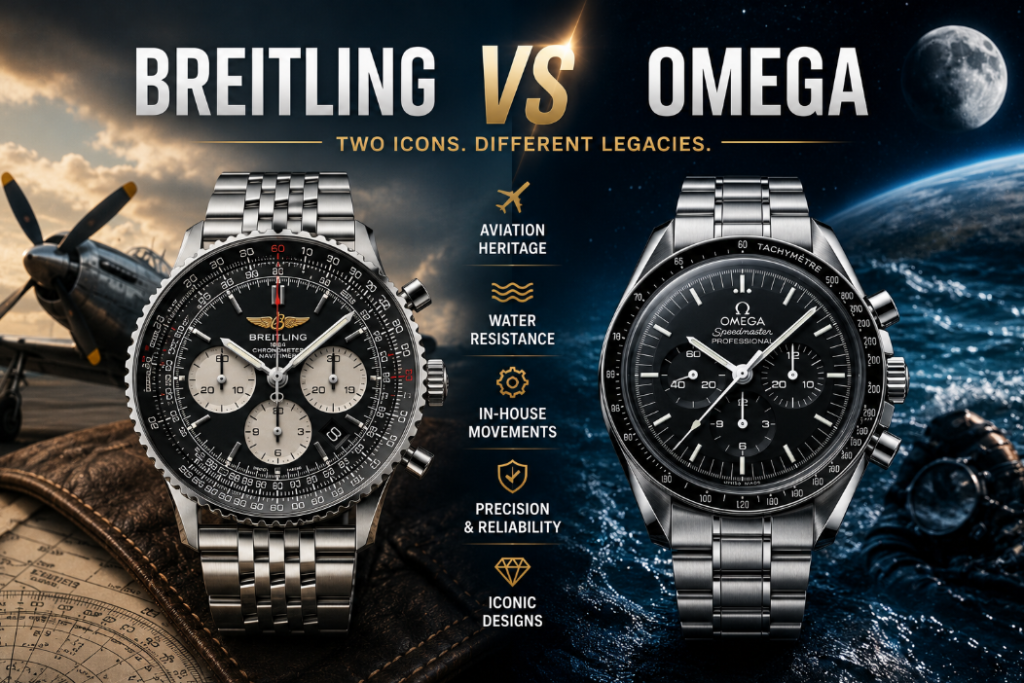
Choosing between Breitling vs Omega is one of the toughest decisions in Swiss watchmaking. Both brands have over a century of history, produce exceptional in-house movements, and offer collections that appeal to professionals, collectors, and everyday enthusiasts alike.
Yet despite competing in a similar price range, they represent two very different philosophies.
Breitling is built around aviation, precision instruments, and bold sports watches. Large cases, highly legible dials, and pilot heritage define much of its identity.
Omega offers broader versatility. From the Speedmaster’s lunar legacy to the Seamaster’s diving pedigree and the elegant Constellation and De Ville collections, Omega covers nearly every segment of luxury watchmaking.
So which brand deserves your investment?
This guide compares Breitling and Omega across heritage, design, movements, accuracy, durability, resale value, and everyday ownership.
- Breitling vs Omega: The Decision in One Useful Frame
- Navitimer vs Speedmaster
- Superocean vs Seamaster
- Chronomat vs Aqua Terra
- Ownership trade-offs: Breitling
- What works in practice
- Where the compromise appears
- Ownership trade-offs: Omega
- What works in practice
- Where the compromise appears
- Breitling and Omega Before the Current Hype
- The Specification That Affects Ownership
- The Design Detail That Sets Them Apart: Breitling
- The Contrarian Case in the Breitling and Omega Debate
- Awards
- Author
Breitling vs Omega: The Decision in One Useful Frame
| Feature | Breitling | Omega |
|---|---|---|
| Founded | 1884 | 1848 |
| Country | Switzerland | Switzerland |
| Famous Collections | Navitimer, Chronomat, Superocean, Avenger | Speedmaster, Seamaster, Constellation, De Ville |
| In-House Movements | Yes | Yes |
| METAS Certification | Selected models | Most modern collections |
| COSC Certification | Most models | Many models |
| Power Reserve | 70-78 Hours (selected calibers) | 55-72 Hours |
| Luxury Segment | Premium | Premium |
Navitimer vs Speedmaster
The Navitimer is the ultimate pilot chronograph. The Speedmaster is the world’s most famous space chronograph.
Personal preference.
Superocean vs Seamaster
The Superocean focuses on bold, modern dive watch design. The Seamaster Professional offers stronger heritage, Master Chronometer movements, and broader recognition. Omega.
Chronomat vs Aqua Terra
The Chronomat feels sportier and more aggressive. The Aqua Terra is one of the most versatile luxury watches available. Omega.
People often compare Breitling and Omega as direct competitors. In reality, they’re built for different personalities. Breitling designs watches that make a statement. Most models are bold, sporty, and immediately recognizable. Omega tends to create more balanced watches that transition effortlessly from the office to the beach or formal occasions.
Neither philosophy is better. It simply depends on how you wear your watch.
Breitling owners often describe their watches as: “Bold, distinctive, and impossible to mistake for anything else.”
Omega enthusiasts usually say: “If you could own only one luxury Swiss watch, an Omega is hard to beat.”
Both opinions reflect the strengths of each brand.
Ownership trade-offs: Breitling
What works in practice
- Legendary aviation heritage
- Outstanding pilot watches
- Excellent B01 chronograph movement
- Bold, distinctive designs
- Exceptional build quality
- Strong sports watch lineup
- Comfortable bracelets
Where the compromise appears
- Larger cases won’t suit every wrist
- Busier dial designs
- Resale value trails Omega
- Dress watch selection is limited
- Premium pricing
Ownership trade-offs: Omega
What works in practice
- Outstanding Master Chronometer movements
- Legendary Speedmaster and Seamaster collections
- Exceptional anti-magnetic technology
- Excellent resale value
- Wide collection diversity
- Strong everyday versatility
- Rich historical legacy
Where the compromise appears
- Higher retail prices
- Numerous model variations can be confusing
- Some models are thicker than competitors
- Servicing costs are premium
- Popular references can be difficult to obtain
Breitling and Omega Before the Current Hype
Omega’s history is difficult to rival. The brand supplied watches to the Olympic Games, became the first watch on the Moon with the Speedmaster Professional, and has been the official watch of James Bond since 1995. Breitling’s heritage is equally impressive within aviation.
The Navitimer became one of the most respected pilot watches ever created, featuring its famous circular slide rule bezel used by professional pilots for decades. Both brands have outstanding histories, but Omega’s influence extends further across multiple areas of watchmaking.
The Specification That Affects Ownership
This is one of Omega’s greatest strengths. Modern Omega watches feature Co-Axial escapements, silicon balance springs, anti-magnetic technology, and METAS Master Chronometer certification capable of resisting magnetic fields up to 15,000 gauss. Breitling also produces excellent in-house calibers, including the B01 chronograph movement, one of the industry’s finest automatic chronographs. However, Omega’s movement technology remains more advanced overall.
Both companies produce highly accurate watches. Omega’s Master Chronometer certification goes beyond COSC testing by evaluating the complete watch under real-world conditions, including magnetic resistance and positional accuracy.
Breitling’s COSC-certified movements also perform exceptionally well. Omega simply offers stricter testing standards.
Both brands occupy similar luxury price brackets. Breitling often offers slightly more aggressive pricing on certain sports models. Omega commands higher prices on flagship collections due to its technology and brand recognition.
Overall ownership costs are similar.
Omega consistently offers stronger resale performance and broader market demand. Breitling has improved significantly in recent years, but depreciation is generally higher. For long-term ownership, Omega provides the better overall value.
The Design Detail That Sets Them Apart: Breitling
Breitling embraces boldness. Large cases, polished bezels, textured dials, and highly detailed chronographs define the brand.
The Navitimer remains one of the busiest yet most iconic dial designs ever produced. Omega offers significantly more variety.
The sporty Seamaster, elegant Aqua Terra, classic Constellation, minimalist De Ville, and legendary Speedmaster each provide a distinct personality. If you want maximum versatility, Omega wins comfortably.
There is virtually nothing separating these brands here. Cases, bracelets, finishing, sapphire crystals, ceramic bezels, and overall manufacturing quality are excellent across both lineups. Breitling leans toward more industrial sports finishing.
Omega balances sportiness with refined luxury.
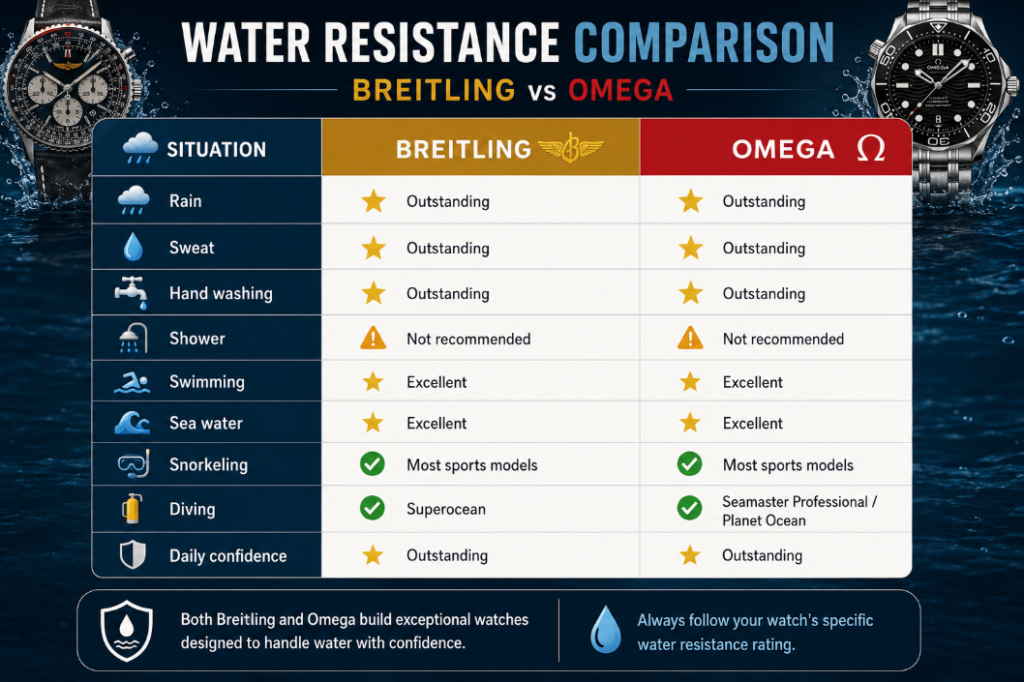
Both brands produce watches capable of lasting decades. The Superocean, Avenger, and Chronomat collections are exceptionally robust. Omega’s Seamaster Professional and Planet Ocean are equally renowned for their toughness. Neither brand has a meaningful advantage.
The Contrarian Case in the Breitling and Omega Debate
Choose Breitling if you: Choose Omega if you:
Breitling and Omega both produce exceptional luxury watches, but they excel in different areas. Breitling remains the benchmark for aviation-inspired sports watches. Collections like the Navitimer and Chronomat offer unmistakable designs, outstanding chronograph movements, and a bold personality that stands out on the wrist.
Omega, however, is the more complete watch manufacturer. Its Master Chronometer technology, iconic Speedmaster and Seamaster collections, exceptional versatility, and stronger resale value make it the better choice for most buyers. If you’re buying your first luxury Swiss watch, Omega is the safer long-term investment.
If your passion is aviation and you want one of the finest pilot watches ever made, Breitling is impossible to ignore.
Awards
🏆 Overall Winner: Omega ✈️ Best Pilot Watches: Breitling 🌊 Best Dive Watches: Omega
⚙️ Best Movement Technology: Omega 💰 Best Long-Term Value: Omega