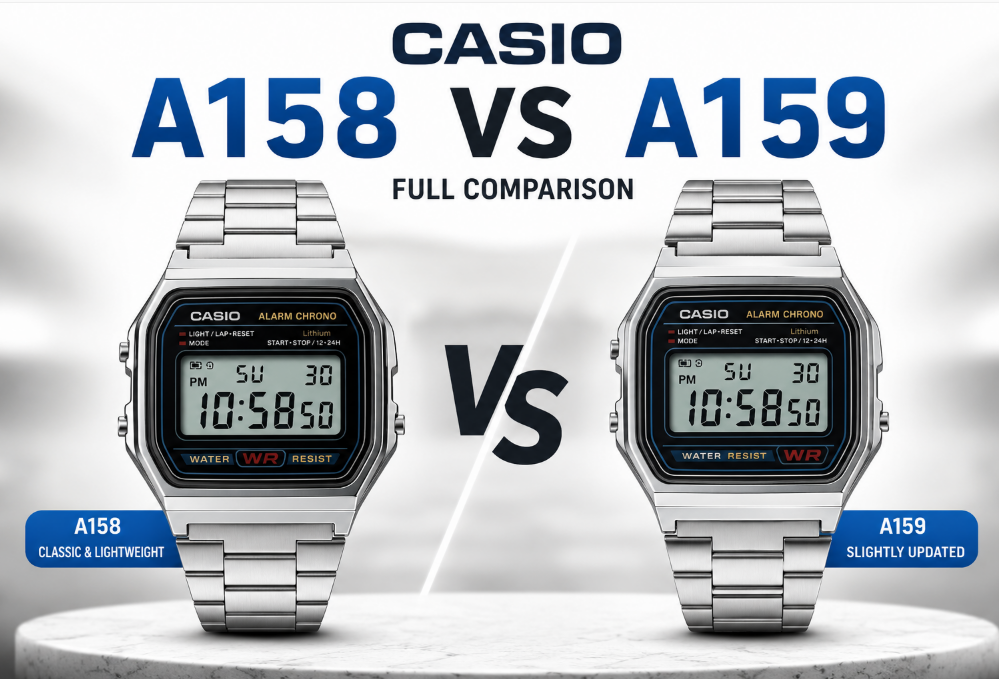
I get some version of this question almost every week at the shop: “Which cheap silver Casio should I get?” Usually the person is holding up their phone with either an A158 or A159 listing open, and honestly, I understand the confusion. These two watches are close enough that Casio itself barely bothers distinguishing them in most retail listings.
So let’s settle it properly instead of just restating the spec sheet.
Both are compact digital watches with a resin case under chrome plating, a folded stainless steel bracelet, a basic LED backlight, and a CR2016 battery that should carry you through roughly seven years before you need to think about it again. Stopwatch, daily alarm, hourly beep — all present on both. If you’re picturing the watch your uncle wore in 1998, you’re picturing both of these at once.
Where they split isn’t in engineering. It’s in paperwork. The A159WA-N1 is one of the few references in this line that Casio’s own site lists as Made in Japan, and that single line item is basically the entire reason the A159 has a following among collectors while the A158 gets treated as the “default” pick.
My take, before we go through the details: grab the A158 if you just want a reliable, cheap watch and don’t care where it was assembled. Grab the A159 if that Made in Japan line matters to you, or if you’re already a few watches deep into a Casio Vintage collection and want the less common variant sitting next to your others.
- Quick Verdict
- Casio A158 vs A159: Main Differences
- Design and Style
- Comfort and Wrist Feel
- Functions and Everyday Use
- Backlight
- Water Resistance
- Durability and Long-Term Wear
- Made in Japan: Is the A159 Actually Better?
- Price and Availability
- Which One Should You Buy?
- Buy the Casio A158 if:
- Buy the Casio A159 if:
- My Personal Recommendation
- Better Alternatives to Consider
- Pros and Cons
- Final Verdict
- FAQ
- Author
Quick Verdict
| Buyer type | Better choice | Why |
|---|---|---|
| Best value | Casio A158 | Usually cheaper and easier to find |
| Best collector appeal | Casio A159 | Made in Japan appeal on A159WA-N1 |
| Best first vintage Casio | Casio A158 | Safer and more available |
| Best if prices are close | Casio A159 | More interesting if the cost difference is small |
| Best for small wrists | Tie | Both are compact |
| Best daily comfort | Tie | Both wear very light and thin |
| Best practical features | Tie | Functionally almost the same |
| Best battery life | Tie | Around 7 years on CR2016 |
| Best understated style | Casio A158 | Cleaner default choice |
| Best niche pick | Casio A159 | Less common and more collector-friendly |
Short answer: A158 for value. A159 for collector interest.
Casio A158 vs A159: Main Differences
Strip away the branding and you’re looking at two watches built on the same case architecture, roughly a millimeter apart in thickness and about two grams apart in weight — differences you’d need a scale to notice, not a wrist.
The case measures 36.8 x 33.2mm on both models. The A158 comes in at 8.2mm thick and 46 grams; the A159 is 8.5mm and 44 grams, which tells you the internal construction differs slightly even though the external footprint doesn’t. Everything else — resin glass, chrome-plated resin case, stainless bracelet, LED illumination, stopwatch, daily alarm, hourly chime — is identical on paper and identical in daily use.
The A159 doesn’t win on any functional line item. It doesn’t light up brighter, resist water any better, or add a single feature the A158 lacks. What it adds is a country-of-origin detail that changes nothing about how the watch performs, but changes quite a bit about how collectors perceive it.
Design and Style
If you’ve handled one Casio Vintage digital, you’ve handled the visual language of both of these: rectangular case, black dial window, simple colored typeface on the LCD, and a metal bracelet that reads as “classic Casio” from ten feet away.
Set them side by side and even I have to check the case back to tell them apart with certainty — there’s no cosmetic tell you can rely on across a photo listing. That anonymity cuts both ways. It means the A158 never looks cheap despite being the budget pick, but it also means the A159 gets zero visual credit for being the rarer model. Nobody’s going to clock the difference from across a room; the appeal here is entirely something you know about your own watch, not something you display.
For daily outfit flexibility, both disappear under a sleeve or sit fine with short sleeves and don’t clash with much of anything. If style alone is your deciding factor, flip a coin — then use the money you didn’t spend chasing the rarer one on a strap or a second watch.
Comfort and Wrist Feel
This is the one area where I’d actually push back gently on treating them as identical, even though the numbers suggest they should be.
At 46g and 8.2mm, the A158 has a hair more presence on the wrist — not uncomfortable, just very slightly more “there.” The A159, at 44g and 8.5mm, trades a fraction of thickness for a fraction less weight. In isolation you won’t notice either measurement. Wearing them back to back for a week, some people do pick up on the A159 feeling marginally lighter, though I’d bet money nobody could tell you which one in a blind test.
The bracelet is where the real comfort story lives, and it’s the same story on both watches: an affordable folded-link stainless design. It looks the part for what these cost, but folded links aren’t solid links, and depending on your wrist and how much arm hair you’ve got, you’ll occasionally feel a pinch or a bit of rattle when you move your arm quickly. It’s a known trait of this era of Casio bracelet, not a defect specific to either model — and it’s easily solved later with an aftermarket strap if it bothers you.
For sleeping in it, working at a desk, or wearing it under a jacket sleeve all day, both watches disappear the way a good beater watch should.
Functions and Everyday Use
Neither of these is trying to be a tool watch, and that’s fine — they’re not pretending otherwise.
You get the basics done well: 12/24-hour time display, a calendar, a stopwatch, a daily alarm, an hourly time signal, and the LED light for checking the time in dim rooms. No timer function, no world time, no Bluetooth, no sensors of any kind. If your daily routine actually needs an interval timer for workouts or a second time zone for calls, neither the A158 nor the A159 is going to serve you — that’s not a knock on them, it’s just outside what this generation of Casio digital was built to do.
If you find yourself wanting more from the feature set after reading this, the AE1200 adds world time, the B640 adds a proper countdown timer with better water resistance, and the ABL100 brings Bluetooth and step tracking into a similar-looking case. But if all you want is time, alarm, and stopwatch in a cheap, familiar shape, you’re already looking at the right two watches.
| Function | Casio A158 | Casio A159 |
|---|---|---|
| Time | Yes | Yes |
| 12/24-hour format | Yes | Yes |
| Stopwatch | Yes | Yes |
| Daily alarm | Yes | Yes |
| Hourly time signal | Yes | Yes |
| Calendar | Yes | Yes |
| Light | Yes | Yes |
| Timer | No | No |
| World time | No | No |
| Bluetooth | No | No |
| Sensors | No | No |
Backlight
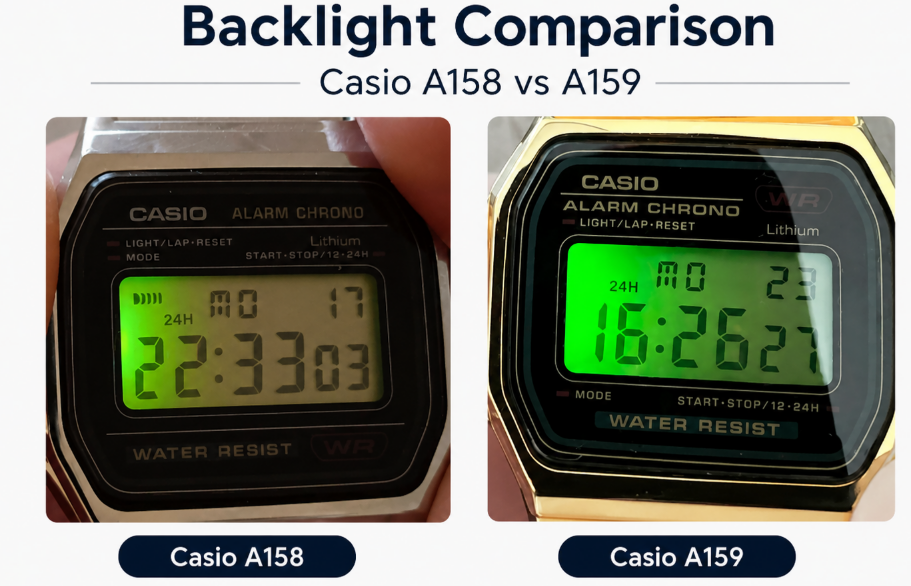
I’ll be blunt about this one because it trips people up more than it should: the LED backlight on both the A158 and A159 is fine, not good.
It illuminates the display well enough to check the time at 2am, but it’s a basic point-source LED, not the electro-luminescent panel Casio uses on the A168 — which lights the entire display evenly and genuinely looks better in the dark. If checking your watch at night is something you do often (bedside table, camping, whatever your situation), the A168 is worth the small step up specifically for this reason. If you barely use the backlight, this difference won’t register in your daily experience with either A158 or A159.
Water Resistance
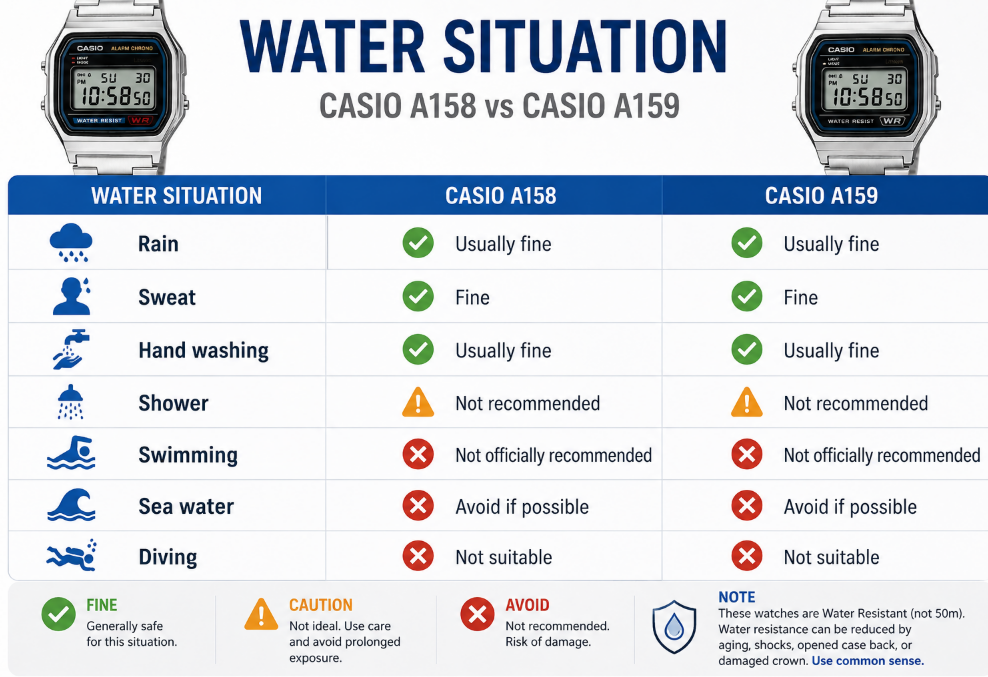
Both watches carry a basic “Water Resistant” rating, which in Casio’s language means splashes, rain, and hand-washing are fine — actual swimming is not something either watch is rated or built for.
The chrome-plated case finish and the folded bracelet aren’t doing you any favors here either; repeated water exposure is more likely to accelerate cosmetic wear than cause a functional failure, but there’s no reason to test that theory in a pool. If water resistance genuinely matters to your lifestyle — swimming, regular outdoor work, anything beyond a rainy commute — look at the W59, the W800H, the AE1200, the B640, or step up to a G-Shock entirely. Neither the A158 nor the A159 was built with that use case in mind.
Durability and Long-Term Wear
For casual, everyday wear, both watches are dependable in the way cheap Casios have always been dependable — which is to say, the module inside will likely outlast the case cosmetics.
The resin glass can pick up fine scratches over time, and the chrome plating on the case will eventually show wear at the edges where it contacts a desk, a doorframe, or your other wrist accessories — this is true of essentially every watch in this price bracket and finish, not a flaw unique to either model. The bracelet holds up fine under normal use but isn’t built for anything you’d call abuse.
If you’re rough on watches — construction work, frequent knocks, anything physical — a G-Shock DW-5600 is the honest answer, not either of these. If you’re after a comfortable, low-stakes daily watch you don’t have to baby, both the A158 and A159 will do that job for years without complaint.ge digital for casual wear, both are fine.
Made in Japan: Is the A159 Actually Better?
Here’s where I want to manage expectations a bit, because this line item does a lot of heavy lifting in how the A159 gets marketed and resold.
Casio’s official listing for the A159WA-N1 does state Made in Japan, and for a certain kind of collector, that detail alone justifies owning the watch. It’s a legitimate piece of information, not marketing fluff — but it doesn’t change the case material, the glass, the backlight, or the bracelet quality. You’re not getting a more premium build; you’re getting the same affordable Casio construction with a production-origin detail attached to it.
Whether that’s worth paying extra for depends entirely on why you’re buying the watch. If you’re building out a collection and provenance matters to you the way it matters to sneaker collectors chasing a specific factory run, then yes — it’s worth it, within reason. If you just want a Casio that tells time reliably, the origin line on the case back isn’t going to change how the watch feels on your wrist tomorrow morning.
My honest read: it’s a nice detail to have, not a reason to pay double.
Price and Availability
The A158 wins this one clearly, and it’s not close.
It’s one of the most widely stocked watches in the entire Casio Vintage lineup — easy to find at most retailers that carry Casio, usually priced as the entry point into the line, and simple to replace if you ever lose or damage it. The A159 is a narrower listing by comparison; depending on your region it can be harder to track down, and sellers who know what they have will often price it above the A158 specifically because of the Made in Japan detail.
If the price gap between the two is small wherever you’re shopping, the A159 becomes the more interesting purchase almost by default — you’re getting the rarer variant for pocket change more. If the gap is large, there’s no functional justification for paying it; the A158 gets you the same watch experience for less.
Which One Should You Buy?
Buy the A158 if you want the safest, cheapest entry into this style of watch, you’re buying your first Casio Vintage piece and don’t want to think too hard about it, you don’t care about production origin, or you just want something easy to replace if it gets lost.
Buy the A159 if the Made in Japan detail genuinely matters to you, you’re already collecting Casio Vintage pieces and want variety rather than a duplicate, the price difference where you’re shopping is small enough to not matter, or you specifically want the less common of the two sitting in a drawer or on a strap rotation.
Buy the Casio A158 if:
| Reason | Explanation |
|---|---|
| You want the best value | Usually cheaper |
| You want easy availability | Easier to find |
| You are buying your first Casio Vintage | Safer choice |
| You do not care about Made in Japan | Then A159 matters less |
| You want a simple daily vintage watch | A158 does the job |
| You want easy replacement | A158 is common |
Buy the Casio A159 if:
| Reason | Explanation |
|---|---|
| You want the Made in Japan version | Main reason to buy it |
| You collect Casio Vintage watches | More interesting than A158 |
| You want something less common | A159 feels more niche |
| The price is close to A158 | Then it is worth considering |
| You already own an A158 | A159 adds variety |
| You care about small details | A159 has more ownership appeal |
My Personal Recommendation
For a watch I’d actually wear day to day without thinking about it, I’d reach for the A158. It’s cheaper, it’s everywhere, and it gives you the same experience as the A159 in every situation that matters on an actual wrist.
For a collection, the calculation flips. The A159 is the one worth tracking down specifically because it’s a little harder to find and carries that Made in Japan line — the kind of detail that means something once you already own three or four watches that look almost the same.
Better Alternatives to Consider
| Model | Why consider it |
|---|---|
| Casio A158 | Best cheap silver Casio Vintage classic |
| Casio A159 | Similar style with Made in Japan appeal |
| Casio A168 | Better backlight and stronger vintage personality |
| Casio A700 | Thinner and more refined design |
| Casio B640 | Better water resistance and countdown timer |
| Casio AE1200WHD | More features, world time and 100m water resistance |
| Casio ABL100 | Bluetooth and step tracking in a vintage case |
| Casio F91W | Lighter and cheaper plastic icon |
| G-Shock DW-5600 | Real rugged upgrade |
If you want the best backlight, choose A168. If you want best value, choose A158. If you want the collector detail, choose A159.
Pros and Cons
| Watch | Pros | Cons |
|---|---|---|
| Casio A158 | Cheap, easy to find, slim, light, classic vintage design, 7-year battery | Basic LED light, basic water resistance, very common |
| Casio A159 | Made in Japan appeal, slightly more niche, light, slim, same useful basics, 7-year battery | Usually harder to find, can cost more, not much better functionally |
| Both | Affordable, comfortable, retro, simple, reliable, stainless steel bracelet | Not rugged, not swim watches, basic bracelet, resin glass can scratch |
The A158’s case for itself is straightforward: it’s cheap, it’s everywhere, it’s slim and light, it looks the part of a classic vintage Casio, and the battery will outlast your attention span. Its downsides are the same ones baked into the whole category — the LED light is basic, the water resistance is minimal, and it’s common enough that it won’t turn any heads.
The A159 trades some of that availability for the Made in Japan detail and a slightly rarer status among collectors, while carrying almost identical downsides — plus the added friction of being harder to source and often priced above its sibling for a difference you can’t see or feel in daily wear.
What both share, for better and worse: they’re affordable, comfortable, unmistakably retro, dead simple to operate, and reliable in the way basic Casios have always been reliable — while also not being swim watches, not being rugged, and running a bracelet and glass that show their price point over time.
Final Verdict
Take away the branding and you’re comparing two watches that are, functionally, the same object. Same case class, same seven-year battery life, same short list of basic functions, same unmistakable Casio Vintage silhouette.
The A158 wins on value — it’s cheaper, easier to find, and delivers nearly the identical experience on your wrist. The A159 wins on story — the Made in Japan line, the relative rarity, the appeal to anyone building out a small shelf of near-identical Casios rather than owning just one.
If you want a good, cheap, silver Casio and nothing more complicated than that: buy the A158. If the A159 is priced close enough that the difference doesn’t sting, and that Made in Japan detail actually means something to you: it’s the more interesting watch to own.
FAQ
Is there a real functional difference between the A158 and A159? Barely. The case dimensions differ by fractions of a millimeter and a couple of grams — nothing you’d notice wearing either one. The meaningful difference is that the A159WA-N1 carries a Made in Japan designation from Casio, which the A158 does not.
Does Made in Japan actually make the A159 a better watch? Not in terms of build quality you can feel. Same resin case, same glass, same bracelet, same backlight. It’s a provenance detail that matters to collectors, not an upgrade in materials or performance.
Which one should a first-time buyer get? The A158, almost without exception. It’s cheaper, more widely available, and easier to replace — a safer entry point if you’re not yet sure you’re going to fall down the Casio Vintage rabbit hole.
Are either of these actually waterproof? No — both are rated Water Resistant, which covers rain and splashes, not swimming or submersion. Treat them like any basic quartz watch around water.
How long will the battery actually last? Casio rates both for roughly seven years on a CR2016 cell under normal use, which matches what I typically see in the shop with watches from this line.
Is the backlight good enough to rely on? It’s usable, not impressive. Both use a basic LED rather than the electro-luminescent panel found on the A168, so nighttime readability is functional but nothing special.
Which one holds up better long-term? Neither has an advantage here — same case finish, same glass, same bracelet construction. Long-term wear comes down to how you treat the watch, not which of the two you bought.
Is the price difference between them worth it? Only if it’s small. When the A159 costs meaningfully more, you’re paying purely for the Made in Japan line and relative scarcity, not for anything you’ll feel on the wrist.
Should I buy the A158 or the A159? If you want the best value and don’t care about origin details, get the A158. If the Made in Japan line matters to you or you’re filling out a small collection, the A159 is the more satisfying pick — assuming the price gap isn’t excessive.