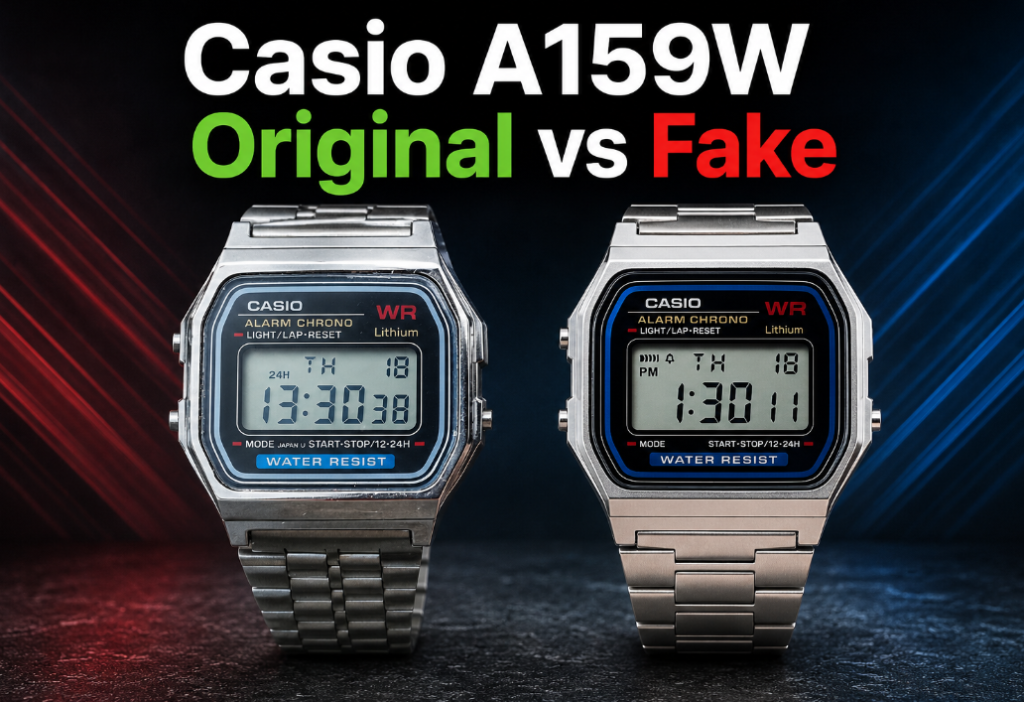
The common mistake is treating Casio A159W Original and Fake as equal products with different logos. Their real strengths sit in different places.
The original is in the photo on the right, and the fake is on the left
The Casio A159W is one of the most recognizable digital watches ever made. Its classic retro design, lightweight construction, and affordable price have made it a bestseller for decades. Ironically, that’s also why it’s frequently counterfeited.
Unlike fake luxury watches that can cost hundreds of dollars to manufacture, fake Casio A159W watches are usually built as cheaply as possible. They may look convincing in listing photos, but once you hold one in your hand, the differences become obvious.
The good news is that the A159W is actually one of the easiest watches to authenticate. If you know where to look, most counterfeit examples can be identified within a few minutes.
If you’re wondering whether a Casio A159W is genuine, don’t focus on just one detail. Check the LCD, backlight, case back, bracelet, and overall finishing together. Unlike fake Swiss watches, counterfeit A159W models rarely match the quality of the original. Most use cheaper materials, lower-quality electronics, and noticeably poorer finishing. Overall Winner: Original Casio A159W
- The Practical Question Behind Casio A159W Original vs Fake
- Verdict
- The Ownership Details Hidden in the Finish: Casio A159W Original
- Where Forum Wisdom Is—and Is Not—Useful: Fake
- Matching the Right Casio A159W Original to the Right Fake
- The Contrarian Case in the Casio A159W Original and Fake Debate
- Author
The Practical Question Behind Casio A159W Original vs Fake
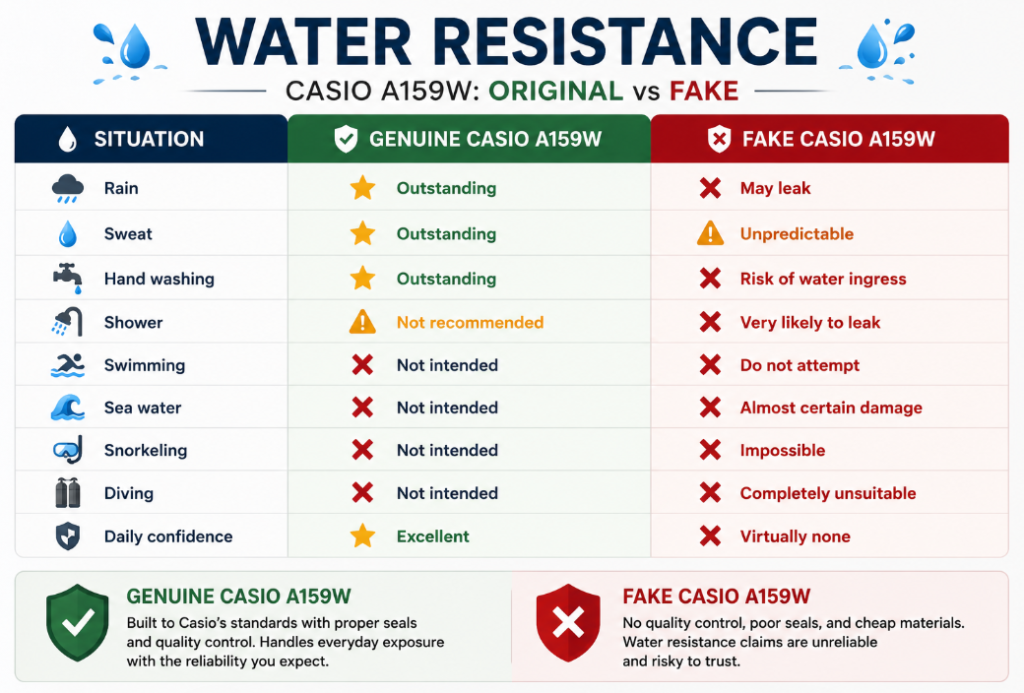
This is one area where counterfeit Casio A159W watches completely fall apart. A genuine Casio A159W is rated Water Resistant, meaning it is designed to handle everyday exposure such as rain, sweat, and accidental splashes. While Casio does not recommend showering or swimming with it, genuine models are manufactured with proper gaskets, quality case construction, and consistent quality control that allow them to perform exactly as specified.
Fake A159W watches, however, are a completely different story. Many counterfeit models only copy the “Water Resist” text printed on the dial without reproducing the actual engineering behind it. Internal seals are often missing, poorly fitted, or made from cheap rubber. Case backs may not tighten evenly, pushers are frequently unsealed, and assembly quality varies dramatically from one fake to another. Some replicas can even leak after nothing more than washing your hands or getting caught in light rain.
The biggest problem is unpredictability. One fake might survive a splash, while another could fail the first time it encounters moisture. Since there is no quality control or standardized testing, you simply cannot trust the printed water-resistance claim.
Verdict
The genuine Casio A159W isn’t a dive watch, but it delivers exactly the level of water resistance Casio promises. For everyday life, that’s all most people need. A fake A159W, on the other hand, should be treated as if it has no meaningful water resistance at all. Even if it survives a few splashes, there’s no guarantee the next encounter with moisture won’t permanently damage the movement. When it comes to water protection, a counterfeit watch isn’t just inferior – it’s fundamentally unreliable.
The Ownership Details Hidden in the Finish: Casio A159W Original
Although inexpensive, the original bracelet is surprisingly well made. A genuine bracelet feels smooth with tight tolerances and clean finishing. Counterfeit bracelets usually suffer from:
- sharp edges
- loose links
- excessive rattling
- poor brushing
Simply running your finger along the bracelet can reveal the difference. The case back contains valuable authentication information. Look for:
- model number
- module number
- country markings
- clear engraving
Original engraving is deep and sharp. Fake case backs often have:
- soft lettering
- inconsistent spacing
- incorrect fonts
- poor engraving depth
Where Forum Wisdom Is—and Is Not—Useful: Fake
Many buyers assume fake Casio watches must be nearly identical because the original is already inexpensive. That’s simply not true. Counterfeit manufacturers build these watches for the lowest possible cost. They don’t use the same LCD panels, electronic modules, bracelet components, or quality control standards that Casio does. The result is a watch that may look similar from a distance but feels noticeably cheaper in daily use.
Among Casio collectors, the same opinions appear repeatedly. “The LCD gives it away immediately.”
“The bracelet feels cheap before you even look at the case back.” “Fake A159s almost always have weaker backlights.”
“If you’ve handled an original before, spotting a fake takes less than a minute.” Most experienced collectors agree that the A159W is one of the easiest Casio models to authenticate.
Matching the Right Casio A159W Original to the Right Fake
Genuine Casio A159W
The LCD is usually the quickest giveaway. A genuine Casio A159W has:
- dark, high-contrast digits
- clean segment edges
- excellent readability
- wide viewing angles
Fake watches often have: Even before pressing any buttons, the display often tells the story.
Verdict: One of the easiest authentication checks.
The classic green side backlight is one of the A159W’s signature features. Original watches produce an even green glow that keeps the time readable. Counterfeit versions commonly have:
- dim lighting
- blue or white LEDs
- uneven brightness
- excessive light bleed
If the backlight looks wrong, there’s a good chance the watch is too. Casio’s printing quality is excellent. Look closely at:
- CASIO logo
- Water Resist text
- Alarm Chronograph lettering
- Minute track
Everything should appear razor sharp. Fake watches frequently have:
- blurry text
- thicker fonts
- uneven spacing
- poor alignment
The clasp is another commonly overlooked area. Original Casio clasps feature:
- crisp logo engraving
- clean brushed finish
- secure locking mechanism
Many fake clasps have: Don’t just check the time. Try:
- Mode
- Alarm
- Stopwatch
- Light
- Time adjustment
Original Casio modules respond instantly. Fake watches often have slower button response or inconsistent operation.
Some people believe fake watches are always lighter. Not necessarily. Some replicas use heavier steel to imitate the original weight.
Instead of relying on weight alone, combine it with the display quality, bracelet, engraving, and overall finishing.
This is where counterfeit watches usually fall apart. Original Casio modules are known for:
- accurate timekeeping
- reliable alarms
- dependable stopwatch operation
- long battery life
Cheap replicas often suffer from: The easiest way to avoid counterfeit watches is buying from reputable sources.
Be cautious if:
- the seller only uses stock photos
- refuses close-up images
- cannot show the case back
- offers an unusually low price
- claims the watch is “factory surplus”
Counterfeit manufacturers usually make the same mistakes. The most common ones include:
- Incorrect LCD font
- Weak backlight
- Blurry front printing
- Poor bracelet finishing
- Loose clasp
- Shallow case back engraving
- Cheap button feel
- Inconsistent display contrast
- Incorrect module markings
- Low-quality chrome plating
If several of these appear together, the watch is almost certainly counterfeit. In one word: No. This isn’t a luxury watch where a genuine model costs thousands of dollars. A genuine Casio A159W is already one of the most affordable watches available.
Saving a few dollars by buying a counterfeit usually means accepting:
- poorer build quality
- unreliable electronics
- shorter lifespan
- lower accuracy
- rough finishing
- no warranty
- no resale value
There simply isn’t much value in choosing a fake when the original is already inexpensive.
The Contrarian Case in the Casio A159W Original and Fake Debate
The Casio A159W is one of the easiest watches on the market to authenticate because counterfeit manufacturers rarely match Casio’s quality standards. While fake examples may resemble the original in online photos, the differences become obvious once you examine the display, backlight, bracelet, buttons, and engraving. More importantly, buying a fake simply doesn’t make financial sense. The genuine A159W is already affordable, reliable, and built to a standard that counterfeit manufacturers rarely achieve. The small amount of money saved isn’t worth sacrificing durability, accuracy, and long-term reliability.
Overall Winner: Genuine Casio A159W If you’re buying new, purchase from an authorized Casio retailer. If you’re buying used, spend a few extra minutes checking the LCD, backlight, bracelet, and case back. Those simple inspections are usually enough to separate an authentic Casio from a counterfeit.