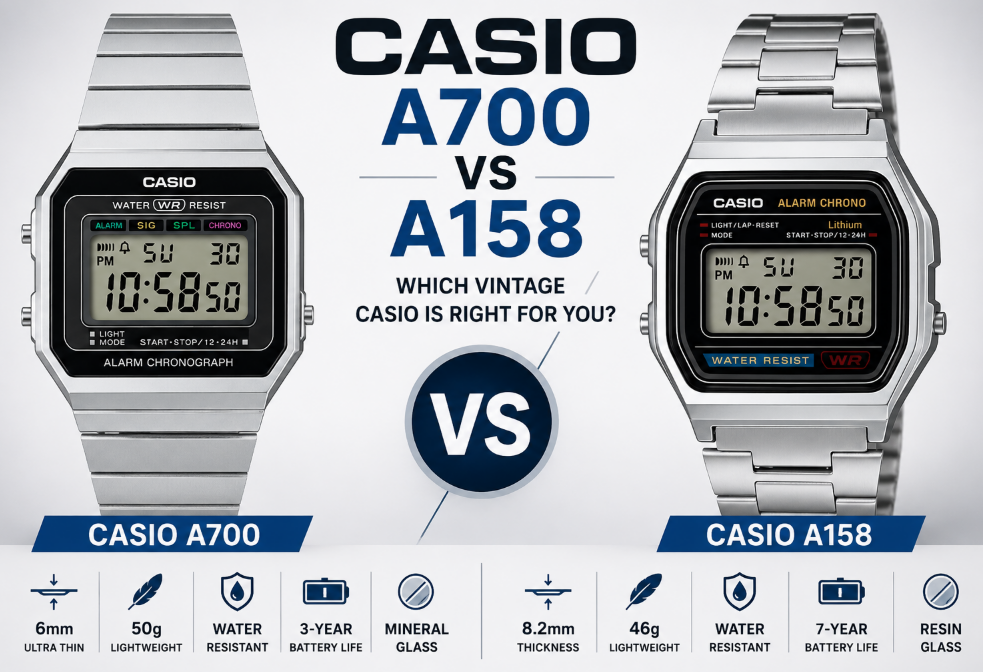
These two look related at a glance, but they’re really answering different questions about what a vintage Casio should be. The A158 is the classic — simple, cheap, light, and about as close to the “default” old-school Casio look as you’ll find. The A700 takes the same basic idea and refines it: a genuinely thin case, a cleaner finish, and a bit more polish overall.
Short version: buy the A158 if you want the more iconic, cheaper watch with dramatically better battery life. Buy the A700 if you want the slimmer, more elegant version and don’t mind changing the battery more often. Buying on nostalgia, it’s the A158. Buying on how it actually looks and sits on the wrist, the A700 has the edge.
- At a Glance
- The Thing That Actually Separates Them
- Comfort Isn’t as Simple as “Lighter Wins”
- Neither Is Trying to Do More Than the Basics
- Water Resistance Doesn’t Differentiate Them Either
- Battery Life Is the Real, Practical Divide
- Durability, Realistically
- Which One Actually Fits You
- Pros and Cons
- Bottom Line
- FAQ
- Author
At a Glance
| Casio A700 | Casio A158 | |
|---|---|---|
| Case size | 37.4 x 35.5 x 6mm | 36.8 x 33.2 x 8.2mm |
| Weight | 50g | 46g |
| Glass | Mineral | Resin |
| Battery | CR1616, ~3 years | CR2016, ~7 years |
| Water resistance | Basic (Water Resistant) | Basic (Water Resistant) |
| Best for | Slim, dressier presence | Classic look, lower cost, longer battery |
The Thing That Actually Separates Them
Forget the spec sheet for a second — the entire personality difference between these two watches comes down to one number: 6mm versus 8.2mm. The A700’s case is genuinely, noticeably thinner than the A158’s, and that difference is the whole reason it reads as the more “designed” of the two. It sits flatter, slides under a cuff more easily, and just looks less like a toy from the side profile — while still keeping the same rectangular vintage Casio identity underneath.
The A158 doesn’t try to compete on that front, and it doesn’t need to. It’s the shape most people already picture when they think “cheap Casio digital” — chrome-tone case, stainless bracelet, simple LCD — and that familiarity is doing real work for it, not a weakness to apologize for.
One material difference worth flagging: the A700 uses mineral glass, while the A158 sticks with resin. Mineral glass resists scratches noticeably better in daily wear, which is a genuine, if modest, upgrade for the A700 beyond just being thinner.
Comfort Isn’t as Simple as “Lighter Wins”
The A158 is technically lighter at 46g against the A700’s 50g, but weight alone doesn’t decide this one. The A700’s thinness changes how it actually sits — flatter, less obtrusive, and on smaller or medium wrists it often looks more proportionate specifically because it doesn’t rise as tall off the skin. Comparing the two side by side, most people read the A700 as the more comfortable watch despite technically weighing slightly more, simply because thinness matters more to perceived comfort than a few grams.
Both share the same basic bracelet character common to Casios at this price — a folded-link stainless design that can feel a little light and occasionally catch arm hair. That’s just how this category of watch is built, not a defect specific to either model.
Neither Is Trying to Do More Than the Basics
Time, daily alarm, stopwatch, calendar, hourly chime, basic LED light — that’s the feature list for both, full stop. Neither watch is remotely aiming for the multi-alarm, world-time, countdown-timer territory of something like the AE1200 or W800H, and if that’s genuinely what you need, this comparison isn’t really relevant to your decision. What you’re choosing between here is two flavors of the same simple, affordable, vintage-style daily watch — not two different levels of capability.
The backlight situation is similarly a wash: both use basic LED lighting, adequate for glancing at the time in the dark but nothing to build a purchase decision around. If backlight quality genuinely matters to you, the A168’s stronger electroluminescent-style glow is worth a look instead of either of these.
Water Resistance Doesn’t Differentiate Them Either
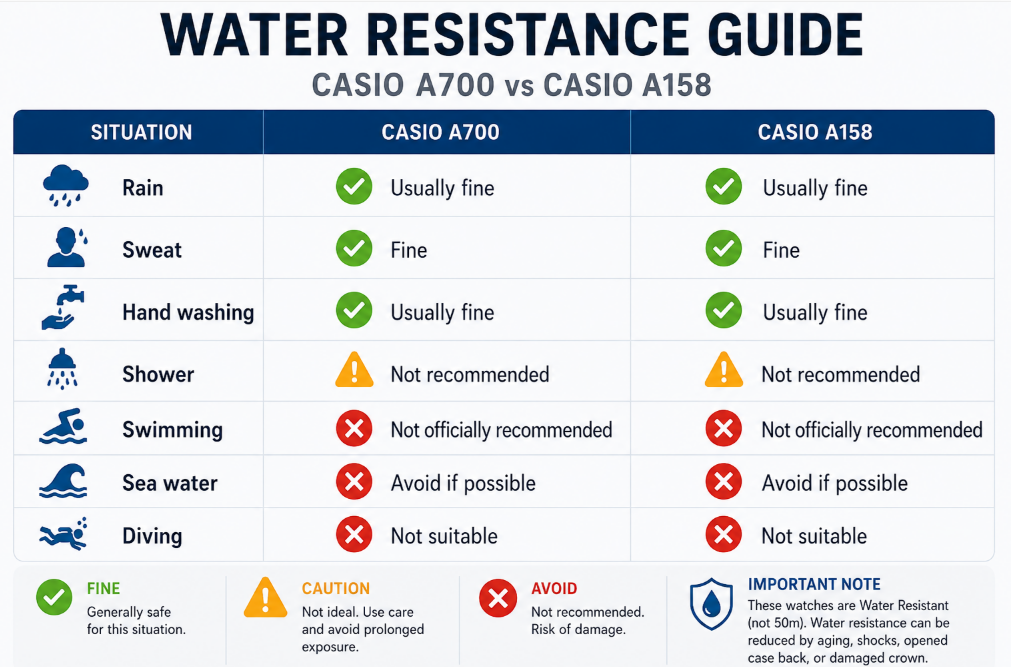
Both carry the same basic “Water Resistant” rating — fine for rain, sweat, and the occasional splash, not something either one was built for actual swimming. Community chatter sometimes suggests these watches survive more casual water exposure than the official rating implies, and that’s plausible, but it doesn’t change the honest recommendation: treat both as splash-tolerant, not swim-ready, and be mindful of soap, hot water, and aging gaskets on either one.
Battery Life Is the Real, Practical Divide
This is where the comparison stops being about taste and starts being about ownership experience. The A158 runs roughly seven years on a CR2016; the A700 runs closer to three years on a CR1616. That’s not a marginal gap — it’s the difference between opening the case back once every few years versus more than twice as often over the same span.
Three years is still perfectly reasonable for an affordable digital watch, especially if you rotate between several watches rather than wearing one daily for years straight. But if you want a genuine “put it on and forget about it” daily beater, the A158’s battery life is doing real work in its favor that the A700 simply can’t match.
Durability, Realistically
Neither watch is built for abuse — both have resin cases with a metallic-look finish that will pick up scratches and marks over time, and the bracelets on both show wear the way affordable Casio bracelets generally do. The A700’s mineral glass gives it a genuine edge in scratch resistance, and its cleaner, more polished look means small cosmetic dings are more noticeable when they happen. The A158, by contrast, already reads as a simple, unpretentious daily Casio — a scuff or two barely registers against that baseline, which arguably makes it the more carefree option to actually live with day to day.
Which One Actually Fits You
Go with the A158 if you want the cheapest, most recognizable version of this watch, you want to deal with the battery as infrequently as possible, or you’re after a no-fuss daily beater you don’t think twice about.
Go with the A700 if you specifically want the thinner, cleaner silhouette — especially if you wear cuffed sleeves regularly and want something that disappears underneath them — or if you already own an A158 and want a more refined sibling rather than a duplicate.
Pros and Cons
Casio A700
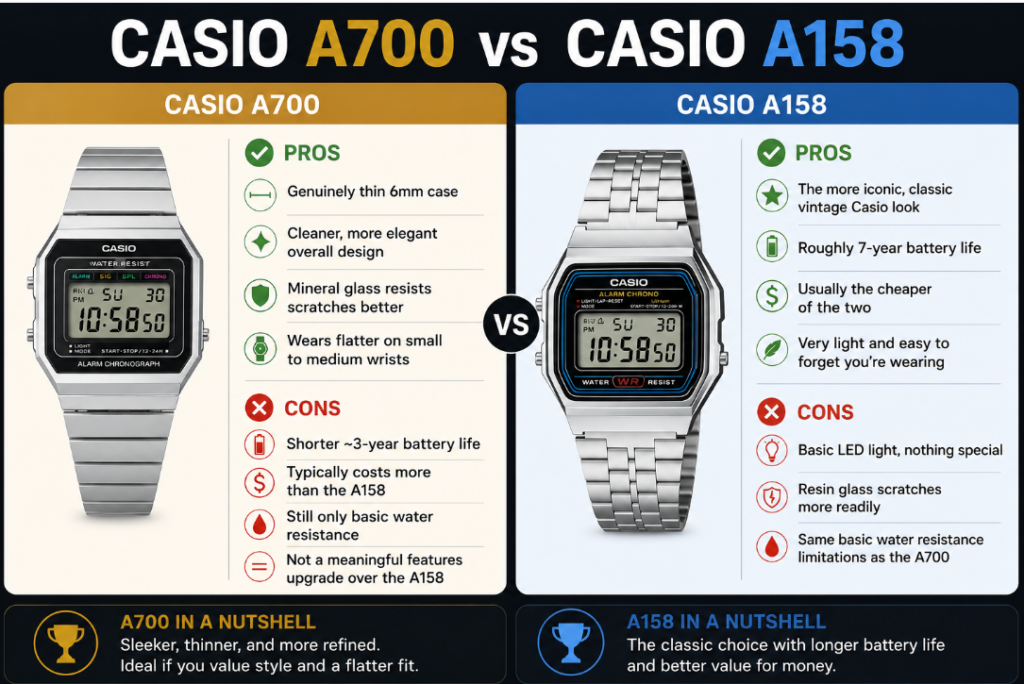
- Genuinely thin 6mm case
- Cleaner, more elegant overall design
- Mineral glass resists scratches better
- Wears flatter on small to medium wrists
- Shorter ~3-year battery life
- Typically costs more than the A158
- Still only basic water resistance
- Not a meaningful features upgrade over the A158
Casio A158
- The more iconic, classic vintage Casio look
- Roughly 7-year battery life
- Usually the cheaper of the two
- Very light and easy to forget you’re wearing
- Basic LED light, nothing special
- Resin glass scratches more readily
- Same basic water resistance limitations as the A700
Bottom Line
There’s no real functional gap here worth agonizing over — this comparison comes down almost entirely to two things: how thin you want the watch to sit, and how often you’re willing to open the case back. The A700 wins on presence and finish; the A158 wins on cost and how rarely you’ll think about its battery. Neither one is the “wrong” choice, which is exactly why this one comes down to personal priorities rather than a clear objective winner.
FAQ
Is the A700 actually better than the A158? Better-looking and slimmer, yes. Better value and lower-maintenance, no — the A158 wins there. It genuinely depends on which of those you’re optimizing for.
Is the A700 worth paying more for? If the thin case and cleaner finish matter to you, yes. If you’re only after basic digital watch functions, the extra cost buys you style rather than capability.
Which one is thinner? The A700, clearly — 6mm against the A158’s 8.2mm.
Which has better battery life? The A158, by a wide margin: roughly seven years versus the A700’s approximately three.
Can either one handle swimming? No — both carry only basic Water Resistant ratings suited to rain and splashes, not submersion.
Which is better for a small wrist? The A700 tends to wear better on smaller wrists thanks to its thinness, even though the A158 is technically the lighter watch.
Does the A700 really have better glass? Yes — mineral glass on the A700 versus resin glass on the A158, and mineral holds up better against everyday scratches.
Which one should I buy first? The A158 if you want the classic, affordable entry point. The A700 if the slimmer, more refined look is what draws you in from the start.