Take the case off either of these and you’d have a hard time telling them apart — same size, same battery, same 100m rating, same 10-year battery estimate. What actually separates them is entirely in the software and the screen layout: one is built around showing you the whole world, the other around timing intervals down to the second. Same hardware, two genuinely different watches depending on what you actually need it to do.
What’s actually shared between them
| Casio AE1200 | Casio AE1300 | |
|---|---|---|
| Case size | 45 × 42.1 × 12.5mm | 45 × 42.1 × 12.5mm |
| Weight | ~39g | ~40g |
| Water resistance | 100m | 100m |
| Battery | CR2025, ~10 years | CR2025, ~10 years |
| Signature feature | World Time + world map | Interval timers |
The AE1200’s whole personality is travel
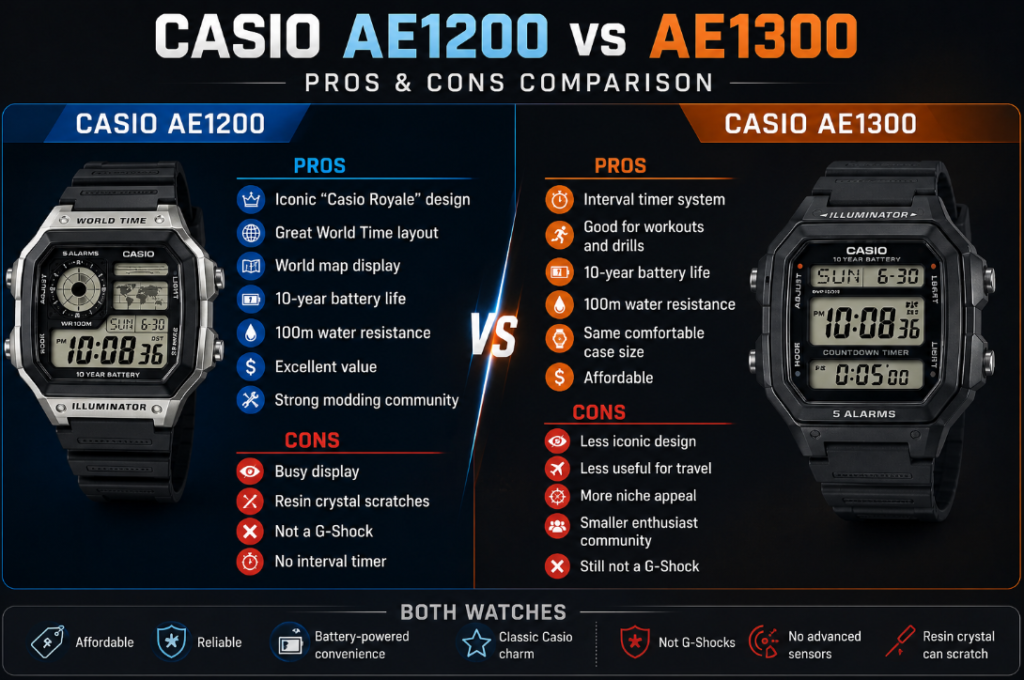
That little world map isn’t just decoration — it’s earned this watch the nickname “Casio Royale” among fans, and it’s genuinely useful if you’re actually dealing with multiple time zones. Flip through world time, glance at the map, and it’s obvious at a glance where you’re at relative to home. Five alarms and a stopwatch round things out, plus a countdown timer for good measure — together they add up to a genuinely capable everyday travel companion for not much money at all.
It’s also the one with the bigger cult following. There’s a real modding scene built around the AE1200 specifically — swapped cases, aftermarket straps, replacement crystals, people quietly turning a cheap Casio into something that looks considerably more expensive.
The AE1300 exists for one job: timing things precisely
Strip out the world map and travel focus, and what’s left is a watch built around structured intervals — multiple preset timers running back to back, which turns out to be exactly what boxing rounds and running intervals actually need. Gym circuits and coaching drills fit the same mold. It can still show world time in a pinch, but that’s not why anyone buys this one. If your workouts involve any kind of repeated timing structure, this is doing a job the AE1200 genuinely can’t match.
Take away the interval timer use case, though, and the AE1300 doesn’t have much of an argument left. It’s a slightly less iconic AE1200 without the map, and the enthusiast community that’s grown up around the 1200 mostly skipped over this one entirely.
Backlight
Both models use an LED light.
It is good enough for checking the time in the dark, but not a premium backlight experience. Do not expect G-Shock-level lighting or a beautiful full-screen glow.
For the price, both are fine.
Winner: Tie.
Water Resistance
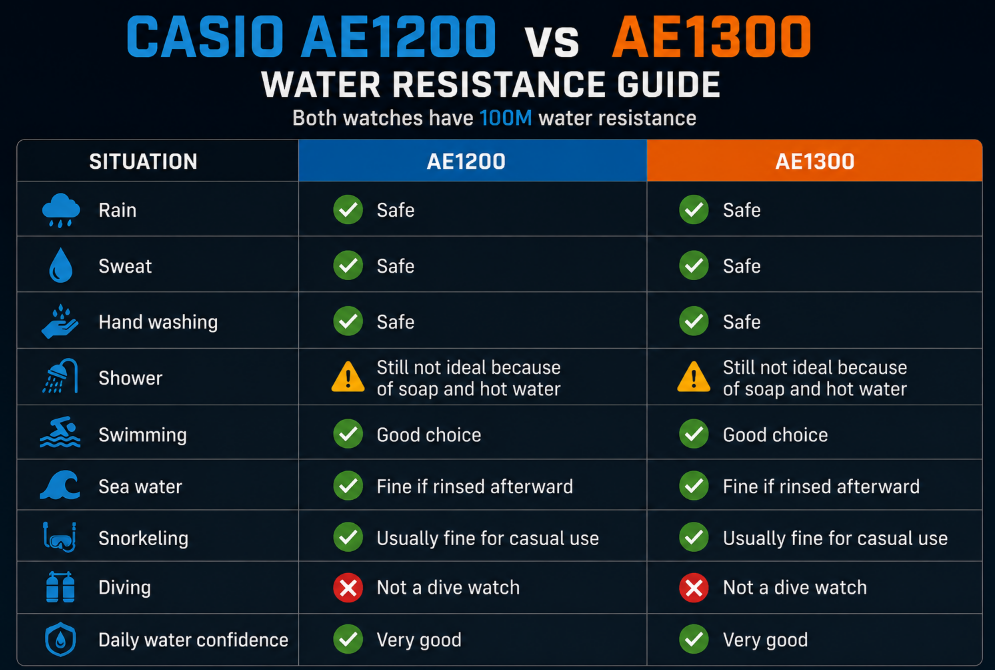
Both watches have 100m water resistance, which is much better than basic Casio Vintage “Water Resistant” models.
Everything else is close to a wash
Readability favors the AE1200 slightly for plain daily use — its layout is a touch cleaner if you just want to check the time, while the AE1300’s screen is optimized for something more specific. Comfort is functionally identical; a single gram of weight difference isn’t something anyone’s actually going to feel. Backlight and durability are the same story on both watches, and water resistance matches too: fine for the price, nothing special, definitely not G-Shock territory.
What this actually comes down to
If you travel, want the more collectible and recognizable design, or just want the single best all-around cheap digital Casio for daily use, the AE1200 is genuinely the smarter default — it does more things well for more people. The AE1300 only makes sense once you know specifically that interval timing matters to your routine; workouts, coaching, or structured training turn it from “a lesser AE1200” into the actual right tool for the job.
A couple of nearby options if neither quite fits: the AE1500 offers a larger, easier-to-read display in the same general format, and anyone who wants genuine toughness on top of this feature set should really be looking at a G-Shock like the GW-M5610U instead.