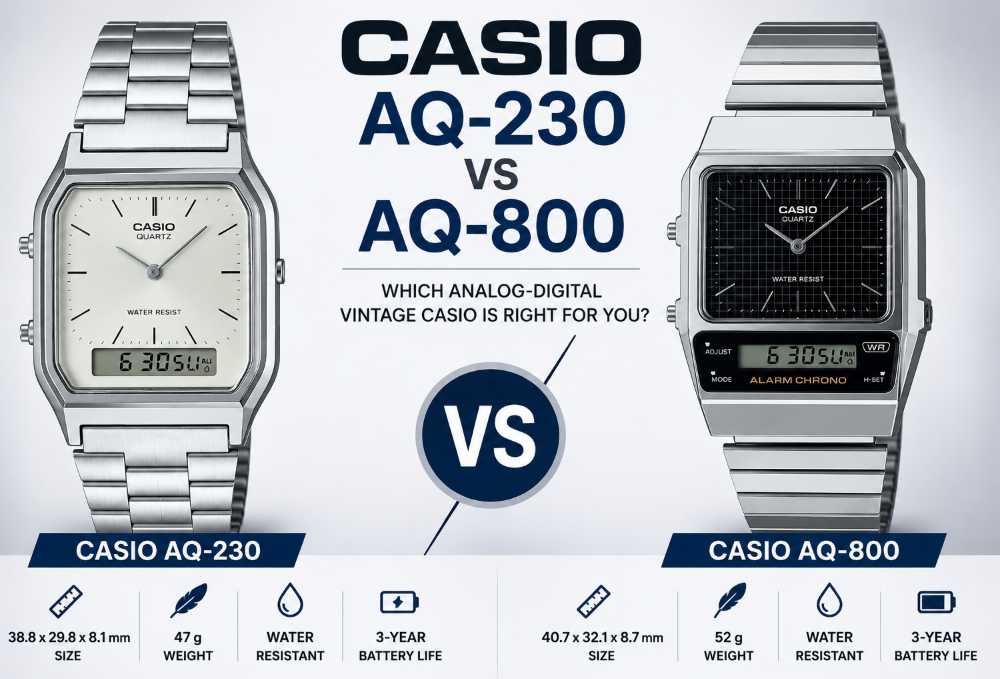
Pick up either of these and you’re getting the same underlying idea: analog hands doing the main work, a small digital readout tucked underneath handling the date, the alarm, the stopwatch. Where the family splits is scale. Casio stretched the same concept into a taller, wider case for the AQ-800, and that decision alone reshapes what each watch is actually for.
The AQ-230 keeps things quiet. At under 30mm across and just over 8mm thick, it slides under a cuff and reads more like a dress-casual piece that happens to have a digital function than a gadget. The AQ-800 adds a couple of millimeters in every direction and about five extra grams, and on a watch this size, that’s enough to change the whole impression — it sits up off the wrist with real presence, closer to what people picture when they think “80s digital Casio” than anything trying to blend in.
Neither is genuinely large. Compared side by side, though, the size gap is the entire reason someone would reach for one over the other.
At a Glance
| Casio AQ-230 | Casio AQ-800 | |
|---|---|---|
| Case size | 38.8 x 29.8 x 8.1mm | 40.7 x 32.1 x 8.7mm |
| Weight | 47g | 52g |
| Battery | SR920W, ~3 years | SR920W, ~3 years |
| Glass | Resin | Resin |
| Water resistance | Basic (Water Resistant) | Basic (Water Resistant) |
The Bracelet Doesn’t Factor Into the Decision
Both come on a stainless steel band with an adjustable clasp, and both inherit the usual character of Casio’s cheaper bracelets — a little rattle, an occasional tug on arm hair, nothing you’d call refined. Since this part is identical either way, it’s simply not something that should sway you toward one over the other.
You’re Not Actually Choosing Features
Time out loud with hands, a digital backup for everything else, a second time zone, a stopwatch that reads to a hundredth of a second, a daily alarm that chimes on the hour too, and a calendar that keeps itself current — every one of those shows up on both watches, with no gap in what either can actually do. Once you know that, the feature list stops being a reason to prefer either one.
What does shift is how much visual weight the digital half carries. Tucked under the hands on the AQ-230, it stays almost incidental. Blown up to match the AQ-800’s larger dial, the same information suddenly reads as a proper instrument panel rather than an afterthought — which is really just the size difference showing up again in a different place.
Neither model reaches further than this. If you’re after multiple alarms, a countdown timer, or city-based world time, you’re already looking at the wrong watch family regardless of which of these two you’re weighing.
Checking the Time at Night Isn’t Either One’s Strength
Small digital windows mean small backlights, and neither watch competes with a full-size digital Casio for genuine nighttime readability. An occasional glance in the dark works fine on both. If that’s a daily habit for you, something like the A168 or the AE1200 will actually serve the purpose better than either AQ.
Water Resistance and Battery Life Land in the Same Place
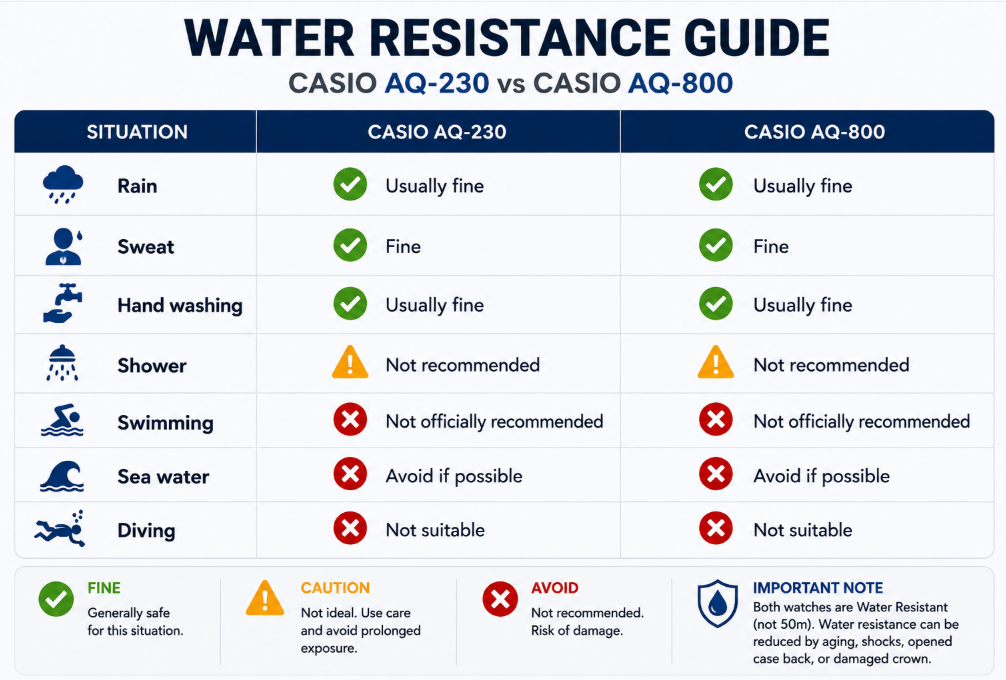
Both carry the same basic Water Resistant rating — enough for rain and the odd splash, nothing you’d trust in a pool — and both run on the same SR920W cell rated for roughly three years. That’s respectable without being exceptional next to Casio’s seven- and ten-year digital models, but since it’s identical on both watches, it simply removes itself from the comparison rather than tipping it either direction.
How They Age
Resin glass and a resin case with a shiny chrome-style finish sit underneath both designs, so the usual wear pattern applies: the case picks up light scuffs over years of use, the crystal can scratch if you’re careless with it. Where this actually diverges a little is visual forgiveness. A small scuff practically disappears on the AQ-230’s plainer, quieter face. The AQ-800’s bolder look draws more attention to the same kind of wear, especially on lighter colorways, simply because there’s more visual real estate for a mark to sit against.
Pros and Cons
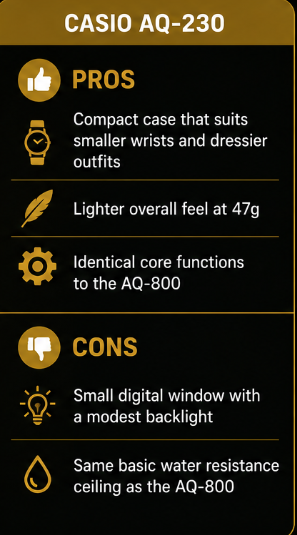
Casio AQ-230
- Compact case that suits smaller wrists and dressier outfits
- Lighter overall feel at 47g
- Identical core functions to the AQ-800
- Small digital window with a modest backlight
- Same basic water resistance ceiling as the AQ-800
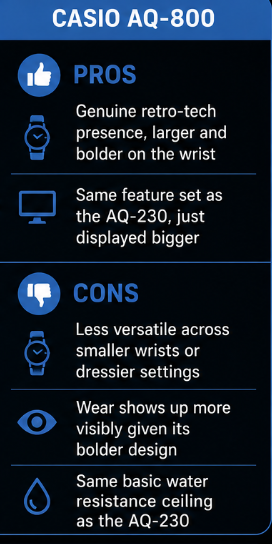
Casio AQ-800
- Genuine retro-tech presence, larger and bolder on the wrist
- Same feature set as the AQ-230, just displayed bigger
- Less versatile across smaller wrists or dressier settings
- Wear shows up more visibly given its bolder design
- Same basic water resistance ceiling as the AQ-230
Making the Actual Call
Price ends up mattering more here than in most comparisons, since the functional gap between these two is essentially zero. Where the AQ-230 comes in noticeably cheaper, it’s the easier recommendation for almost anyone — smaller wrists, office environments, a first analog-digital Casio. Reach for the AQ-800 specifically when its bigger, louder design is what you actually want, whether that’s a first watch built around that look or a second piece meant to contrast with something quieter you already own. Paying a little more for it makes sense once you know that premium is buying you presence, not any additional capability.
Elsewhere Worth a Look
Want stronger backlight in a similar vintage register? The A168 covers that. After something thinner and purely digital instead of analog-digital? The A700. If real water confidence or daily durability matters more than either AQ model offers, the W800H or the B640 are the better direction entirely.
Bottom Line
Specs won’t settle this one — they’re too close. What actually decides it is how much wrist presence you want from a small, cheap Casio. Quiet and compact points toward the AQ-230. Loud and retro points toward the AQ-800. Everything else about the two watches is close enough to call a wash.
FAQ
Is the AQ-230 better than the AQ-800? For most situations, yes — it’s more versatile across wrist sizes and outfits. The AQ-800 only pulls ahead for someone specifically chasing its bigger, bolder look.
How much bigger is the AQ-800, really? About 2mm in each dimension and 5g heavier. Modest on paper, noticeable in person on a watch this small.
Do they share the same features? Completely — dual time, hundredth-of-a-second stopwatch, daily alarm with hourly chime, and auto-calendar are identical on both.
Can either one go in the water? Not for swimming. Both carry a basic Water Resistant rating meant for rain and light splashes only.
Which lasts longer on a battery? Neither has an edge — both run the same SR920W cell for around three years.
Is paying more for the AQ-800 worth it? Only if its look is specifically what you want. You’re not getting any functional upgrade for the extra cost.
Which should I buy first? The AQ-230 if you want the safer, more broadly wearable option. The AQ-800 if the bolder retro design is the whole reason you’re comparing these two in the first place.