Casio F105W vs F91W: Which Cheap Casio Digital Watch Is Better?
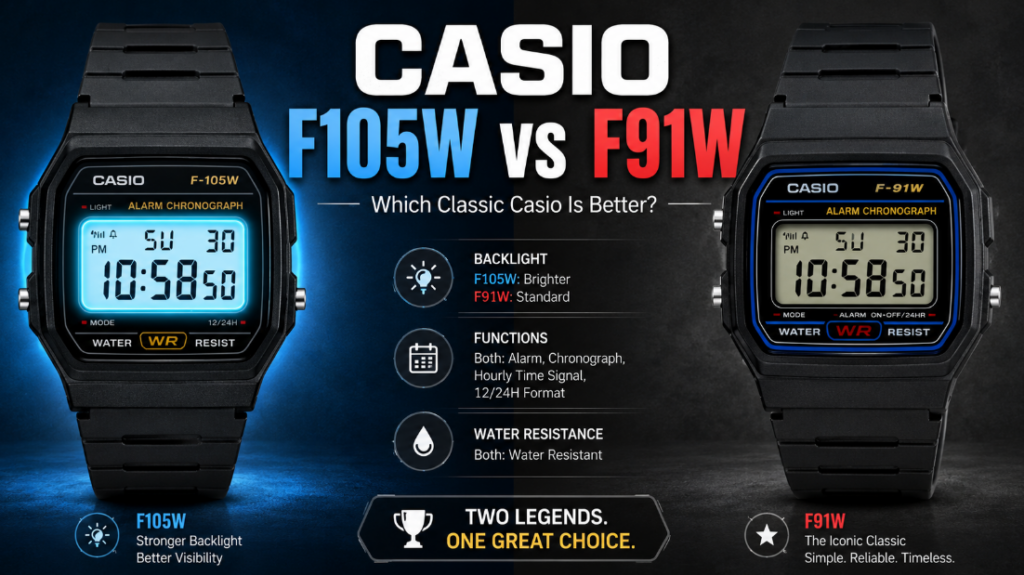
Strip away the marketing and this comparison really comes down to one component: the backlight. Everything else — case size, battery, stopwatch, alarm, water resistance — is close enough to identical that it barely counts as a difference. The F91W is the icon everyone recognizes. The F105W is basically that same watch with a proper light bolted on. Whether that trade is worth it depends entirely on how often you actually need to read a watch in the dark.
The one component that actually separates them
The F91W’s backlight has a reputation, and it’s not really a good one — a small side light that illuminates the display unevenly, weak enough that it’s become something of a running joke among people who’ve owned one. It technically works. Reading the time with it on is a “yes, but” experience rather than a genuinely good one.
The F105W swaps that out for a proper Illuminator-style EL backlight, and the difference is immediate the first time you use it in a dark room. Even, bright, actually pleasant to read by. If you’ve ever fumbled to read an F91W at 3am, the F105W solves that specific annoyance completely.
Water Resistance
Why the rest barely matters
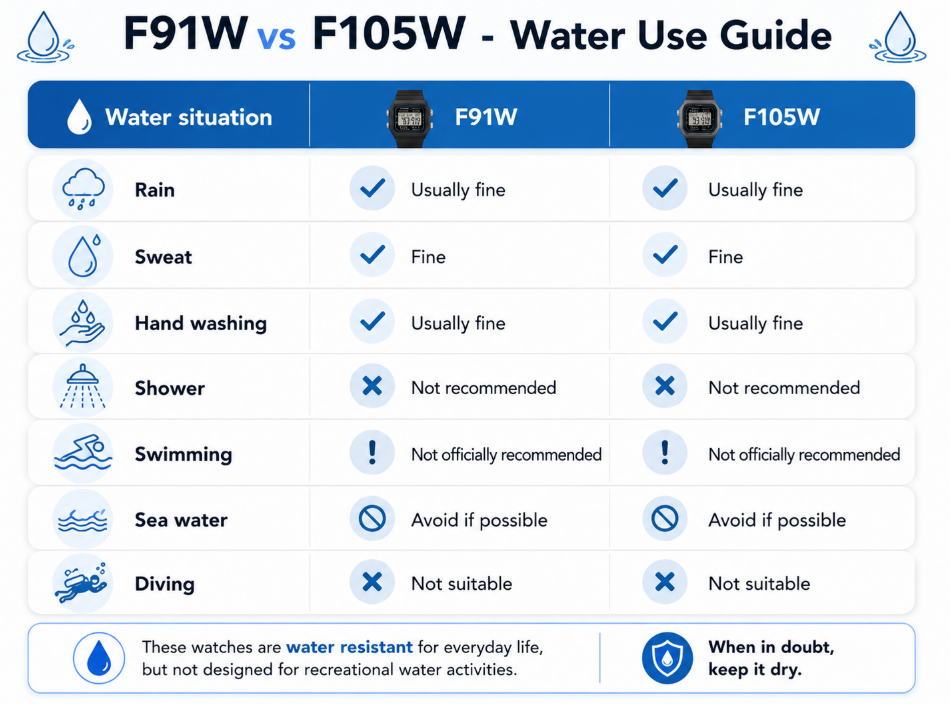
Both watches weigh 21 grams. Both run a CR2016 rated for around seven years. Both have the same 1/100-second stopwatch and daily alarm, plus an identical hourly time signal. The F105W is a hair thicker — 9.6mm against the F91W’s 8.5mm — which is genuinely too small a difference to notice on the wrist without a caliper in hand. Water resistance is identical on paper: fine for rain and hand-washing, not something either watch was built for swimming laps.
The only place the F91W pulls ahead outside the backlight question is pure recognizability. It’s the watch people picture when someone says “cheap Casio digital,” and the F105W, despite being nearly the same watch, doesn’t carry that same cultural weight.
| Watch | Pros | Cons |
|---|---|---|
| Casio F91W | Iconic, very cheap, thin, light, simple, long battery life | Weak backlight, basic water resistance, basic resin glass |
| Casio F105W | Much better backlight, still cheap, light, simple, long battery life | Slightly thicker, less iconic, less classic design |
| Both | Affordable, reliable, comfortable, easy to wear, simple digital functions | Not G-Shocks, not swim watches, no advanced features |
Battery Life and Maintenance
Both watches use a CR2016 battery and are officially rated for around 7 years of battery life. That is excellent for such cheap watches.
| Battery factor | Casio F91W | Casio F105W |
|---|---|---|
| Battery type | CR2016 | CR2016 |
| Approx. battery life | About 7 years | About 7 years |
| Replacement cost | Cheap | Cheap |
| Solar power | No | No |
| Charging needed | No | No |
| Maintenance | Very low | Very low |
Who actually needs the upgrade
If your watch spends real time getting checked in low light — nightshift work, waking up in a dark bedroom, camping, whatever your situation happens to be — the backlight difference isn’t a minor nice-to-have, it’s the entire reason to pick the F105W over its more famous sibling. If you rarely use the backlight at all and just want the watch that looks and feels like the classic Casio experience, that extra 1mm of thickness buys you nothing you’ll actually use.
The honest bottom line
Price-wise these two usually sit close enough together that cost alone shouldn’t decide it. Think about how you actually use a watch instead. Heavy backlight users get real, tangible value out of the F105W upgrade. Everyone else is probably better off with the F91W simply because it’s the more iconic, more recognizable version of essentially the same watch.