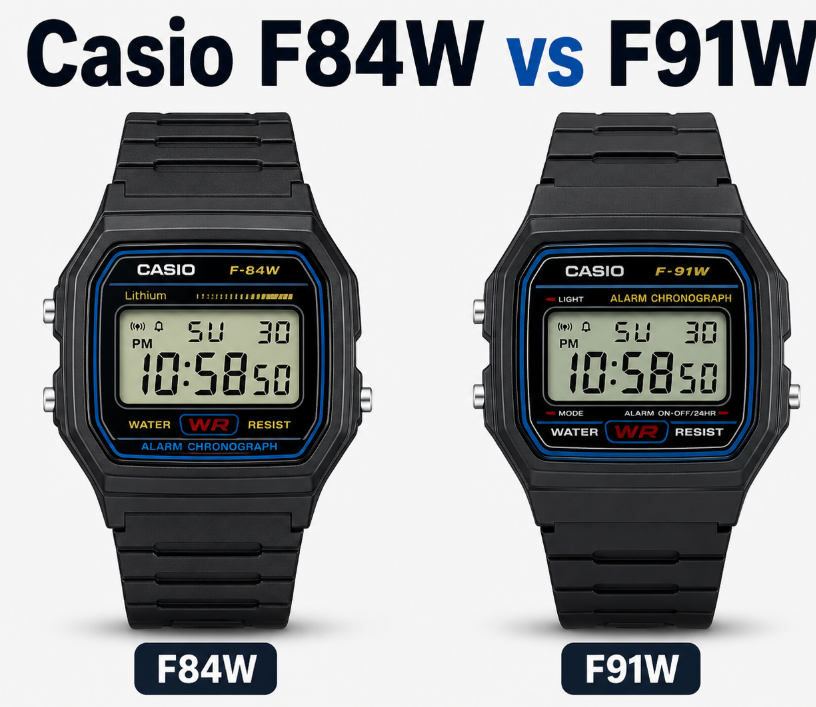
This isn’t really a spec battle — on paper these two watches are nearly twins. Same weight, same battery, same basic function set, same general “cheap classic Casio digital” DNA. The real question hiding under this comparison is a different one entirely: is the F84W’s rarity actually worth chasing, or is it just a slightly different-looking F91W that happens to be harder to find?
Why anyone even asks this question
The F91W is, at this point, a cultural object as much as a watch. Black case, blue outline, red WR mark, yellow text — recognizable at a glance to basically anyone who’s ever browsed a “cheap watches” thread. The F84W lives in its shadow, treated by a lot of collectors as the JDM-flavored sibling: a little narrower-looking on the wrist, less globally known, and mostly bought by people who already own an F91W and want the slightly different flavor of the same idea.
What’s actually different between them
Almost nothing, if you’re being strict about it. Case dimensions are within a millimeter of each other. Both run the same CR2016 battery for roughly seven years. Both have the same alarm and stopwatch, plus a basic LED light that nobody’s ever described as impressive. The genuine difference is the case shape — the F84W reads a touch narrower and more angular on the wrist, giving it a slightly different personality despite near-identical numbers on paper — and availability, which is where the real gap opens up. The F91W sits on shelves everywhere. The F84W usually means importing from Japan or hunting through resellers, and that hassle shows up in the price too.
Water Resistance
Both watches should be treated as basic water-resistant Casio digitals. They are fine for normal daily life, but they are not the watches I would buy for swimming.
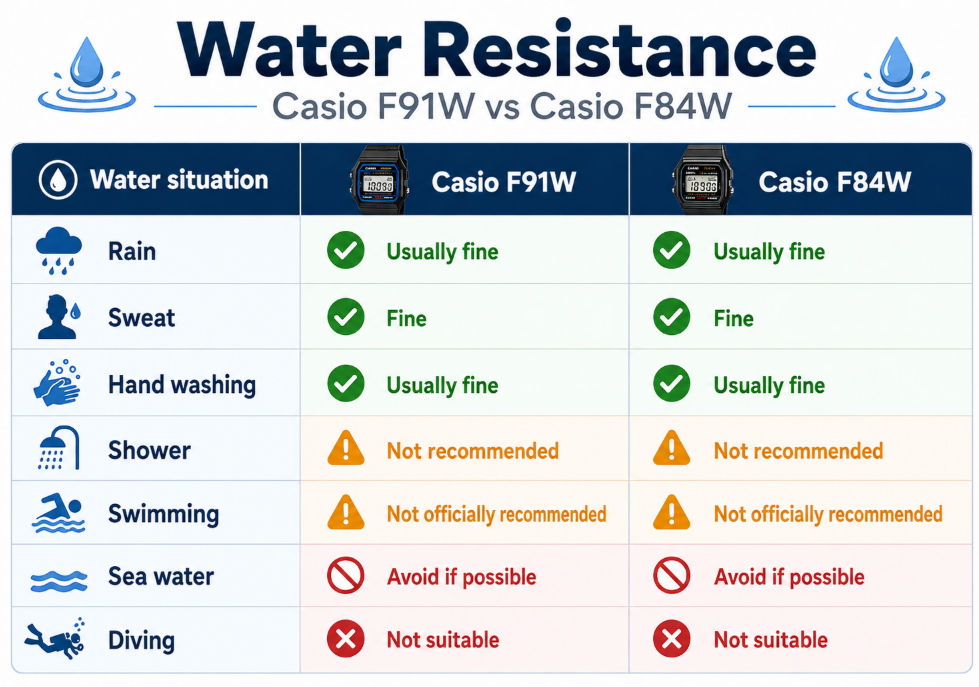
The F91W has a reputation for surviving more water abuse than expected, but that does not make it a proper swimming watch. The same logic applies to the F84W. For real water confidence, choose a G-Shock DW-5600, GW-M5610 or another Casio with a stronger water rating.
Who actually ends up buying the F84W
Almost nobody buys this as their first cheap Casio, and that’s kind of the point. It’s a watch for people who already own (or have owned) an F91W, like the format enough to want a variation, and don’t mind paying a small premium or dealing with import shipping to get something a little less common. There’s a real appeal in owning the version fewer people recognize, especially among collectors who enjoy the tiny differences between Casio’s endless lineup of near-identical classics.
Pros and Cons
| Watch | Pros | Cons |
|---|---|---|
| Casio F91W | Iconic, cheap, easy to find, light, thin, simple, reliable | Very common, weak light, basic water resistance, basic resin glass |
| Casio F84W | More niche, lightweight, compact feel, JDM appeal, same simple functions | Less available, often costs more, not more capable than F91W |
| Both | Very light, thin, simple, long battery life, classic Casio digital charm | Not G-Shocks, not swim watches, weak backlights, no advanced features |
The honest recommendation
If this is your first cheap digital Casio, the F91W is the correct default. It’s cheaper and easier to replace. It’s also no less capable in any practical sense that matters. The F84W only really makes sense once you’re already deep enough into this hobby that “slightly rarer version of a watch I already like” genuinely sounds appealing. Neither watch does more than the other; the F84W’s entire value proposition is being a little harder to get.
A couple of nearby alternatives worth knowing
If the weak backlight on both of these bothers you, the F105W keeps the same basic size and format with a genuinely better light. If you want more display real estate and actual water confidence in the same general price range, the W800H is worth a look on its own merits.