Casio F91W vs W800H: Which Cheap Casio Digital Watch Is Better?
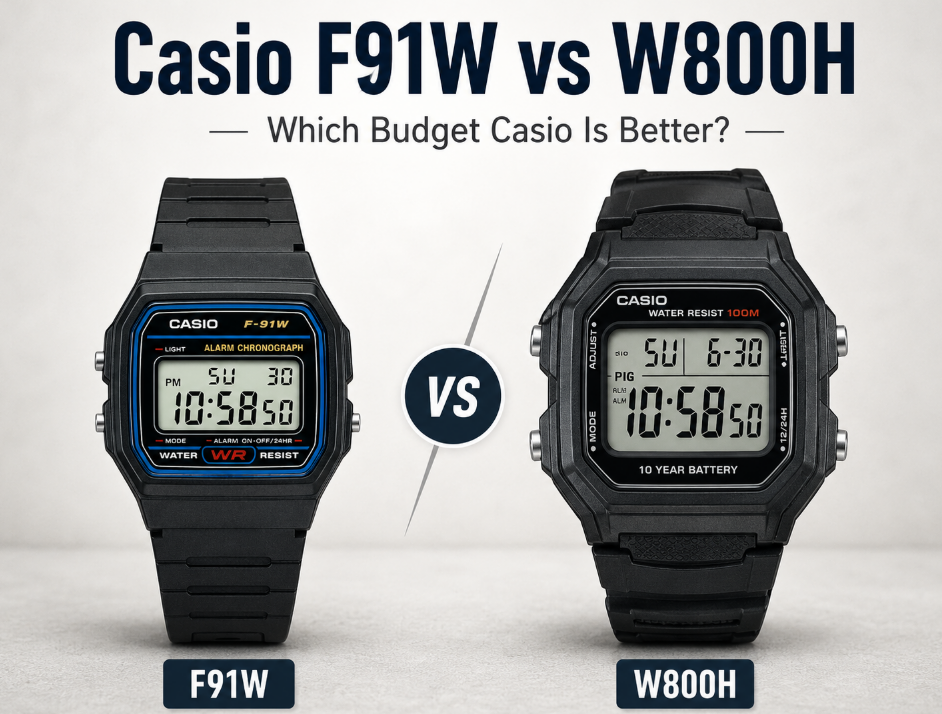
Everyone knows the F91W by sight even if they’ve never owned one — it’s basically the platonic ideal of “cheap Casio digital watch.” The W800H barely gets a fraction of that recognition, despite doing more on paper: bigger screen, real water resistance, a battery that outlasts the F91W by three years. This isn’t really an icon-versus-nobody comparison, though. It’s a question of what you actually do with a watch day to day, and the two answer that question pretty differently.
The basics
| Casio F91W | Casio W800H | |
|---|---|---|
| Case size | 38.2 × 35.2 × 8.5mm | Larger, more wrist presence |
| Weight | 21g | Heavier, still light |
| Water resistance | Water Resistant (basic) | 100m |
| Battery life | ~7 years | ~10 years |
| Dual time | No | Yes |
| Display | Small | Larger |
At a desk or wearing long sleeves
This is the F91W’s home turf. At 21 grams and under 9mm thick, it slides under a cuff without a hint of bulk and disappears from your attention within a day of wearing it. The W800H isn’t uncomfortable by any stretch, but the bigger case and display mean it announces itself a little more — fine if you don’t mind, slightly more noticeable if invisibility is the whole point for you.
Checking the time without really looking
Here’s where the size trade-off flips in the W800H’s favor. Its bigger digits and more open display layout make it genuinely easier to read at a glance — walking, working, mid-workout, whatever. The F91W’s screen is perfectly functional but compact, and the weak backlight doesn’t do it many favors after dark. If you find yourself squinting at a watch more than you’d like, the W800H is the one that actually fixes that.
Around water
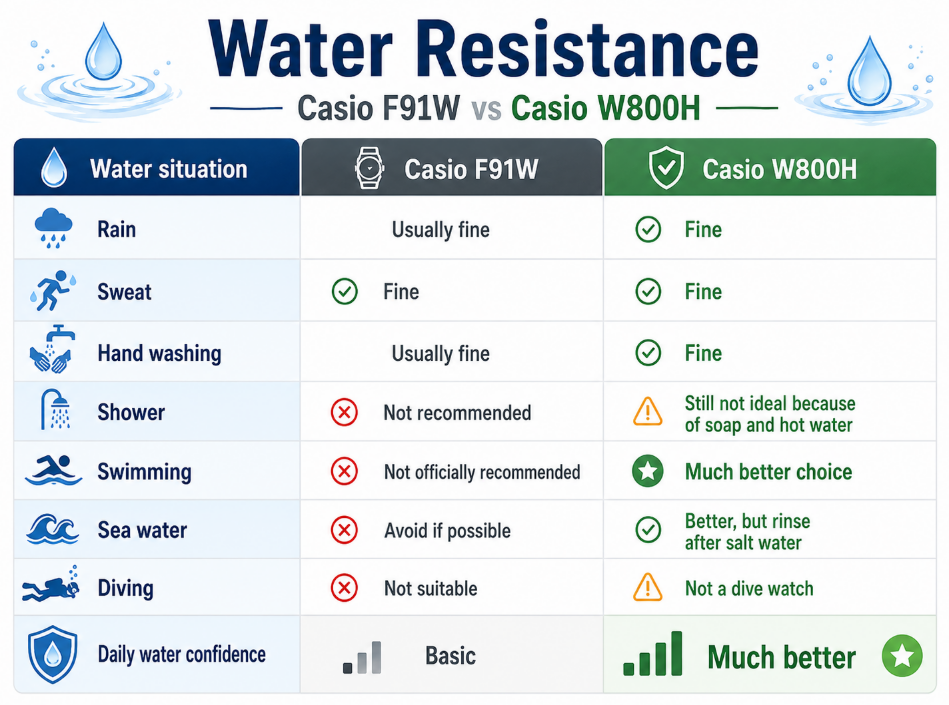
This is close to a non-contest. The F91W is rated only “Water Resistant,” which covers rain, sweat, and quick hand-washing without much confidence beyond that. The W800H’s 100m rating handles actual swimming and general water exposure without a second thought. Neither is a dive watch, but only one of them will survive a pool day without you thinking twice about it.
Traveling or juggling time zones
The W800H’s dual time function is a small feature that matters more than it looks on a spec sheet — genuinely useful the moment you’re dealing with a second time zone, whether that’s a work call or an actual trip. The F91W has no answer here at all; it’s a single-timezone watch through and through, which is fine until you actually need the other feature.
Owning it for years without thinking about it
Both watches are close to maintenance-free, but the W800H’s roughly 10-year battery edges out the F91W’s already-solid 7 years. Neither number is going to change your life, but if minimizing how often you think about your watch at all is the goal, the W800H wins this by a small, real margin.
Where the F91W still wins outright
None of this touches what actually makes the F91W special, which has nothing to do with specs. It’s cultural — the watch shows up in movies, gets referenced as a shorthand for “the cheapest Casio that still looks right,” and carries a kind of understated cool that a purely practical watch just can’t manufacture. If that appeals to you at all, no amount of extra water resistance from the W800H is going to compete with it.
Bottom line
Judged purely on usefulness, the W800H is the stronger everyday watch — better screen, real water confidence, dual time. Add a longer battery life on top and the practical case is pretty complete. None of that changes what made cheap Casios a whole subculture in the first place, though, and that’s the argument the F91W still wins outright. Most people end up picking based on which of those two arguments they actually care about, and both answers are perfectly reasonable.
A few other cheap Casios worth a glance if neither quite fits: the W217H splits the difference with a bigger display and 50m water resistance in an F91W-adjacent size, and the F105W keeps the F91W’s proportions while improving the backlight. The AE-1200 goes further still, adding genuine extra features like world time for not much more money.