A part can fit Casio GA-2100 Battery physically and still be electrically or electronically incompatible. Confirm the number, polarity, generation, or receiver system before installation.
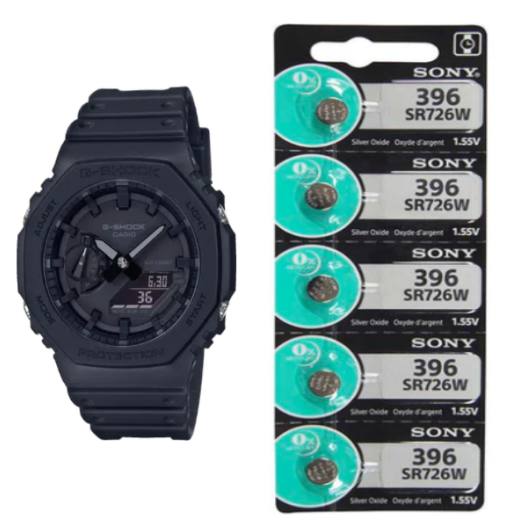
Open the case back on a GA-2100 for the first time and there’s a decent chance you’ll pause. Most Casio digitals run on a single cell, so people expect one battery sitting in there — instead there are two SR726W silver oxide cells side by side. It’s not a defect or an odd unit; it’s just how this particular module was built, and it’s the one fact that causes almost every question people bring to me about this watch.
Quick orientation before anything else: check the reference on the case back. GA-2100 means two disposable SR726W batteries. GA-B2100 means Tough Solar — no batteries to buy at all. The two watches share almost the same octagonal silhouette, which is exactly why this mix-up happens as often as it does.
- Identify the Version Before Following the Steps
- What Shortens the Expected Run Time
- Why Casio went with two small cells instead of one
- How long the batteries actually last
- The Battery Change From Case Back to AC Reset
- Doing the replacement
- New batteries installed, watch still dead
- What Must Be Reinitialized
- Keep This Reference With the Device
- Casio GA-2100 Battery Specifications
- When the hands and the digital display disagree
- What the Case and Dial Get Right
- Not every “2100” is the same watch inside
- What to actually buy
- Should you do it yourself?
- The Pattern Behind the Warning
- The Signal That Tells You It Worked
- A Better Way to Choose the Replacement
- The Ownership Cost Behind the Purchase
- Author
Identify the Version Before Following the Steps
Two SR726W cells, roughly three years of life under normal wear, 200m water resistance, no solar, no Bluetooth. If you just wanted the spec sheet, that’s it. Everything below is the “why” and the “how” that the spec sheet skips.
What Shortens the Expected Run Time
Why Casio went with two small cells instead of one
This isn’t about the GA-2100 drawing unusual amounts of power — it’s a packaging decision. A single larger cell would have made the case noticeably thicker, and part of what makes this watch sit so much slimmer than chunkier siblings like the GA-100 comes down to fitting the analog hands, LCD, alarms, and LED light around two compact cells instead of one bulky one.
That has a practical side effect worth knowing before you order parts: replacing only one battery almost never makes sense. The pair costs a few dollars total, and the labor of opening the case doesn’t change whether you swap one cell or two — so doing just one guarantees a second trip inside the case a few months later.
How long the batteries actually last
Three years is Casio’s number, and it holds up reasonably well against what owners actually report. Since the watch isn’t running Bluetooth or a connected display, most of the drain comes from the analog movement itself, with the LED and alarms adding a bit on top for anyone who uses them often.
A watch worn mostly for basic timekeeping tends to hit or slightly beat that three-year mark. Heavy LED use trims it down somewhat. And there’s a detail that catches secondhand buyers off guard: the clock on battery life starts at the factory, not on your wrist. A GA-2100 that sat on a shelf for a year before you bought it is already a year into that three-year estimate.
The Battery Change From Case Back to AC Reset
Doing the replacement
This is a step up from swapping a single battery in a basic Casio, though nothing about it is genuinely difficult. You’re handling two cells, a retainer clip, a gasket, and a module that expects a specific reset step before it comes back to life properly.
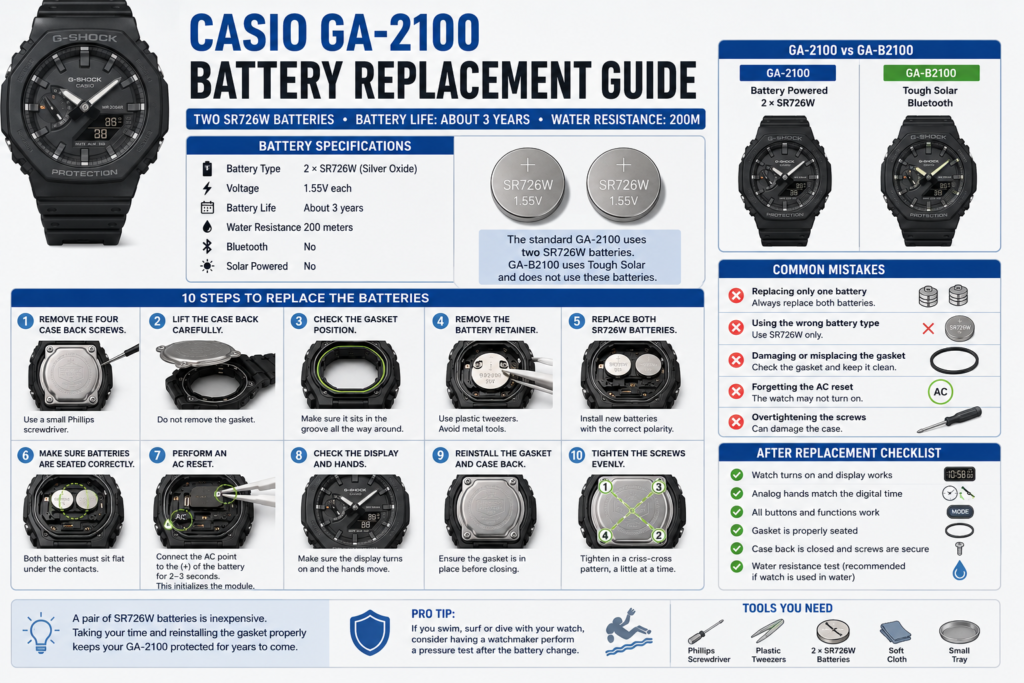
The sequence:Remove the four case-back screws
Lift the case back off, noting how the gasket sits
Remove the battery retainer
Replace both SR726W cells — not just the one that looks worse
Check that each sits flat in its holder
Perform the AC reset (see below — this step gets skipped constantly)
Confirm the LCD lights up
Confirm the hands start moving
Reseat the gasket carefully
Tighten the case-back screws evenly, not one corner first
That gasket check in step 9 is worth slowing down for. It’s easy to miss a slight twist on the bench and much harder to deal with once moisture has actually gotten past it.
New batteries installed, watch still dead
This happens often enough that it deserves its own section rather than a line in a troubleshooting table. The missing step is almost always the AC reset — after power is fully disconnected, the module typically needs this reset before it’ll respond normally, even with two fresh, correctly seated batteries installed. Skip it, and you’re left staring at a blank screen assuming you got a bad pair, when the batteries were probably fine the whole time.
What Must Be Reinitialized
Not the screws, not the gasket, not the battery type itself — the two things that trip people up are forgetting there are two cells to begin with, and skipping the AC reset afterward. Get those right and the rest of the job is routine, especially if you’ve opened other Casio watches before.
Keep This Reference With the Device
Casio GA-2100 Battery Specifications
When the hands and the digital display disagree
I’d put this at the top of the “don’t panic” list. A correct digital time next to hands pointing somewhere else isn’t a dead battery — it’s a hand-alignment issue, and the GA-2100 has a specific procedure built in for exactly this.
Re-setting the time won’t fix it, because the module’s internal time is already correct. What’s needed is the hand home-position adjustment, which tells the analog hands where to physically land relative to what the digital side already knows.
What the Case and Dial Get Right
Not every “2100” is the same watch inside
Color and dial variant don’t matter here. A black GA-2100-1A1 and a transparent GA-2100SU run on the identical two-battery setup. What actually matters is which letter comes before or after “2100”:
Reading the case back reference takes ten seconds and eliminates the guesswork entirely — worth doing before you buy anything, since this family is exactly where wrong-battery orders happen most.
What to actually buy
The batteries are the cheapest part of this whole job by a wide margin, so this isn’t where I’d try to save money. Panasonic, Murata, Maxell, and Renata are the names I’d trust here. It’s also worth reading the full designation on the packaging rather than assuming any battery marked “726” is interchangeable — a few similar-looking numbers exist for different movement types.
Should you do it yourself?
Comfort with a screwdriver matters less here than how you actually use the watch. Anyone with basic watch tools already can manage this without much trouble. Someone who wears it in the pool weekly has a different priority — keeping the water resistance intact is worth more than the labor savings, and reopening the case a second time because a gasket shifted is a worse outcome than just paying for the job once.
The Pattern Behind the Warning
A dimmer LED is usually the first tell, followed by an LCD that’s harder to read from an angle, or hands that seem to drift out of step with the digital display. Left alone, the watch eventually goes dark entirely.
That third symptom — hands and digital time disagreeing — deserves its own callout, because it’s the one people misdiagnose constantly. If the digital time is still correct and only the hands are off, that’s very likely not a battery problem at all. More on that below.
The Signal That Tells You It Worked
Almost all of these show up in the first few minutes after reassembly, and in nearly every case I’ve dealt with, the fix lives inside the battery compartment rather than deeper in the module — assuming the watch worked fine before it was opened.
A Better Way to Choose the Replacement
If this watch is a daily wear-and-forget piece, a competent local watchmaker handles it fine. If it regularly goes underwater — swimming, snorkeling, that kind of use — I’d spend the extra on pressure testing rather than skip it. That’s the one scenario where a slightly imperfect gasket seat actually costs you something real.
The Ownership Cost Behind the Purchase

Worth repeating because it’s the single most common source of wasted orders. From the front, these two look close enough to be the same watch. Inside, one runs on disposable SR726W cells and the other charges itself via Tough Solar — completely different systems, no overlap in parts.
If your case back says GA-B2100, buying batteries accomplishes nothing. Checking the exact reference before ordering anything is the fastest way to avoid that entirely.
If Casio GA-2100 Battery still behaves the same after the matching test and a known-good power source, stop repeating the replacement and diagnose the device or receiver instead.