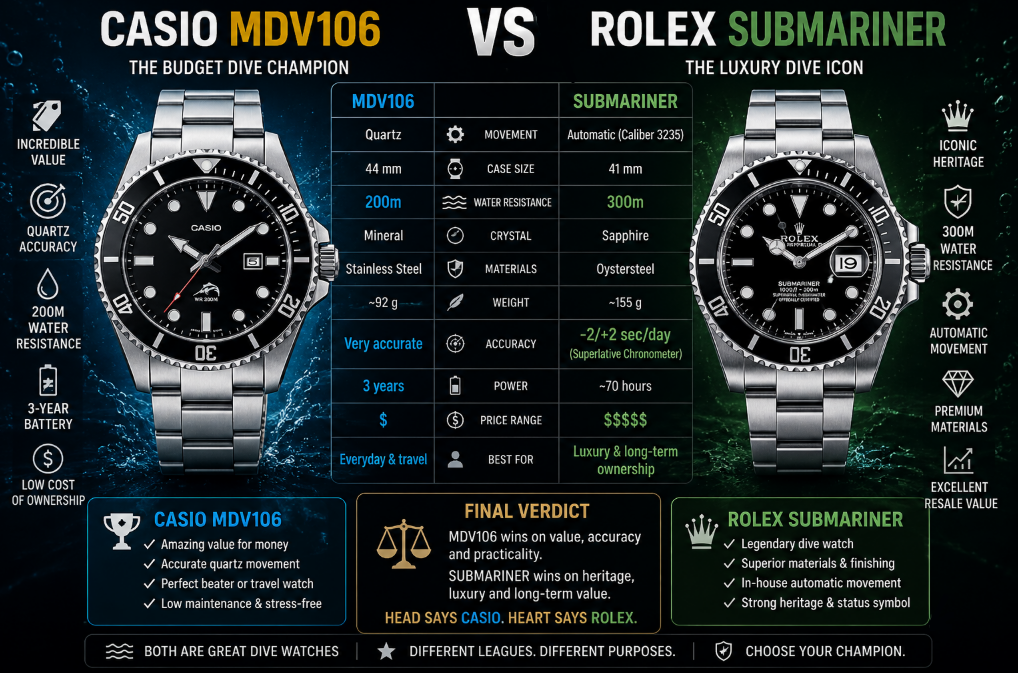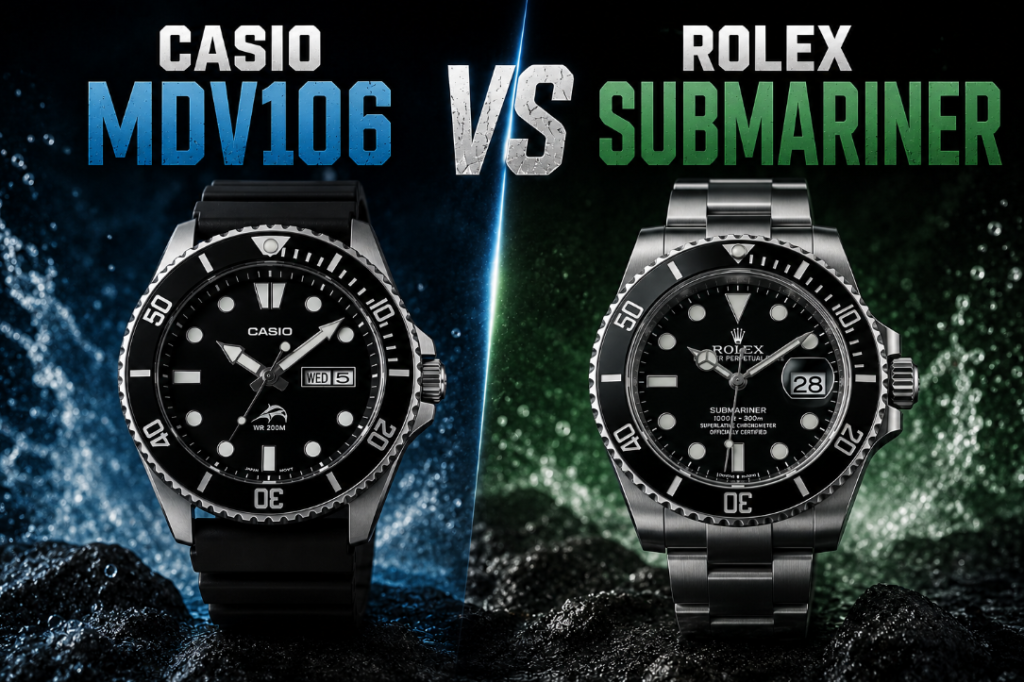
People bring these two up together for one simple reason: the Casio Duro gives you a black dive-watch silhouette that echoes the Submariner for a couple hundred dollars, a small sliver of what the Rolex actually costs. Fair enough as a starting point. But the moment you look past the silhouette — at movement, materials, finishing, or what either watch actually means to own — this stops being a real contest and turns into two completely different categories of object that happen to share a general shape.
What each one actually is
| Casio MDV106 | Rolex Submariner Date 126610LN | |
|---|---|---|
| Movement | Quartz | Automatic Caliber 3235 |
| Case size | ~44mm | 41mm |
| Water resistance | 200m | 300m |
| Crystal | Mineral | Sapphire |
| Bezel | Rotating dive-style | Ceramic Cerachrom |
| Power | Battery, ~3 years | Automatic, ~70-hour reserve |
| Accuracy | Very good quartz | Superlative Chronometer, -2/+2 sec/day |
Where the Duro genuinely wins
Accuracy is the obvious one — quartz just doesn’t need the same kind of forgiveness a mechanical movement does, and the MDV106 will hold time better in raw seconds-per-month terms than a mechanical watch costing a hundred times more. Maintenance is basically nonexistent: a battery every few years and you’re done. And there’s a real argument that the Duro is easier to actually live with day to day, because nobody hesitates to wear it in the ocean, bang it against a doorframe, or leave it in a beach bag. People baby Rolexes. Almost nobody babies a $70 Casio, and that carefree relationship counts for something real in daily use.
Where the Submariner is in an entirely different league
Materials and finishing aren’t close. Oystersteel, sapphire crystal, a ceramic bezel insert with genuinely satisfying click action, an Oyster bracelet with Glidelock adjustment — every part of the watch feels engineered rather than assembled to a price point. The automatic Caliber 3235 inside is a genuinely impressive piece of mechanical engineering, chronometer-certified and running around 70 hours on a full wind. Water resistance edges out the Duro too, at 300m against 200m, though both numbers comfortably exceed what almost anyone actually needs.
Then there’s everything the spec sheet can’t capture — heritage, brand weight, a resale market that treats the Submariner less like a depreciating purchase and more like a semi-liquid asset. None of that shows up in a comparison table, and yet it’s a huge part of why people want one specifically.
The honest value conversation
Dollar for dollar, the Duro is simply the better value. You’re getting a genuinely capable, accurate, good-looking dive-style watch for a fraction of a fraction of Submariner money, and it does the actual job of telling time and surviving water exposure just as well for most people’s purposes. The Submariner isn’t competing on that axis at all. What you’re actually buying there is brand, craftsmanship, mechanical heritage, decades of cultural weight — the price tag reflects all of that long before it reflects how well the watch tells time.
Who each one is actually for
Someone who wants a reliable, accurate, low-stress dive-style watch without spending real money lands on the Duro easily, and it makes just as much sense as a beach or travel beater for someone who already owns something nicer. Prestige and mechanical craftsmanship are what pull people toward the Submariner instead, along with genuine long-term collector value and simply wanting to own the watch that basically defined the category.
A few alternatives worth knowing
If the Duro’s rubber strap and mineral crystal feel too basic but Rolex money isn’t on the table, the Orient Kamasu and Seiko’s Turtle line both offer real automatic movements at a fraction of Submariner pricing. If you want something closer to Rolex quality without quite the Rolex price, the Tudor Black Bay 58 is the obvious next step up — genuinely luxury dive watch territory, just with a different name on the dial.
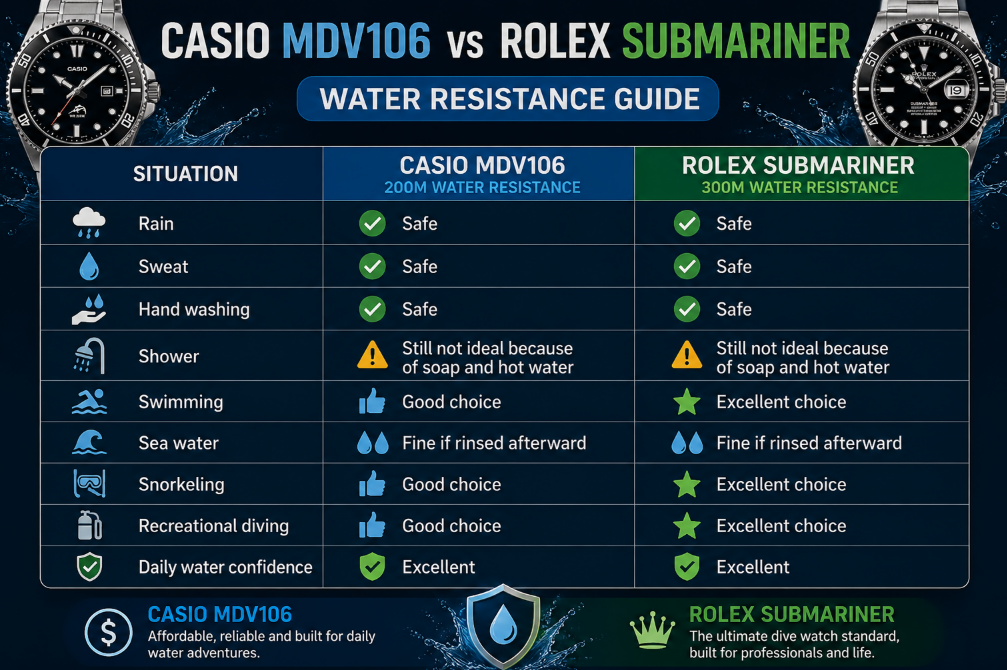
Water Resist
Quick questions
Is the Casio actually a Submariner alternative? As a budget dive-style look, yes. As a genuine substitute for what the Submariner actually delivers, that’s a stretch — it covers the silhouette and solid water resistance well, but the luxury build underneath is simply a different tier of watch entirely.
Which one keeps better time? The MDV106, in raw accuracy terms. Quartz movements just don’t drift the way even excellent mechanical movements do.
Can you actually swim with both? Yes, comfortably. 200m and 300m both leave enormous margin above what swimming or snorkeling actually requires.
Is the Submariner worth the money? Purely on function, no — you’re paying many multiples more for water resistance you’ll never test the limits of. For craftsmanship and heritage, most Submariner owners would say absolutely, and the ownership experience itself is a big part of that answer.
Which should someone buy first? The Duro, without much hesitation, if dive watches are new territory. Save the Submariner for later, once you actually know you want a luxury piece and the ownership costs that come with it.