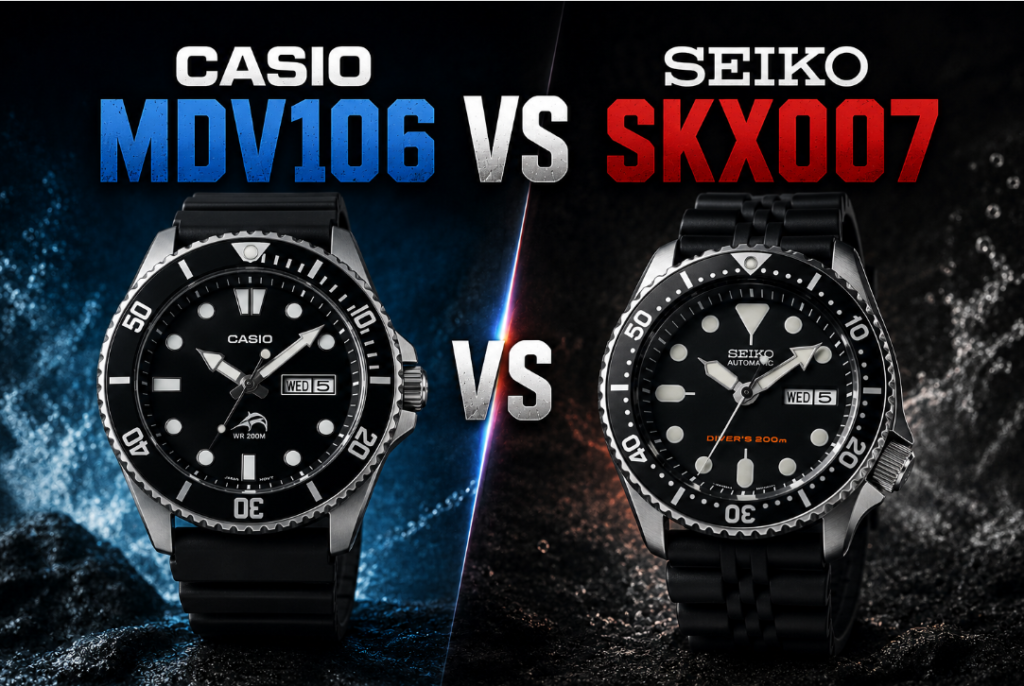
Ask around in any watch forum long enough and these two names come up together constantly, usually in the same breath as “gateway watch.” Both built cult followings on a shoestring budget. Both turned a lot of casual watch-curious people into genuine enthusiasts. And despite getting lumped together so often, they’re really not chasing the same thing at all.
Why people even compare these two
The MDV106, better known to most people as the Casio Duro, is one of the great bargains in modern watchmaking — a reliable quartz movement, 200m water resistance, and a dive-watch look that punches way above its price tag. The SKX007 is a different animal entirely. It’s been discontinued for years now and people still hunt down good examples, because it helped build an entire modern era of Seiko enthusiasm almost single-handedly.
First impressions
Put the Duro on and it looks more expensive than it has any right to. The dial’s clean, the proportions work, and the whole thing reads as a proper dive watch despite costing less than dinner for two. It’s the kind of watch that surprises people who assume “cheap” and “good-looking” can’t coexist.
The SKX007 hits differently. It’s smaller on paper at 42.5mm against the Duro’s 44mm, but the cushion case wears bigger than the number suggests, and there’s a chunky, purposeful feel to the whole thing that the Duro doesn’t quite match. This is a watch that looks like it’s been doing hard work for decades, because in a lot of cases it actually has.
Living with each one day to day
This is really where the split happens. The Duro runs on quartz, and it just works — accurate to within a few seconds a month, a battery change every three years or so, and basically zero thinking required beyond that. It’s the low-maintenance option in every sense.
The SKX007 asks more of you, and that’s kind of the point for the people who love it. The 7S26 automatic movement inside isn’t a precision piece — daily variance can swing anywhere from -20 to +20 seconds, sometimes better, sometimes worse. It never needs a battery, but it will eventually need servicing, and owning one is genuinely more of an ongoing relationship than a “buy it and forget it” purchase. Some people find that annoying, though plenty of SKX007 owners will tell you that’s exactly what makes the watch interesting in the first place.
Diving, bezels, and actual water use
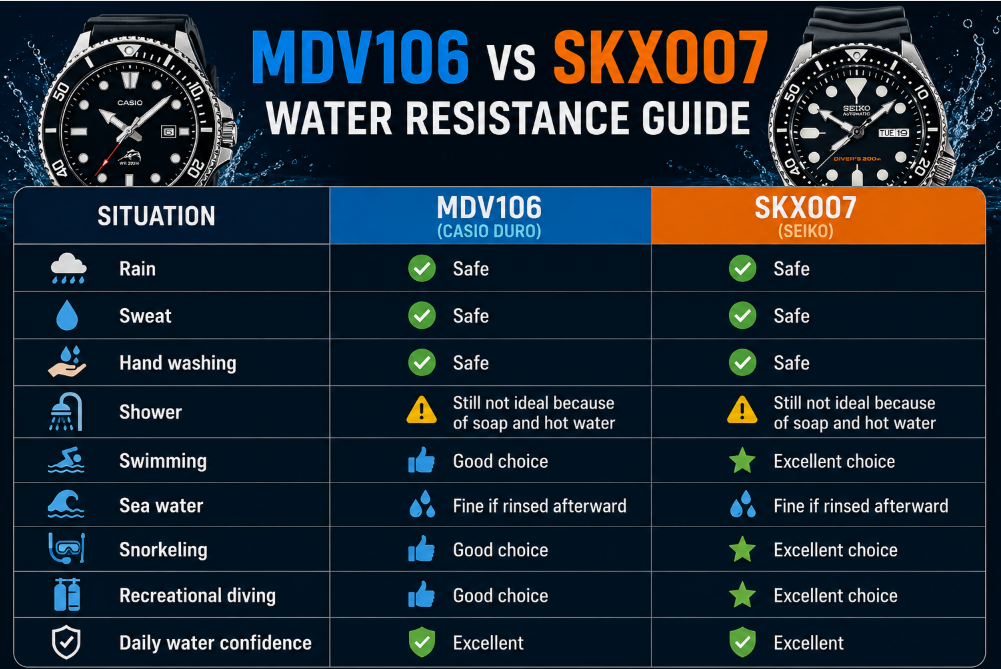
Both watches carry a 200m rating, but only the SKX007 holds real ISO diver certification — it was built from the ground up to meet that standard, bezel action and all. In practice, most owners of either watch spend their water time swimming or snorkeling — genuine decompression diving is rare for either crowd — so the gap matters more to spec-sheet readers than to actual daily users. That said, the SKX007’s bezel action genuinely feels better — more mechanical, more satisfying to turn, the kind of detail that dive watch enthusiasts notice immediately. The Duro’s bezel is solid for the price, just not in the same league.
The modding rabbit hole
If there’s one place the SKX007 has no real competition, it’s here. The aftermarket scene around this watch is enormous — bezels, dial and hand sets, cases, crystals, entire businesses built purely around customizing SKX007s into something personal. People have turned $200 SKX007s into watches that look like five-figure dive pieces just by swapping parts. The Duro has a modest aftermarket following too, but nothing that comes close to matching what’s grown up around the Seiko.
What you’re actually paying
Here’s where the Duro pulls dramatically ahead: it’s genuinely one of the best values in the hobby, brand new, for a fraction of what a good SKX007 costs today. That gap exists specifically because the SKX007 is discontinued — at its original retail price it was already excellent value, but collector demand has pushed used prices well past what it used to cost. Whether that’s still “worth it” depends entirely on how much the heritage and mechanical charm matter to you personally.
So which one should you actually buy
The smarter purchase on paper is pretty clearly the Duro — more accurate, dramatically cheaper, easier to maintain. It’s a genuinely strong pick as a first watch or first dive-style piece. Soul is a different currency entirely, though, and that’s where the SKX007 cashes in: more history, a modding community that’ll keep you entertained for years. The reputation it’s built is earned honestly, even at today’s inflated prices.
A few worth knowing if neither is quite right: the Seiko SRPD55 is the closest modern successor to the SKX line, and the Citizen Promaster Diver BN0150 is a genuine rival to the Duro at a similar price. The Orient Kamasu rounds things out as one of the better affordable automatics for SKX-style mechanical charm without hunting down a discontinued model.