- Casio vs Swatch: Which Watch Brand Is Better?
- Where they actually stand today
- The honest version of this comparison
- Heritage and why it matters here
- Design philosophy
- Movement, accuracy, and everyday reliability
- Build quality, durability, and living with either one
- Price and where the value actually sits
- A few specific matchups people ask about
- Who actually fits each brand
- Bottom line
- Quick questions
- Author
Casio vs Swatch: Which Watch Brand Is Better?
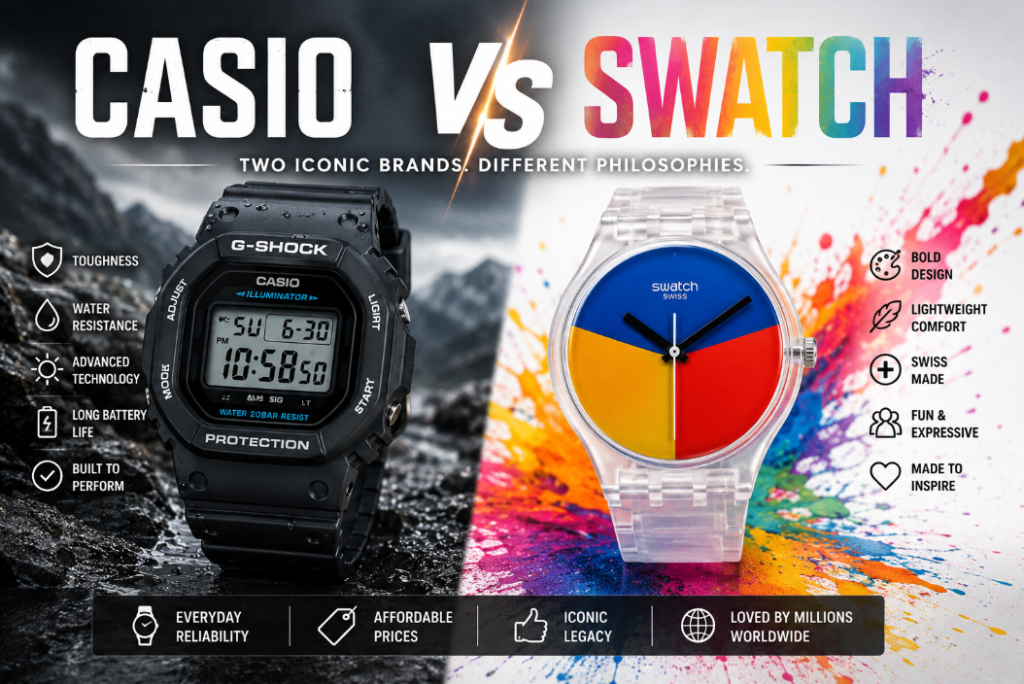
These two brands solved the same problem in completely opposite ways. Back when quartz watches nearly wiped out mechanical Swiss watchmaking, Casio leaned all the way into what quartz could actually do — cheap, accurate, packed with features nobody had bothered adding to a watch before. Swatch took the other route, using quartz to save the Swiss industry from itself, wrapping cheap movements in color, plastic, and genuine personality. Both bets paid off. Neither company makes the same kind of watch as the other, which is really the whole reason this comparison keeps coming up.
Where they actually stand today
| Casio | Swatch | |
|---|---|---|
| Founded | 1946 | 1983 |
| Country | Japan | Switzerland |
| Movement | Quartz, some digital-analog hybrids | Quartz, plus the automatic Sistem51 |
| Solar charging | Yes, Tough Solar across many lines | No |
| Digital watches | A huge, ongoing lineup | Barely any |
| Smart features | Bluetooth and radio sync on select models | None |
| Best known for | G-Shock, Edifice, Pro Trek, vintage digitals | Originals, Big Bold, Sistem51, the MoonSwatch collab |
The honest version of this comparison
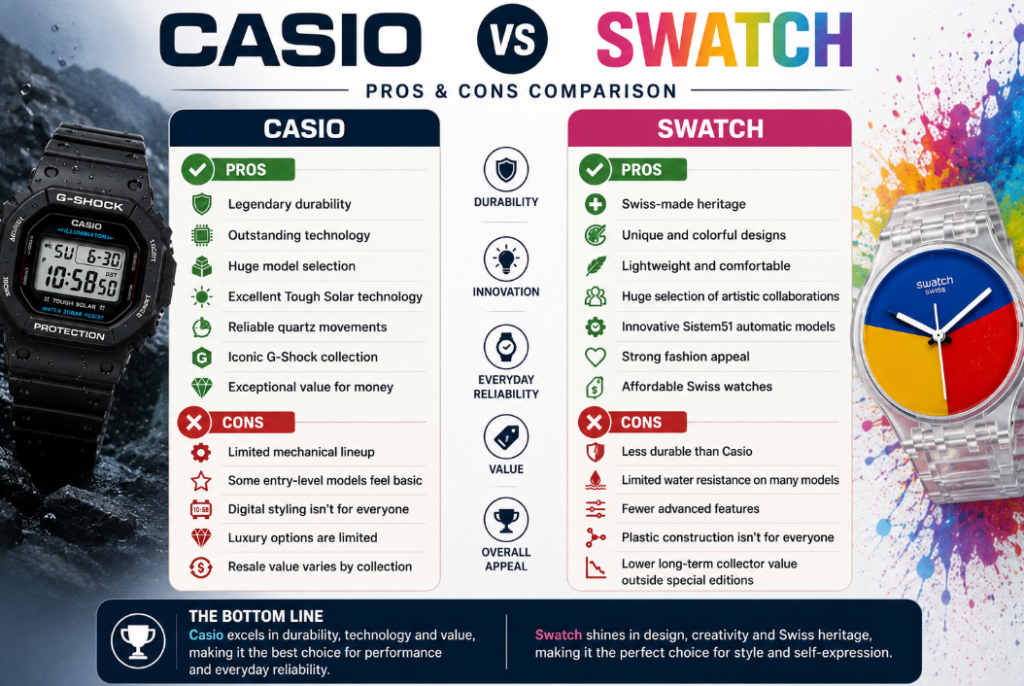
Casio builds around function first. Nearly everything it makes is designed to survive daily abuse and just keep working without asking much of the owner. Swatch starts from a completely different place — design and personality come first, durability is more of an afterthought. A G-Shock is built to take a beating for a decade without complaint. A Swatch Original has a different job entirely — putting a smile on your face every time you glance at your wrist. Neither approach is a mistake. They’re just answering different questions.
Heritage and why it matters here
Casio’s reputation was built on genuine innovation — the digital watch itself, then the G-Shock, arguably still the toughest mainstream watch on the planet. Swatch’s story runs deeper into industry history: it didn’t just make watches, it helped keep Swiss watchmaking alive during the Quartz Crisis, and the profits from that success eventually built the Swatch Group, which now owns Omega, Longines, Tissot, Hamilton, and several other serious names. That’s a bigger legacy than most people realize when they think “cheap plastic Swatch.”
Design philosophy
Swatch’s whole identity runs on being instantly recognizable — bright colors, transparent cases, constant artist collaborations, a playful attitude that never really goes out of style. Casio spreads itself much wider: minimalist analog dress watches sit in the same catalog as aggressive G-Shock sports models and unapologetically retro digital classics. If you want a watch that doubles as a fashion statement, Swatch tends to hit harder. If you want range and the ability to find something for every situation, Casio’s catalog is tough to match.
Movement, accuracy, and everyday reliability
Casio’s quartz game is deep and reliable, mature enough after decades that it’s genuinely trusted, and it’s backed up further by radio-controlled and Bluetooth-synced models that quietly keep perfect time without you doing anything. Swatch mostly sticks to quartz too, but the Sistem51 line adds something genuinely interesting: a fully automatic Swiss movement built almost entirely by machine, no winding required. It’s a clever piece of engineering, but it doesn’t change the overall picture much — day to day, both brands are accurate enough that the difference is academic for most owners.
Water Resistance
Build quality, durability, and living with either one
Materials tell part of the story. Swatch works mostly in lightweight bioceramic and plastic, occasionally stainless steel depending on the collection. Casio’s range runs from cheap resin all the way up to titanium and steel G-Shock models, and the brand generally feels more substantial across the board. Durability isn’t really a contest — G-Shock set the global benchmark for shock resistance, and even Casio’s basic digital watches have a well-earned reputation for lasting years without complaint. Swatch watches hold up fine for normal daily wear, but nobody’s buying one expecting it to survive a construction site.
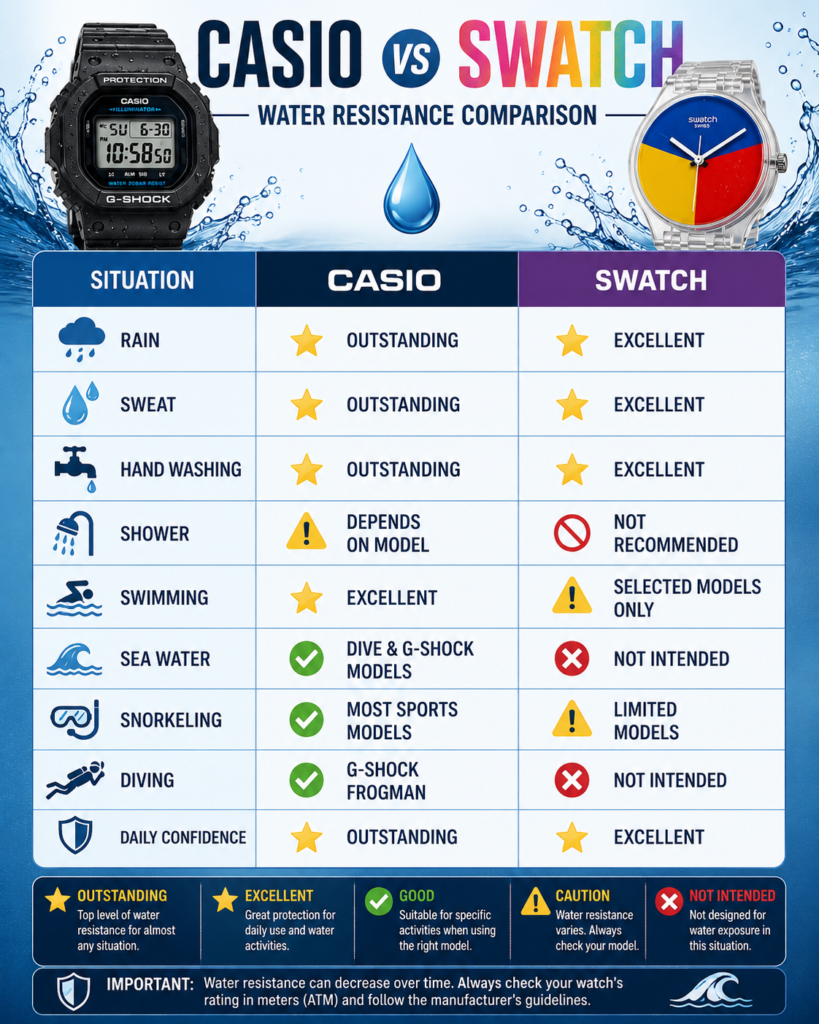
Water resistance follows the same pattern. Both brands handle rain, sweat, and hand-washing without issue. Push further, though, and the gap widens — Casio has dedicated dive and G-Shock Frogman models rated for serious water use, while most Swatch watches are explicitly not meant for swimming or anything beyond light splashes.
Price and where the value actually sits
Both brands sit in similar entry-level price territory, but the money buys different things. Swatch charges a bit of a premium for design and genuine Swiss manufacturing. Casio tends to pack in more features and functionality for the same dollar, which is exactly why it usually wins the straightforward “value for money” argument — more tech, more durability, more watch for the price, if that’s what you’re optimizing for. Swatch’s value proposition is different: you’re paying for originality and fashion appeal, wrapped in a Swiss-made label at a price point that’s genuinely hard to find elsewhere.
A few specific matchups people ask about
Put a G-Shock against a Swatch Big Bold and it’s really a durability watch against a fashion watch — no contest if toughness is what you care about. Casio’s vintage digital line against Swatch Originals is a much closer call, since both have become icons in their own right; that one really does come down to taste. Casio Edifice against Swatch Irony follows the bigger pattern too — precision and tech-forward styling on one side, casual Swiss design on the other.
Who actually fits each brand
Casio makes sense if durability is non-negotiable, you want digital features, you spend real time outdoors, or you just want a watch you never have to think about maintaining. Swatch makes more sense if you love colorful or artistic designs, want an affordable way into “Swiss-made,” prefer something light on the wrist, or genuinely enjoy collecting limited editions as much as wearing the watch itself.
Bottom line
If you’re buying one watch to wear every single day and want it to disappear into the background of your life, Casio is the easier recommendation. Durability and tech both point that way, and so does the value math. If you’re after a second watch that adds some personality and color to your collection, or you specifically want an affordable entry into Swiss watchmaking, Swatch earns its place for a simpler reason: it’s just genuinely fun to wear.
Quick questions
Is Swatch actually Swiss-made? Yes — genuinely manufactured in Switzerland and compliant with the Swiss Made labeling requirements.
Is Swatch owned by Omega? No, though they’re both part of the same parent company. Swatch and Omega operate as separate brands under the Swatch Group.
Does Swatch make automatic watches? Yes, through the Sistem51 line — a fully automatic movement assembled almost entirely by machine, which is unusual for a brand this affordable.