- Casio W217 vs W218: Which Budget Digital Watch Should You Buy?
- What you’re actually getting for the money
- The part nobody wants to hear
- Design and first impressions
- Living with each one day to day
- Reading the display and using the backlight
- Water resistance and everyday toughness
- Buttons and everyday operation
- Who each one actually fits
- Price and value
- Final thoughts
- A few common questions
- Overall Winner: Casio W218H 🏆
- Author
Casio W217 vs W218: Which Budget Digital Watch Should You Buy?
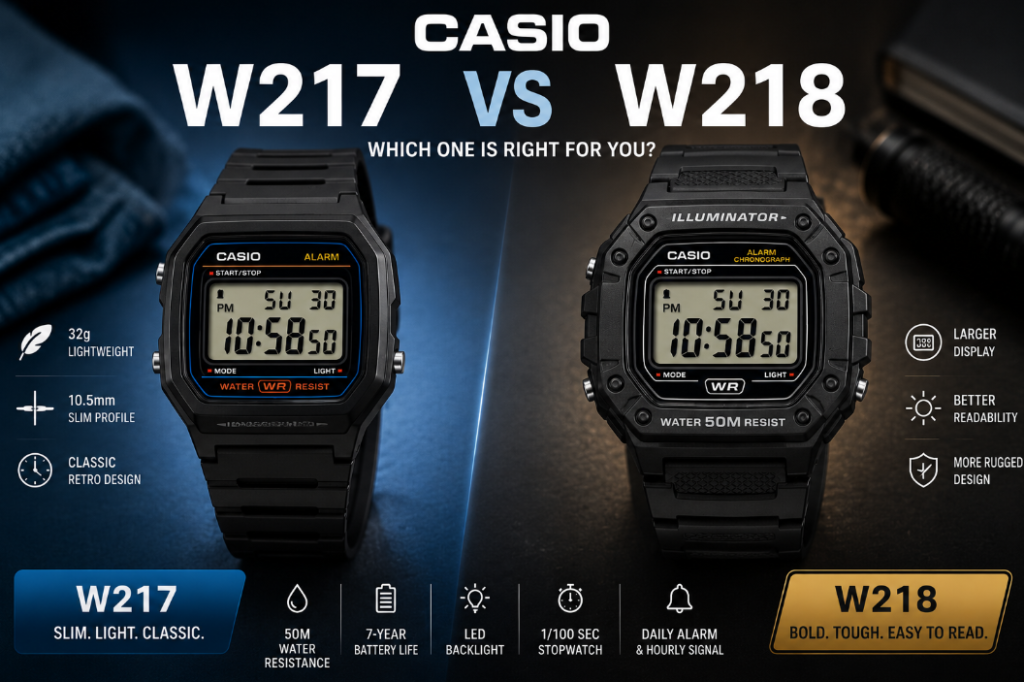
If you’ve spent any time browsing budget Casio digitals, you’ve probably run into both of these without realizing how close they actually are underneath. Same battery, same water resistance rating, same basic Casio module doing the same basic Casio things. On paper it barely reads like a comparison at all. Put them on your wrist for a week each, though, and you start noticing just how different two watches built from nearly identical guts can feel.
What you’re actually getting for the money
| Casio W217H | Casio W218H | |
|---|---|---|
| Case size | 43.1 × 41.2 mm | 44.4 × 43.2 mm |
| Thickness | 10.5 mm | 10.8 mm |
| Weight | 32 g | 37 g |
| Water resistance | 50m | 50m |
| Battery | CR2016, ~7 years | CR2016, ~7 years |
| Backlight | Single LED | Single LED |
| Crystal | Acrylic | Acrylic |
The spec sheet is telling you something important here: these two aren’t really competing on features. They’re competing on how they feel to actually wear.
The part nobody wants to hear
A lot of people spend way more time agonizing over this decision than the actual difference deserves. Strip away the marketing and the module inside both watches is essentially the same. What changes is the case around it. The W217 wraps that module in something that looks and wears like a modern take on a classic Casio digital. The W218 wraps the same guts in something closer to a compact G-Shock, minus the actual shock rating. If you were hoping for one watch to do meaningfully more than the other, that’s not really what’s on offer. This is a choice about which one you’ll enjoy wearing.
Design and first impressions
The W217 sticks close to the classic Casio formula — a slim, rounded case with compact proportions that reads as retro the moment you glance at it. It doesn’t announce itself. Someone would have to actually look at your wrist to notice you’re wearing anything at all.
The W218 goes a different direction. The bezel’s larger, the display’s bigger, and the whole case carries more visual weight and a sportier, more rugged-looking profile. Stand next to someone wearing one and it’s the watch your eye lands on first, purely because it takes up more visual real estate.
Neither approach is objectively better here — it really is a matter of what you want people (including future-you glancing down at your wrist) to notice.
Living with each one day to day
The W217 is genuinely one of the more comfortable digital Casios out there. Lower weight and a slimmer profile combine into a case shape that just melts into the wrist after the first day or two. It sits well under a shirt sleeve without any bulk fighting back, which matters more than people expect once they’ve actually tried wearing a chunkier watch to work.
The W218 isn’t uncomfortable by any stretch, but you do notice it more throughout the day. The extra few grams and slightly thicker case give it more of a physical presence on your wrist — not heavy exactly, just there in a way the W217 mostly isn’t. Some people like that presence. Runners and hikers in particular seem to appreciate a watch that feels solidly attached rather than one they occasionally forget they’re wearing.
Reading the display and using the backlight
This is where the case-size difference actually pays off in something concrete. The W218’s larger case makes room for bigger digits and noticeably better contrast, which shows up most clearly outdoors or mid-workout when you’re glancing at your wrist quickly rather than studying it. The W217’s display is perfectly readable in normal conditions, just a bit more compact — fine for checking the time at a desk, less ideal squinting at it on a bike.
Both use the same basic single-LED backlight, and neither is going to wow anyone used to a modern smartwatch’s full-panel light. The W218’s bigger screen does make that same weak LED feel like it’s covering more useful ground, simply because there’s more surface for the light to land on.
Water resistance and everyday toughness
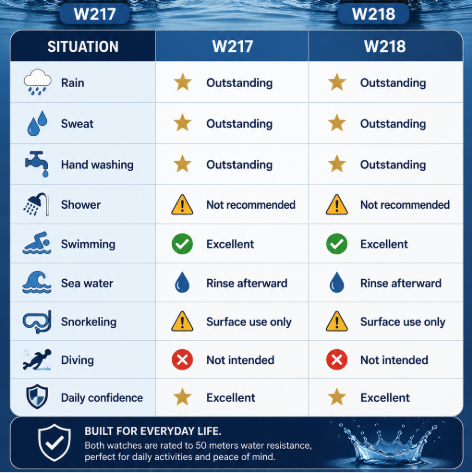
Both watches carry a 50-meter rating. Rain and sweat are comfortably covered, hand-washing too, and so is a swim in the pool. Neither one is meant for diving or serious snorkeling, and a hot shower is still worth avoiding out of habit more than strict necessity. In practical terms, day-to-day water confidence is a dead heat between them.
Durability tells a similar story. Neither watch is a G-Shock, and neither should be treated like one. But both are surprisingly capable of absorbing normal life — gym sessions, gardening, travel, the general wear and tear that comes with actually wearing a watch day to day. The W218’s chunkier case does inspire a bit more confidence here, mostly because it simply looks like it can take more of a knock, even if the underlying construction isn’t dramatically tougher.
Buttons and everyday operation
The W218’s buttons are noticeably larger, and it shows the moment you try to start the stopwatch or set the alarm with gloves on, or just with bigger fingers in general. The W217’s buttons work fine under normal conditions, but they’re a touch fiddlier if your hands aren’t especially small or precise.
Who each one actually fits
Smaller wrists, a preference for lightweight watches, long sleeves worn often — all of that leans toward the W217. It’s the choice for someone who wants a digital watch that mostly disappears until they need it. The W218 pulls the opposite crowd. Bigger displays, real time spent outdoors, a sportier look on the wrist — that’s the draw, and it tends to suit medium-to-large wrists best.
Price and value
Both watches sit firmly in budget territory, and the price gap between them tends to be small enough that it rarely decides anything on its own. You’re really paying for the case size and styling difference more than any meaningful jump in capability, which makes this one of the more genuinely personal-preference decisions in Casio’s cheap digital lineup.
Final thoughts
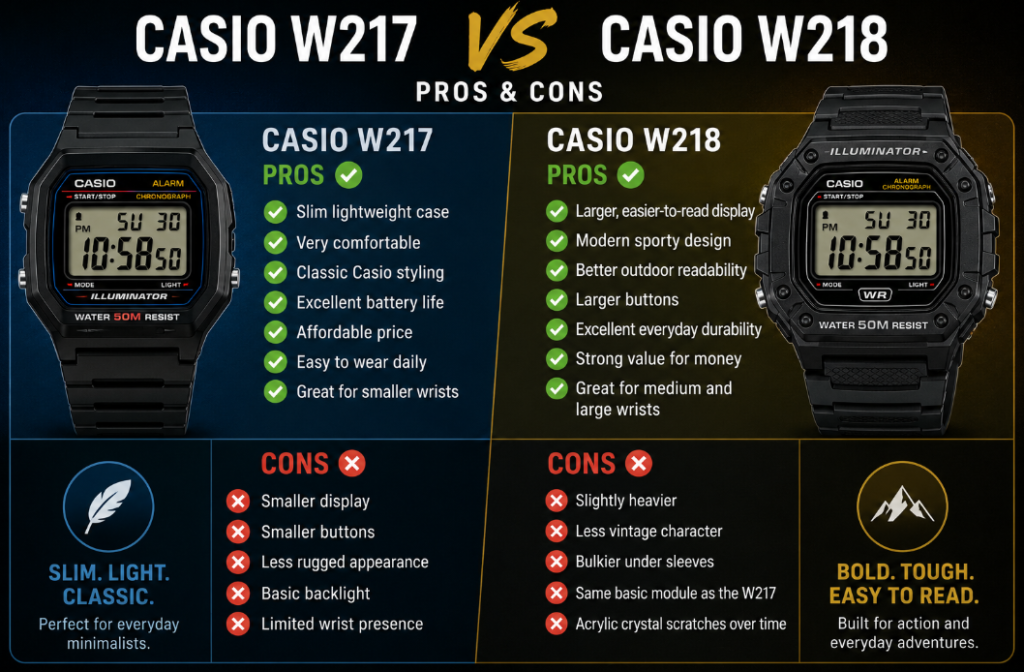
Neither watch is trying to be more than it is, and that’s honestly part of the appeal of both. The W217 stays close to the classic Casio digital formula — light, understated, easy to forget you’re wearing. The W218 takes the same core idea and scales it up into something bolder and a bit more outdoor-ready without losing the affordability that makes both of these worth considering in the first place.
If you’re not sure which way to go, the W218 is the safer general recommendation simply because the bigger display and buttons make it more forgiving in more situations. But if comfort and a classic look matter more to you than raw readability, the W217 remains one of the better budget digital Casios you can buy.
A few common questions
Is there a real functional difference between the W217 and W218? Not much of one. The battery and water resistance are essentially identical, and the core feature set matches too — the difference lives almost entirely in case size and how each one wears.
Which one’s easier to read outdoors? The W218, thanks to its bigger digits and slightly better contrast in bright light.
Is either one tough enough for regular gym or outdoor use? Yes, both hold up fine for normal daily abuse, though neither is built to G-Shock standards of toughness.
Which is better for a small wrist? The W217, by a comfortable margin — it’s smaller and lighter, and it sits noticeably flatter against the skin.
Do they use the same battery? Yes, both run on a CR2016 rated for roughly seven years under normal use.