Ask ten people which cheap Casio to buy and the F91W comes up almost every time, mostly on reputation alone. It’s the watch that’s been on wrists in every decade since the ’90s, the one people recognize even if they can’t name the model. The W217H barely registers by comparison, which is honestly a little unfair, because once you actually wear both for a week, the story gets more complicated than “buy the famous one.”
My honest take, upfront
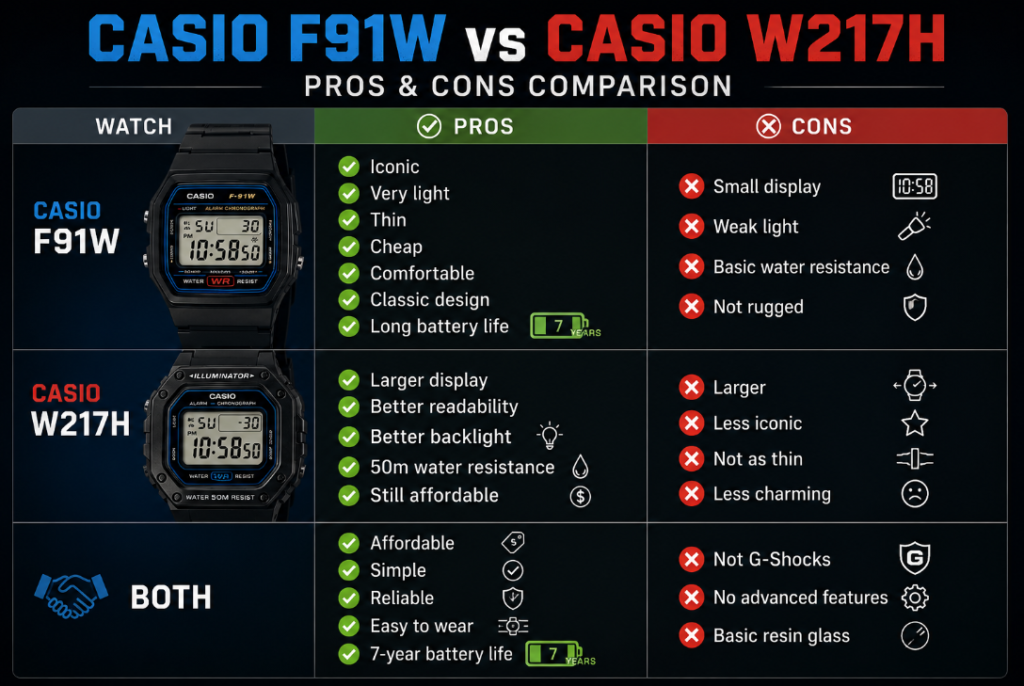
The F91W has more charm than any watch this cheap has any right to. The W217H, though, is just easier to live with day to day — bigger numbers, better light, a bit more confidence around water. Neither answer is wrong. It really depends on whether you’re buying a piece of Casio history or a watch you’ll actually squint at less.
What’s actually different on paper
| Casio F91W | Casio W217H | |
|---|---|---|
| Case size | 38.2 × 35.2 × 8.5 mm | 43.1 × 41.2 × 10.5 mm |
| Weight | 21 g | 32 g |
| Water resistance | Water Resistant (basic) | 50m |
| Battery | CR2016, ~7 years | CR2016, ~7 years |
| LED backlight | Weak, uneven | Noticeably better |
| Display | Small, cramped | Larger, more open |
Why the F91W still has a following
Small black case, that blue outline, the red WR mark, yellow text — anyone who grew up around Casios recognizes it instantly. It’s not trying to look expensive, and that’s kind of the point. At 21 grams and under 9mm thick, it disappears on the wrist in a way almost nothing else does. If you have small wrists, hate feeling a watch at all, or just want the object that started this whole cheap-Casio obsession, there’s a real case for buying it and nothing else.
Where the W217H pulls ahead
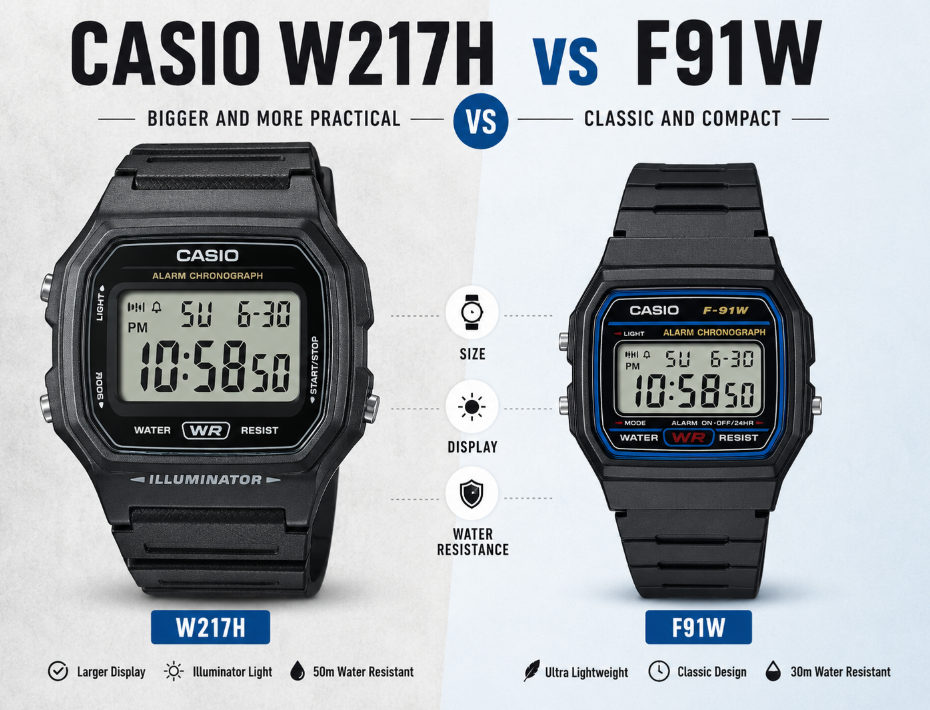
Put the two side by side and the display gap is obvious immediately. The F91W’s tiny digits work fine in good light, but they’re not generous, and the weak backlight doesn’t do you many favors after dark. The W217H’s bigger case buys you a genuinely larger display — the kind of thing you don’t think about until you’ve spent a week glancing at the F91W and having to actually focus for a second longer than you should need to.
Water resistance tells a similar story. The F91W is only rated “Water Resistant,” which in practice means rain and hand-washing and not much more. The W217H’s 50m rating won’t turn it into a dive watch, but it buys real peace of mind for the stuff that happens in normal life — dishes, a sudden downpour, forgetting to take it off before a shower.
Neither of these is a tool watch in any serious sense. Both are basic resin Casios that hold up fine under normal wear and fall apart under anything genuinely rough. The W217H just feels a touch more substantial simply by being bigger, though “substantial” for a watch this cheap is a relative term..
Display and Readability
This is where the W217H wins clearly.
The biggest practical weakness of the F91W is the small display. It is readable, but it is not generous. The digits are small, the screen is compact and the weak light does not help much at night.
The W217H has larger time digits and a bigger display. That makes it much easier to glance at during the day, while walking, working, driving, exercising or checking time quickly.
| Display factor | Casio F91W | Casio W217H |
|---|---|---|
| Digit size | Small | Larger |
| Quick glance readability | Acceptable | Better |
| Best for older eyes | Not ideal | Better |
| Best for night reading | Weak | Better |
| Display layout | Classic but cramped | More open |
| Practical usability | Good | Better |
This is the main reason I think the W217H is the better daily watch for most people. You do not need to admire the watch every time. Sometimes you just need to read the time quickly.
Backlight
The F91W backlight is famous, but not because it is good. It is weak and uneven. It works, but it feels old and basic.
The W217H has a better LED backlight. It is not a premium smartwatch-style display, but it is much more useful in real life.
| Backlight factor | Casio F91W | Casio W217H |
|---|---|---|
| Brightness | Weak | Better |
| Display coverage | Uneven | Better |
| Night readability | Basic | More practical |
| Bedside use | Not great | Better |
| Main criticism | Weak light | Less iconic design |
If you often check the time at night, the W217H is the easier watch to live with. The F91W light is charming only if you like old-school limitations.
Water Resistance
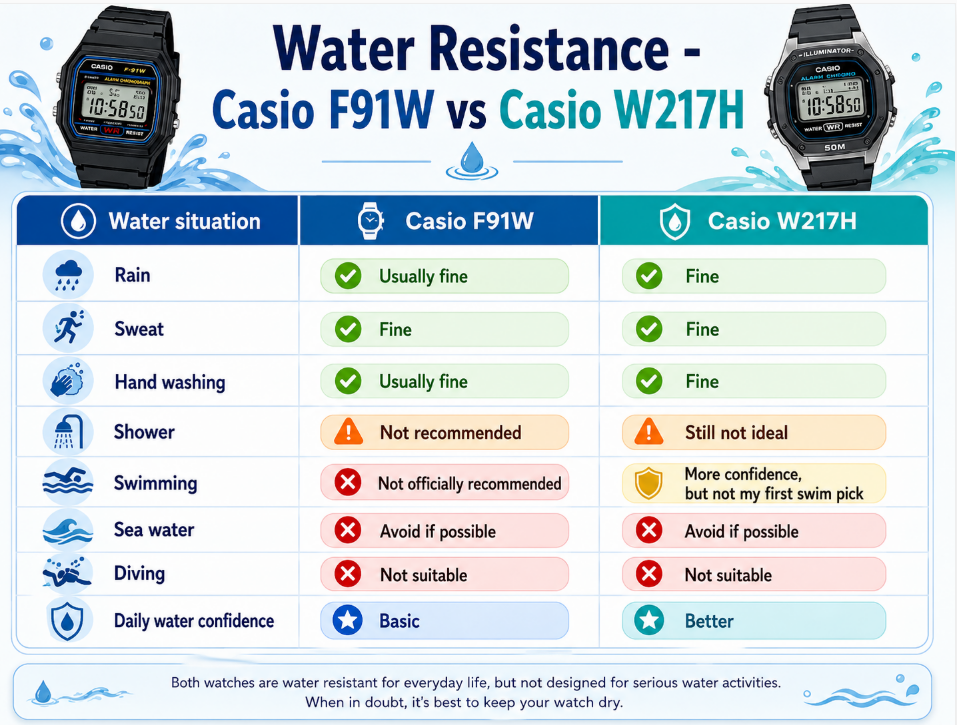
The W217H has a real practical advantage here. It offers 50m water resistance, while the F91W is listed only as Water Resistant.
In normal language, both can handle everyday splashes, rain and hand washing. But the W217H gives more confidence for daily water exposure.
Who’s actually buying each one
People choosing the F91W are usually chasing the history, the tiny footprint, or both — it’s a strong pick if your wrist is on the small side or you just want to feel that specific bit of Casio nostalgia every time you check the time. The W217H crowd tends to care a lot less about the legend. What they’re after is not having to think about the watch at all: bigger numbers, a backlight that actually helps, enough water resistance to stop worrying about the sink.
A few other cheap Casios worth a look
The F105W gives you F91W-style proportions with a noticeably better backlight. The W-800H goes further in the practical direction with a bigger display and genuinely useful daily features. If durability is what you’re actually after, skip both of these and look at a G-Shock DW5600 instead — different category of watch entirely.
Quick questions people ask
Is the W217H just a bigger F91W? Close, but not quite — the case and display are bigger, and the water resistance jumps from basic Water Resistant to a real 50m rating.
Which one’s better for small wrists? The F91W, by a clear margin. It’s smaller and thinner, and the weight difference is noticeable the moment you put both on.
Is the W217H a G-Shock? No — it’s a standard resin digital Casio, same family as the F91W, just built around a bigger case and better readability.