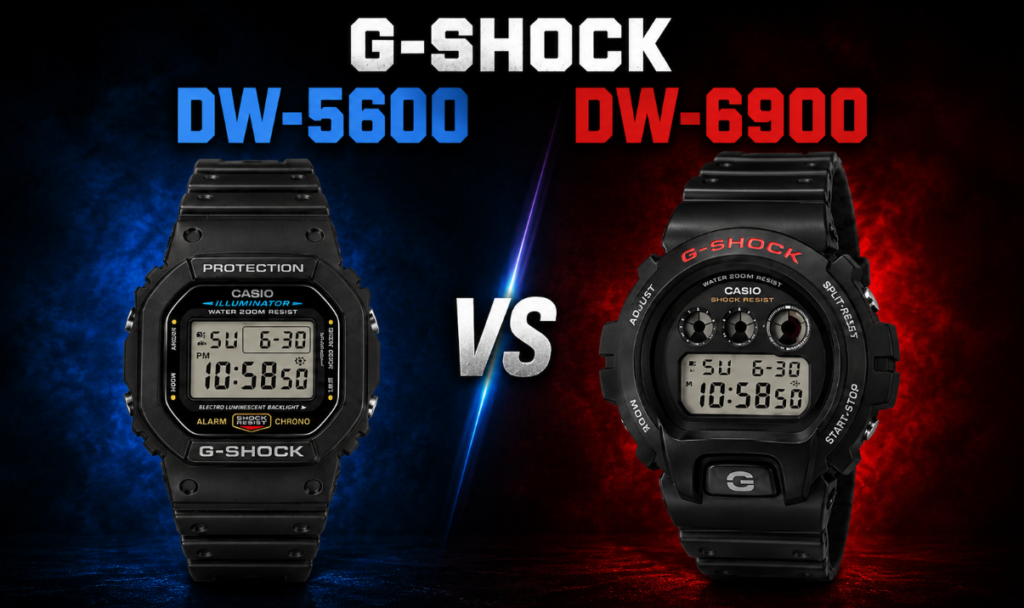
- dw 5600 vs dw 6900 v2 · MD
- G-Shock DW-5600 vs DW-6900: Which Classic Actually Fits You
- At a Glance
- Two Different Ideas of a G-Shock
- Wearing One vs the Other
- What Each Watch Actually Does
- Reading the Display
- The Light Button
- Water Resistance
- Battery
- Long-Term Durability
- Price
- Pros and Cons
- Making the Call
- A Few Upgrades Worth Knowing
- Author
dw 5600 vs dw 6900 v2 · MD
G-Shock DW-5600 vs DW-6900: Which Classic Actually Fits You
Long-time G-Shock owners tend to name the same two watches when the brand’s history comes up. The DW-5600 traces straight back to the original 1983 G-Shock. The DW-6900 is the round-faced watch that ended up on military wrists, on skateboards, and in a few hundred streetwear collabs since.
At a Glance
| DW-5600E | DW-6900 | |
|---|---|---|
| Case size | 48.9 x 42.8 x 13.4mm | 53.2 x 50 x 18.7mm |
| Weight | 53g | 67g |
| Water resistance | 200m | 200m |
| Battery life | ~2 years | ~2 years |
| Display | Rectangular digital | Round digital, three-eye |
| Backlight button | Side | Front |
Two Different Ideas of a G-Shock
The 5600 is a tool. Square shape, clean layout, nothing extra bolted on. Most modern square G-Shocks trace their DNA back to this one design.
The 6900 is a statement. Big round face, three-eye layout, proportions built to be noticed. Plenty of collectors rank it among the most recognizable G-Shock shapes ever made.
I’ve had customers bring in both models for battery swaps over the years, and the pattern is always the same. Someone with a beat-up 5600 usually shrugs and says they forgot they were even wearing it. Nobody says that about a 6900.
Wearing One vs the Other
The 5600 sits low and light at 53 grams. After the first hour it stops registering.
The 6900 weighs 67 grams and stands noticeably taller off the wrist. That extra height shows up fast on a smaller wrist, and past a certain point it starts catching on cuffs and sleeves in a way the 5600 never does.
What Each Watch Actually Does
Stopwatch, countdown timer, multi-alarm, hourly chime, auto calendar, EL backlight, shock resistance, 200m water resistance. Both watches carry the identical list. Neither has world time, Bluetooth, or solar power in its stock form.
The square’s larger screen makes reading a running timer easier at a glance. The round’s front-mounted light button wins in the dark, no contest.
Reading the Display
The square pulls ahead here without much argument. Bigger digits, a cleaner layout, faster to read mid-run or mid-drive. The round watch is readable too, just not as efficiently, because some of that screen real estate went toward the three-eye look instead of raw legibility. I’ve had a few customers switch back to a 5600 specifically over this, usually after squinting at a 6900 in bright sun one too many times.
The Light Button
Casio built one of its best light buttons ever into the 6900’s front bezel. Big target, easy to find blind, easy to hit with gloves on. That’s exactly why it caught on with military users in the first place. The 5600’s side button gets the job done, just not with the same confidence.
Water Resistance
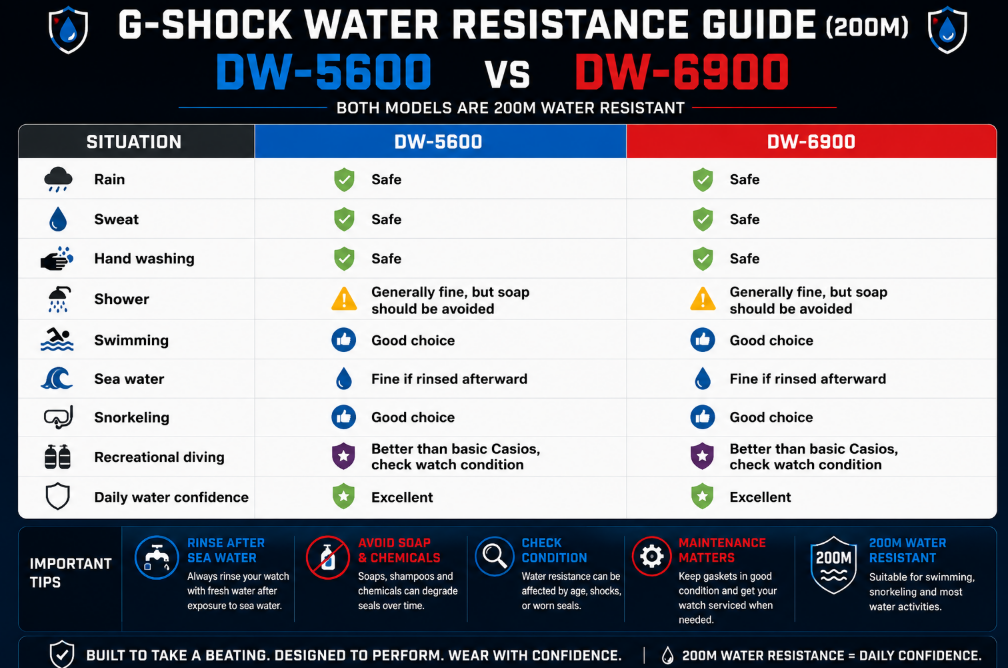
Both carry real G-Shock-grade 200m ratings. An old gasket, an opened case back, or a damaged button chips away at that number on either watch equally.
Battery
About two years on both. Go easy on the backlight and either one will likely outlast that estimate.
Long-Term Durability
Decades of abuse back up both designs. The 5600’s smaller footprint just has fewer edges to catch on things day to day. The 6900’s thicker bezel does an unusually good job shielding its buttons from impact. I’ve serviced both off the wrists of mechanics and construction crews who wore them daily for years without a single crack.
Price
The 5600 usually runs a bit cheaper for nearly identical core function. Most of what you’re paying extra for on a 6900 is the shape and the collector demand around it, not anything mechanical underneath.
Pros and Cons
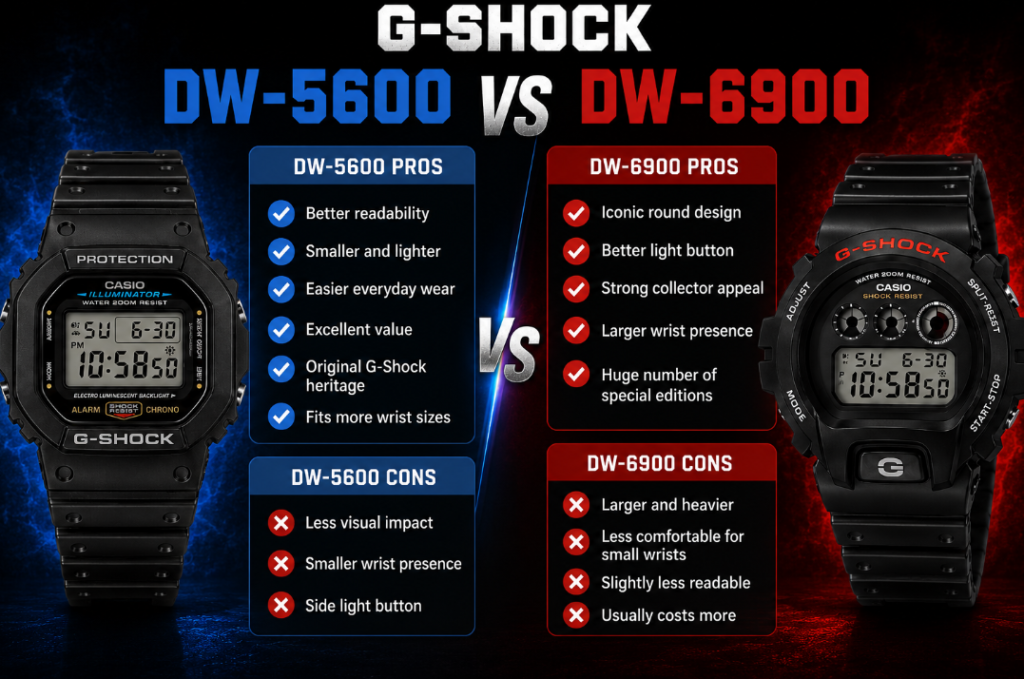
DW-5600
- Easiest of the two to read at a glance
- Smaller, lighter, disappears on the wrist
- Usually the cheaper option
- Fits a wider range of wrist sizes
- Less visual presence
- Side-mounted light button
DW-6900
- Iconic round shape with real collector demand
- The better light button, by a clear margin
- Bigger wrist presence
- Endless special editions to chase
- Larger and heavier
- Costs more, slightly harder to read at a glance
Making the Call
A first G-Shock, a smaller wrist, or a daily beater meant to be forgotten about: that’s the 5600’s territory. The shape itself, the collector culture built around it, or a wrist that can carry the extra bulk without complaint: that’s what the 6900 is actually selling.
Whether the 5600 genuinely counts as better depends on what you’re weighing it against. It reads easier, wears lighter, and usually costs less, which covers most people’s daily needs. None of that makes the 6900 a lesser watch. Its whole appeal sits somewhere else, in the shape and the history riding along with it. Both are proven daily wearers, and I’d trust either one on a wrist that actually uses it.
A Few Upgrades Worth Knowing
The GW-M5610U keeps the 5600’s shape and adds Tough Solar plus Multi-Band 6, probably the smartest single upgrade from either watch. The DW-5600BB and DW-6900BB deliver the same two shapes in stealth black. The GA-2100 brings an analog-digital take on the square design. The GA-B2100 adds Bluetooth and solar charging to the CasiOak line, for anyone wanting the square’s aesthetic with modern connectivity thrown in.