Start inside the watch: the engineering choices behind Grand Seiko and Tudor shape accuracy, maintenance, and daily convenience.
- Why Grand Seiko and Tudor Divide Buyers
- Where Capability Matters More Than Prestige: Tudor
- What Owners Tend to Notice Later: Tudor
- Grand Seiko Pros ✅
- Grand Seiko Cons ❌
- Tudor Pros ✅
- Tudor Cons ❌
- The Choice I Would Test First: Grand Seiko vs Tudor
- The History Behind the Buying Decision: Tudor
- Grand Seiko Snowflake vs Tudor Black Bay 58
- Grand Seiko White Birch vs Tudor Pelagos 39
- Grand Seiko Shunbun vs Tudor Black Bay Chrono
- Is Moving From Grand Seiko to Tudor Actually an Upgrade?
- Overall Winner: Grand Seiko 🏆
- Author
Why Grand Seiko and Tudor Divide Buyers
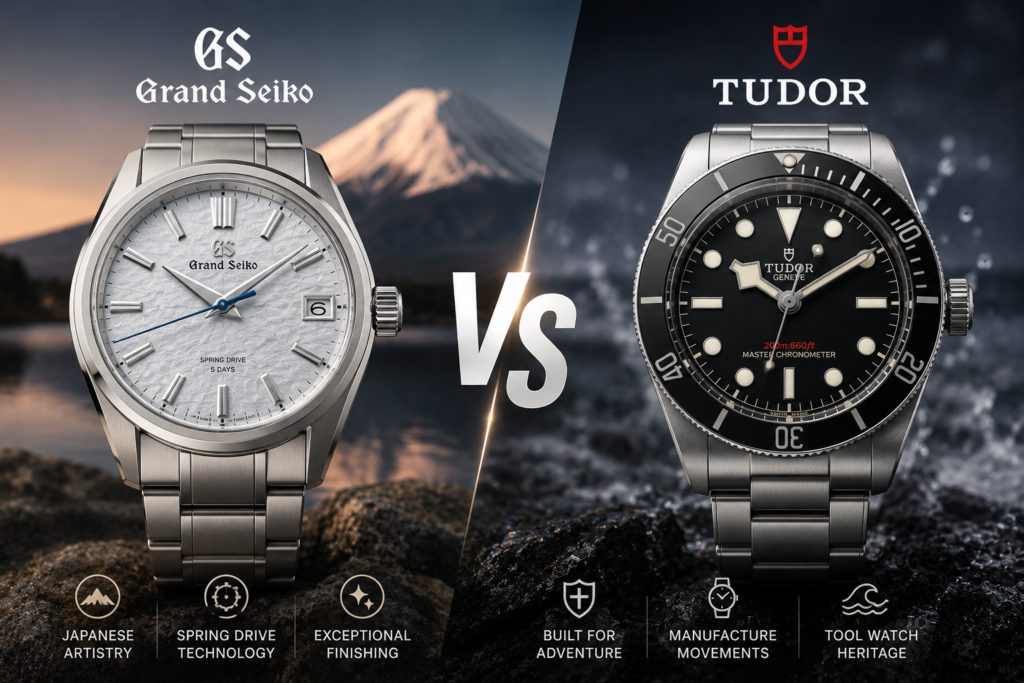
This category often comes down to personal preference. Tudor specializes in vintage-inspired sports watches. The Black Bay 58 has become one of the most beloved designs of the last decade. The Pelagos remains a benchmark tool watch.
Grand Seiko takes a different approach. Cases feature razor-sharp Zaratsu polishing. Dials frequently draw inspiration from nature:
- Snow
- Birch forests
- Cherry blossoms
- Mountain landscapes
- Ice formations
Few brands create dials at this level. Many collectors consider Grand Seiko dials among the best in the entire industry.
Tudor quality is excellent. Bracelets are superb.
Clasps are among the best available below Rolex. Cases feel substantial and robust.
Grand Seiko’s finishing, however, operates on another level. The sharpness of the hands.
The polishing of the indices. The precision of the case surfaces.
The consistency of the finishing. Everything feels obsessively executed.
Collectors frequently compare Grand Seiko finishing to Rolex, Omega, and even brands above them. Very few compare Tudor finishing at that level.
Where Capability Matters More Than Prestige: Tudor
Both brands produce watches you can trust virtually anywhere, though Tudor’s professional diving heritage provides a slight advantage.
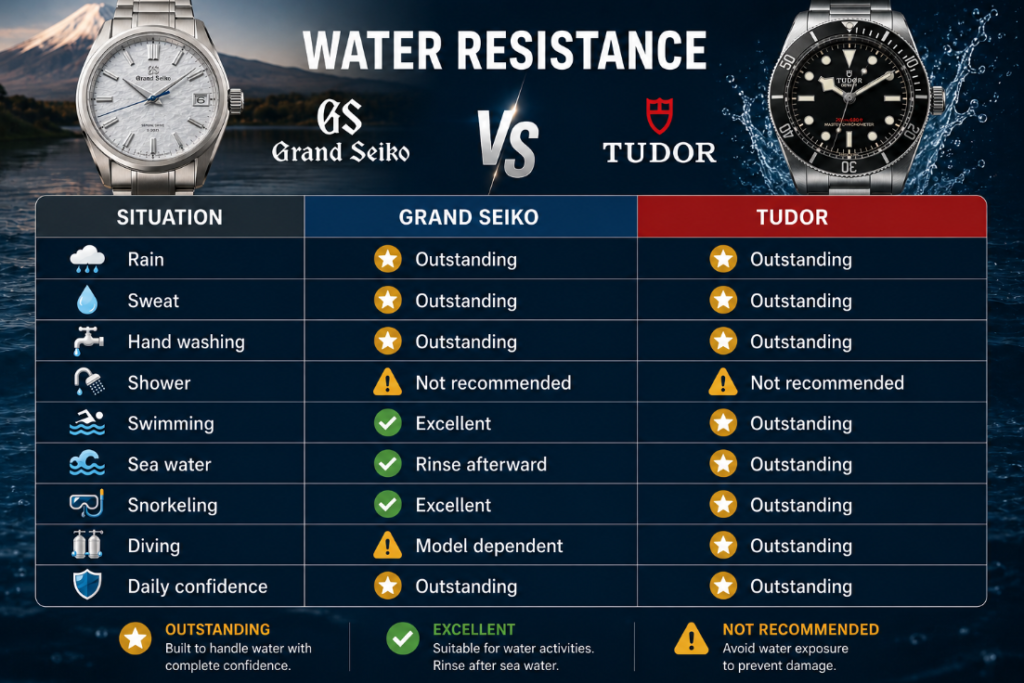
The Pelagos remains one of the best modern dive watches available at any price.
This is where the gap becomes significant. Tudor manufacture movements are outstanding.
The MT5402 and MT5602 families offer:
- COSC certification
- Excellent reliability
- Strong power reserves
- Proven durability
For most owners, they are nearly perfect. Grand Seiko responds with:
- High Beat movements
- Spring Drive movements
- Advanced quartz calibers
Spring Drive alone changes the conversation. The smooth glide of the seconds hand remains one of the most impressive sights in modern watchmaking. No Swiss brand has created anything quite like it.
What Owners Tend to Notice Later: Tudor
This comparison exposes one of the biggest disconnects in modern watch collecting. Grand Seiko makes objectively better watches than many Swiss brands that receive more attention. Tudor is one of those brands. That doesn’t mean Tudor is overrated.
It isn’t. Tudor produces some of the best luxury sports watches on the market. The uncomfortable truth for Tudor owners is that Grand Seiko often offers superior finishing, more advanced movement technology, and more hand craftsmanship. The uncomfortable truth for Grand Seiko owners is that most buyers still prefer Tudor.
Why? Because people understand Tudor. People understand Rolex. People understand Swiss luxury.
Grand Seiko often requires explanation. Tudor rarely does. That’s why Tudor frequently sells faster despite Grand Seiko’s technical advantages. Across Reddit, WatchUSeek, WatchCrunch, and enthusiast forums, both brands are highly respected.
Tudor receives praise for:
- Black Bay 58
- Pelagos
- Manufacture movements
- Rolex-level quality
Grand Seiko receives praise for: The most common criticism of Tudor is that many models live in Rolex’s shadow.
The most common criticism of Grand Seiko is bracelet quality and weaker resale value. A surprisingly common opinion among experienced collectors is:
“Grand Seiko is the watch I bought after I stopped caring what other people think.” That sentiment appears repeatedly throughout enthusiast communities.
Grand Seiko Pros ✅
- ✅ Exceptional dial finishing
- ✅ Spring Drive technology
- ✅ Outstanding craftsmanship
- ✅ High Beat movement options
- ✅ Unique Japanese design philosophy
- ✅ Incredible attention to detail
- ✅ Strong enthusiast respect
Grand Seiko Cons ❌
- ❌ Weaker resale value
- ❌ Bracelets trail competitors
- ❌ Limited mainstream recognition
- ❌ Larger cases on some models
- ❌ Requires enthusiast appreciation
Tudor Pros ✅
- ✅ Rolex Group credibility
- ✅ Excellent manufacture movements
- ✅ Outstanding sports watches
- ✅ Strong resale value
- ✅ Excellent bracelets and clasps
- ✅ Strong collector appeal
- ✅ Modern tool-watch reputation
Tudor Cons ❌
- ❌ Less movement innovation
- ❌ Some models are thick
- ❌ Constant Rolex comparisons
- ❌ More conservative designs
| Feature | Grand Seiko | Tudor |
|---|---|---|
| Founded | 1960 | 1926 |
| Country | Japan | Switzerland |
| Parent Company | Seiko Group | Rolex Group |
| Famous Models | Snowflake, Shunbun, White Birch | Black Bay, Pelagos |
| Main Strength | Finishing & Movements | Sports Watches |
| Signature Technology | Spring Drive | Manufacture Calibers |
| Collector Demand | Strong | Very Strong |
| Resale Value | Moderate | Strong |
| Luxury Prestige | Growing | Strong |
This is surprisingly close. A Black Bay 58 often costs less than many Grand Seiko models. However, Grand Seiko frequently delivers finishing and movement technology unavailable elsewhere.
Tudor provides incredible value in luxury sports watches. Grand Seiko provides incredible value in luxury watchmaking. Both overdeliver relative to their competitors.
The value simply comes from different places.
The Choice I Would Test First: Grand Seiko vs Tudor
If you’re looking for the better luxury sports watch brand, Tudor wins. If you’re looking for the better watchmaker, Grand Seiko wins. This is one of the most fascinating comparisons in modern watchmaking because both brands deliver exceptional value relative to their competition. Tudor offers Rolex-level quality at a fraction of Rolex prices.
Grand Seiko offers finishing and movement technology that often rivals or exceeds brands costing significantly more. The answer depends entirely on what you value. If you prioritize tool watches, ruggedness, and resale value, Tudor is hard to beat. If you care about craftsmanship, dial artistry, and horological innovation, Grand Seiko becomes one of the strongest arguments in luxury watchmaking.
The History Behind the Buying Decision: Tudor
Both brands have impressive stories. Tudor was created by Hans Wilsdorf as a more affordable alternative to Rolex. Over the decades it built a reputation for rugged military and diving watches. Modern Black Bay models draw heavily from that heritage.
Grand Seiko was created in 1960 with a simple goal: Build the finest watch possible. Not the most famous. Not the most expensive.
Simply the best. That philosophy still defines the brand today. While Tudor’s heritage is more recognizable among Western collectors, Grand Seiko’s mission remains one of the most compelling in watchmaking.
Grand Seiko Snowflake vs Tudor Black Bay 58
Verdict: Snowflake is the better watch. Black Bay 58 is the easier watch to own.
Grand Seiko White Birch vs Tudor Pelagos 39
Verdict: White Birch showcases horology. Pelagos showcases utility.
Grand Seiko Shunbun vs Tudor Black Bay Chrono
Verdict: Shunbun offers more artistry. Black Bay Chrono offers more mainstream appeal.
Few brands innovate like Grand Seiko. The company developed Spring Drive after decades of research. Its quartz movements are among the most accurate ever produced.
Its manufacturing techniques continue to push the industry forward. Tudor innovates carefully. The brand focuses on reliability rather than groundbreaking technology.
That approach works well. But innovation isn’t really Tudor’s game.
Is Moving From Grand Seiko to Tudor Actually an Upgrade?
Grand Seiko and Tudor represent two different philosophies of luxury watchmaking. Tudor focuses on robust sports watches. Grand Seiko focuses on craftsmanship and precision. If you’re buying a luxury watch to wear every day, beat up a little, swim with, and eventually resell, Tudor is arguably the smarter purchase.
If you’re buying a watch because you genuinely appreciate watchmaking, Grand Seiko becomes incredibly difficult to ignore. Objectively, Grand Seiko offers better finishing. Objectively, Grand Seiko offers more advanced movement technology. Objectively, Tudor offers stronger resale value and broader market appeal.
For the average luxury buyer, Tudor may be the easier recommendation. For the enthusiast who cares about horology itself, Grand Seiko wins.