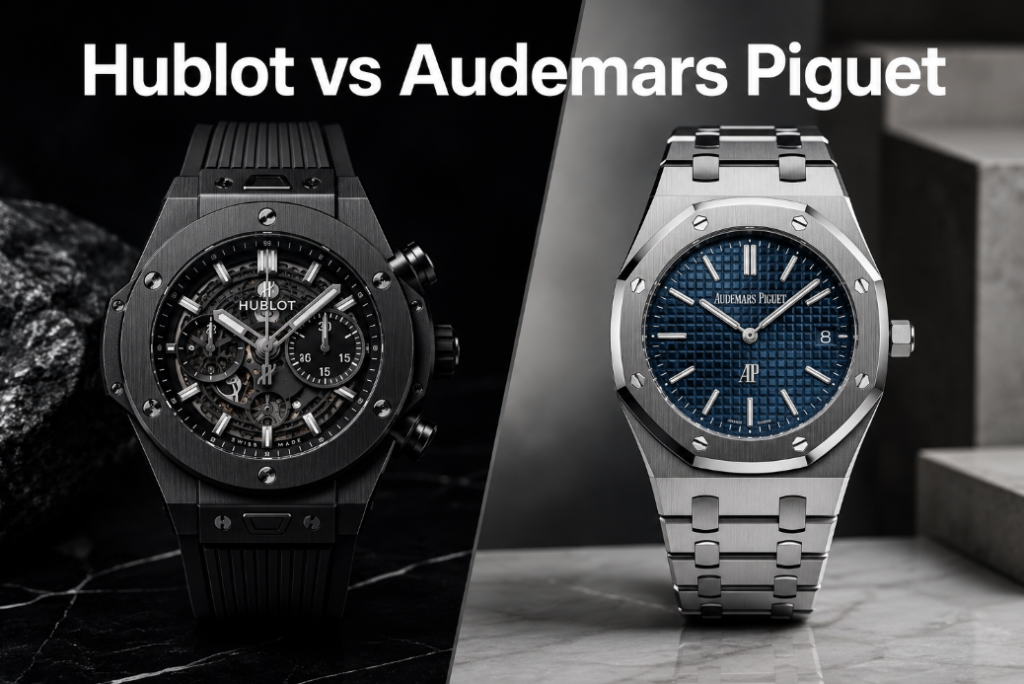
Hublot and Audemars Piguet reached today’s market from different periods and different ideas about what a watch should be.
Hublot and Audemars Piguet are two of the most recognizable names in modern luxury watchmaking, but they appeal to very different buyers.
Hublot is known for bold designs, innovative materials, and oversized sports watches that make a statement. Audemars Piguet, on the other hand, has built its reputation on exceptional craftsmanship, haute horlogerie movements, and one of the most influential watch designs ever created – the Royal Oak.
Although both brands operate in the luxury segment, they represent two very different philosophies. One focuses on innovation and modern styling, while the other emphasizes traditional Swiss watchmaking and timeless design.
If you’re deciding between Hublot and Audemars Piguet, here’s how they compare.
- Hublot vs Audemars Piguet: The Decision in One Useful Frame
- Ownership trade-offs: Hublot Pros ✅
- Hublot Cons ❌
- Ownership trade-offs: Audemars Piguet Pros ✅
- Audemars Piguet Cons ❌
- Who Should Shortlist Hublot—and Who Should Shortlist Audemars Piguet
- How the Past Shapes Today's Watches
- What Survives the First Impression: Audemars Piguet
- What Is Happening Under the Dial: Hublot
- A More Useful Way to Compare Them: Hublot
- Choosing Hublot Over Audemars Piguet: My Final Call
- Author
Hublot vs Audemars Piguet: The Decision in One Useful Frame
Many buyers compare these brands simply because they’re expensive. In reality, they occupy different positions within the luxury watch industry.
Hublot is primarily known for pushing boundaries in materials and contemporary design. Audemars Piguet is regarded as one of the “Holy Trinity” of Swiss watchmaking, alongside Patek Philippe and Vacheron Constantin. That status reflects more than price – it represents decades of technical innovation, exceptional finishing, and influence on the industry.
If you’re looking for traditional haute horlogerie, the comparison isn’t especially close.
Watch enthusiasts often describe the two brands very differently. One opinion appears repeatedly: “People buy Hublot because they want attention.”
Another common view is: “People buy Audemars Piguet because they appreciate watchmaking.” Collectors consistently praise Audemars Piguet for its finishing, movement quality, and historical significance.
Hublot receives admiration for its willingness to experiment with materials and bold designs, though it remains a more divisive brand among enthusiasts.
Ownership trade-offs: Hublot Pros ✅
- Innovative materials
- Bold modern styling
- Comfortable rubber straps
- Strong in-house Unico movement
- Excellent sports watch presence
- Distinctive identity
- Lower entry price than AP
Hublot Cons ❌
- Polarizing design
- Weaker resale value
- Some entry models use outsourced movements
- Less prestigious among collectors
- Depreciates more than AP
Ownership trade-offs: Audemars Piguet Pros ✅
- One of the Holy Trinity brands
- Exceptional finishing
- Outstanding in-house movements
- Iconic Royal Oak design
- Strong collector demand
- Excellent resale value
- Rich watchmaking heritage
Audemars Piguet Cons ❌
- Extremely expensive
- Limited availability
- High servicing costs
- Long waiting lists
- Many models are difficult to purchase at retail
| Feature | Hublot | Audemars Piguet |
|---|---|---|
| Founded | 1980 | 1875 |
| Country | Switzerland | Switzerland |
| Price Range | ~$6,000-$250,000+ | ~$25,000-$1M+ |
| Famous Model | Big Bang | Royal Oak |
| Movements | In-house & outsourced | Primarily in-house |
| Case Materials | Steel, Ceramic, Carbon, Titanium, Sapphire, Gold | Steel, Gold, Titanium, Ceramic, Platinum |
| Warranty | 2-5 Years | 5 Years |
Hublot generally offers a lower entry point into luxury watch ownership. Many Big Bang and Classic Fusion models cost significantly less than a Royal Oak. However, Audemars Piguet’s higher prices are largely driven by craftsmanship, demand, and limited production.
This category isn’t about affordability. It’s about what your money buys.
Hublot offers:
- modern materials
- bold styling
- unique aesthetics
Audemars Piguet offers:
- exceptional craftsmanship
- stronger heritage
- better movements
- superior finishing
- greater collectability
Who Should Shortlist Hublot—and Who Should Shortlist Audemars Piguet
If your priority is traditional watchmaking, movement quality, long-term value, and collector appeal, Audemars Piguet is the clear winner. Hublot remains an excellent choice for buyers who prefer bold contemporary designs and cutting-edge materials, but it cannot match Audemars Piguet’s heritage, finishing, or prestige among collectors.
Overall Winner: Audemars Piguet Best for Modern Design: Hublot
How the Past Shapes Today's Watches
Audemars Piguet has been producing fine mechanical watches since 1875. Its history includes:
- complicated perpetual calendars
- minute repeaters
- ultra-thin calibers
- the Royal Oak, one of the most influential watches ever made
Hublot, founded in 1980, is much younger. Its biggest achievement has been introducing the “Art of Fusion” philosophy by combining unconventional materials such as ceramic, carbon fiber, sapphire, and rubber. While Hublot deserves credit for innovation, Audemars Piguet has over a century more experience in high-end watchmaking.
The Big Bang embraces bold modern design, while the Royal Oak remains one of the most iconic luxury sports watches ever created. Verdict: Royal Oak.
The Classic Fusion is sleek and contemporary, but the Royal Oak offers superior finishing, movement quality, and long-term value. Verdict: Royal Oak.
Both feature sporty personalities, but the Offshore benefits from stronger heritage and broader collector appeal. Verdict: Royal Oak Offshore.
What Survives the First Impression: Audemars Piguet
This category depends heavily on personal taste. Hublot watches are:
- bold
- modern
- oversized
- aggressive
- highly recognizable
Audemars Piguet watches are: The Royal Oak’s integrated bracelet remains one of the most iconic designs ever created.
Hublot’s Big Bang is equally recognizable but intentionally more polarizing.
Despite their bold appearance, many Hublot watches wear comfortably thanks to lightweight materials and rubber straps. Audemars Piguet’s Royal Oak bracelet is widely considered one of the finest integrated bracelets ever produced.
It combines excellent articulation with exceptional finishing.
Hublot arguably leads the industry in experimental case materials. Examples include:
- transparent sapphire
- colored ceramic
- carbon fiber
- forged carbon
- Magic Gold
Audemars Piguet generally focuses on more traditional luxury materials while maintaining exceptional finishing standards. If cutting-edge materials are your priority, Hublot has the advantage.
Both brands produce exceptional watches. However, Audemars Piguet demonstrates a higher level of consistency in:
- case finishing
- bracelet construction
- dial detailing
- hand finishing
The difference becomes obvious under magnification.
What Is Happening Under the Dial: Hublot
This is where the gap becomes clear. Audemars Piguet manufactures some of Switzerland’s finest mechanical movements, featuring:
- exceptional decoration
- refined architecture
- slim profiles
- outstanding reliability
Hublot has significantly improved its in-house offerings with movements like the Unico chronograph, but many entry-level models still rely on modified third-party calibers. From a horological standpoint, Audemars Piguet remains in a different class.
Both brands offer excellent real-world accuracy. The difference is negligible in everyday use.
Neither brand competes on quartz-level precision; instead, both emphasize mechanical craftsmanship.
Verdict: Both brands provide sufficient water resistance for everyday wear, but neither should be viewed primarily as a professional dive watch manufacturer.
A More Useful Way to Compare Them: Hublot
This is Hublot’s strongest category. The brand pioneered the widespread use of:
- colored sapphire cases
- carbon composites
- Magic Gold
- ceramic technologies
- integrated rubber straps in luxury watches
Audemars Piguet also innovates, particularly in movement engineering, but Hublot has consistently pushed material science further. Hublot builds surprisingly robust luxury sports watches.
Rubber straps, ceramic cases, and modern construction make them well suited for active lifestyles. Audemars Piguet watches are also durable but are generally treated more carefully due to their value and highly refined finishing.
Choosing Hublot Over Audemars Piguet: My Final Call
Choose Hublot if you: Choose Audemars Piguet if you:
Hublot deserves more credit than it sometimes receives. Its innovations in materials and willingness to challenge traditional watch design have influenced the modern luxury watch industry. If you’re looking for a bold, contemporary sports watch with a distinctive personality, Hublot delivers something few brands can match. That said, when comparing overall watchmaking excellence, Audemars Piguet is the stronger brand. It offers superior movement finishing, deeper heritage, stronger collector demand, and one of the most influential watch designs ever created. The Royal Oak alone has shaped the luxury sports watch category for more than 50 years.
Overall Winner: Audemars Piguet Best for Innovation: Hublot
If your priority is making a bold design statement and enjoying cutting-edge materials, Hublot is an excellent choice. If you’re looking for one of the finest examples of traditional Swiss haute horlogerie with exceptional long-term appeal, Audemars Piguet remains the benchmark.