Start inside the watch: the engineering choices behind IWC and Jaeger-LeCoultre shape accuracy, maintenance, and daily convenience.
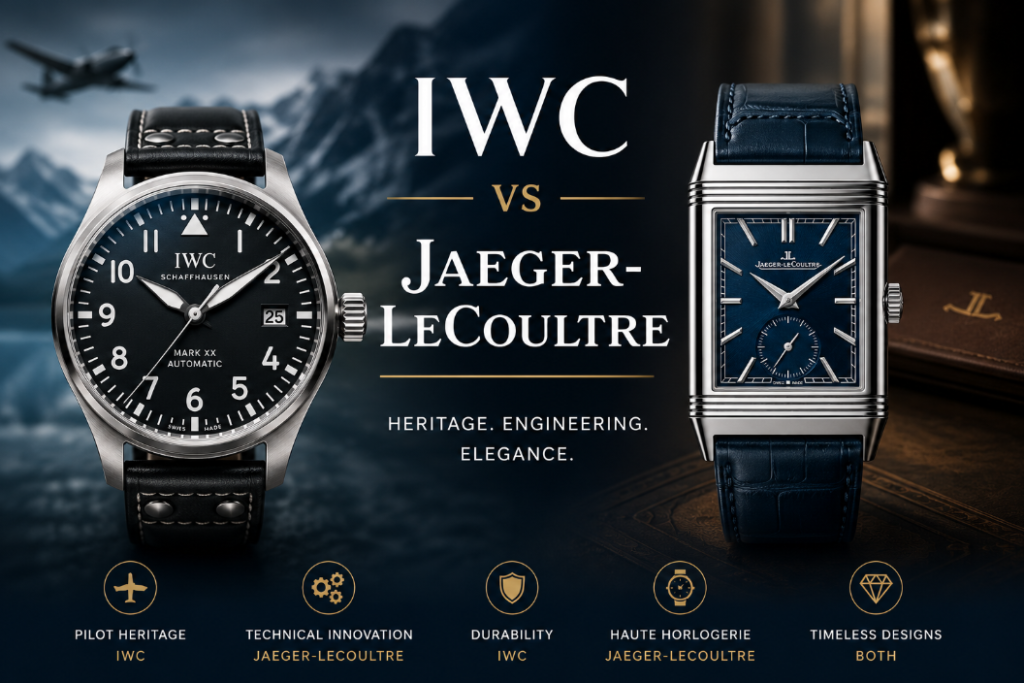
Choosing between IWC Schaffhausen and Jaeger-LeCoultre (JLC) isn’t easy because both brands sit among Switzerland’s finest watchmakers. However, they approach luxury watchmaking from completely different directions.
IWC has built its reputation on clean engineering, pilot watches, and understated luxury. Its watches are robust, practical, and designed to be worn every day.
Jaeger-LeCoultre, often called “the watchmaker’s watchmaker,” is famous for technical innovation, elegant dress watches, and some of the finest movements ever produced. Many of the world’s greatest brands, including Patek Philippe, Audemars Piguet, and Vacheron Constantin, have used Jaeger-LeCoultre movements throughout history.
Both brands have exceptional histories, but they appeal to different buyers.
If you’re trying to decide between IWC and Jaeger-LeCoultre, this guide compares their heritage, design, movements, finishing, durability, value, and collector appeal to help you make the right choice.
If you’re looking for the stronger everyday luxury watch, IWC is the better choice. Its Pilot, Ingenieur, and Aquatimer collections combine outstanding engineering with excellent durability and versatility. If your priority is traditional haute horlogerie, sophisticated complications, and exceptional movement craftsmanship, Jaeger-LeCoultre is on another level. For the average luxury watch buyer, IWC offers the more practical ownership experience.
For collectors and enthusiasts, Jaeger-LeCoultre offers greater horological depth. Overall Winner: Jaeger-LeCoultre
- What a Fair IWC vs Jaeger-LeCoultre Comparison Must Explain
- Ownership trade-offs: IWC
- What works in practice
- Where the compromise appears
- Ownership trade-offs: Jaeger-LeCoultre
- What works in practice
- Where the compromise appears
- IWC Portugieser vs JLC Master Control
- IWC Pilot Mark XX vs JLC Polaris Date
- IWC Ingenieur vs JLC Polaris
- Why Collectors Read These Names Differently
- The Dial and Case Details That Distinguish IWC From Jaeger-LeCoultre
- The Engineering Trade-off Between IWC and Jaeger-LeCoultre
- Where Value Stops Being About the Price Tag: Jaeger-LeCoultre
- A Detail Worth Separating From the Marketing: Jaeger-LeCoultre
- Choosing IWC Over Jaeger-LeCoultre: My Final Call
- Awards
- Author
What a Fair IWC vs Jaeger-LeCoultre Comparison Must Explain
People often compare IWC and Jaeger-LeCoultre because their prices overlap. In reality, they’re built around different philosophies.
IWC focuses on making luxury watches that can comfortably become daily wearers. Jaeger-LeCoultre focuses on demonstrating what traditional Swiss watchmaking can achieve.
That doesn’t mean IWC movements are inferior. It means the company prioritizes robustness and practicality over showcasing complicated mechanical artistry.
If you’re buying your first serious luxury watch, IWC is often the easier recommendation. If you’re building a collection, Jaeger-LeCoultre becomes much harder to ignore.
Among collectors, one opinion appears repeatedly: “IWC makes fantastic watches.” Another common statement is:
“Jaeger-LeCoultre makes watchmakers smile.” That summarizes the brands surprisingly well. IWC earns admiration through engineering.
Jaeger-LeCoultre earns admiration through horology.
Ownership trade-offs: IWC
What works in practice
- Outstanding pilot watches
- Excellent everyday durability
- Strong engineering heritage
- Reliable in-house movements
- Clean timeless designs
- Comfortable cases
- Better resale value than many competitors
Where the compromise appears
- Less movement innovation than JLC
- Dress watch lineup is smaller
- Large case sizes on many models
- Premium pricing
- Finishing is more industrial than artistic
Ownership trade-offs: Jaeger-LeCoultre
What works in practice
- One of Switzerland’s greatest manufactures
- Exceptional in-house movements
- Beautiful case and movement finishing
- Legendary Reverso collection
- Outstanding complications
- Rich watchmaking heritage
- Strong enthusiast respect
Where the compromise appears
- Higher servicing costs
- Resale can be weaker than expected
- Fewer rugged everyday sports models
- Some models are relatively understated
- Complex movements may require more specialized service
IWC Portugieser vs JLC Master Control
The Portugieser feels larger and more contemporary. The Master Control is slimmer, more elegant, and showcases finer finishing. Jaeger-LeCoultre.
IWC Pilot Mark XX vs JLC Polaris Date
The Mark XX is one of the best everyday pilot watches available. The Polaris Date is more luxurious and versatile.
Tie.
IWC Ingenieur vs JLC Polaris
The Ingenieur emphasizes engineering and sportiness. The Polaris offers more elegance and greater movement sophistication. Personal preference.
Why Collectors Read These Names Differently
Few manufacturers have contributed as much to modern watchmaking as Jaeger-LeCoultre. Founded in 1833 in the Vallée de Joux, the company has created well over 1,200 calibers and holds hundreds of patents. Throughout the 20th century, it supplied movements to brands that are now considered the pinnacle of Swiss watchmaking. The Reverso alone is one of the most iconic watch designs ever created.
IWC was founded later, in 1868, by American engineer Florentine Ariosto Jones. From the beginning, IWC combined Swiss craftsmanship with industrial engineering, eventually becoming famous for precision pilot watches, marine chronometers, and durable tool watches. Both brands have extraordinary histories. Jaeger-LeCoultre’s influence on watchmaking, however, is almost unmatched.
The Dial and Case Details That Distinguish IWC From Jaeger-LeCoultre
The design philosophies are completely different. IWC emphasizes clean, functional aesthetics. Whether you look at the Big Pilot, Mark XX, Portugieser, or Ingenieur, every model feels purposeful and highly legible. The designs rarely chase trends.
Instead, they evolve slowly over decades. Jaeger-LeCoultre leans toward elegance. The Reverso remains instantly recognizable nearly a century after its introduction. The Master Control collection embodies classic Swiss dress watch design, while Polaris brings a more contemporary sporting character.
JLC watches generally feature finer details, slimmer cases, and more intricate dial work. If you prefer understated sports watches, IWC has the advantage. If you appreciate refined dress watches, Jaeger-LeCoultre clearly wins.
Both brands produce exceptional cases and bracelets. IWC generally builds slightly more robust sports watches.
Pilot watches, Ingenieur models, and Aquatimers feel incredibly solid and confidence inspiring. Jaeger-LeCoultre emphasizes refinement.
Case finishing is more intricate, polishing is often more elaborate, and overall execution feels slightly more luxurious. Neither disappoints.
The choice depends on whether you value ruggedness or refinement.
The Engineering Trade-off Between IWC and Jaeger-LeCoultre
Both brands manufacture their own movements, but the level of complexity differs. IWC calibers are designed for durability and everyday reliability. Modern movements feature long power reserves, ceramic winding systems on selected models, and excellent serviceability.
Jaeger-LeCoultre goes much further. Its manufacture produces everything from ultra-thin calibers to perpetual calendars, minute repeaters, tourbillons, and some of the industry’s most sophisticated complications. Even relatively simple JLC movements demonstrate remarkable finishing and engineering.
This is one of the areas where Jaeger-LeCoultre earns its legendary reputation.
Both companies regulate their watches to a very high standard. Real-world performance is excellent from either brand. Neither should be purchased based solely on accuracy. The differences are measured in seconds rather than minutes.
Where Value Stops Being About the Price Tag: Jaeger-LeCoultre
Comparable models often sit in similar price ranges. However, Jaeger-LeCoultre generally offers more movement complexity for the money. IWC, meanwhile, provides outstanding engineering and everyday usability. Neither brand could be called inexpensive.
IWC typically depreciates less dramatically on the secondary market than many Jaeger-LeCoultre references. JLC’s exceptional watchmaking doesn’t always translate into equally strong resale prices.
That’s one reason enthusiasts often describe JLC as an incredible value on the pre-owned market. If resale matters, IWC has a slight advantage.
If you’re buying to wear and appreciate the movement, JLC offers remarkable value.
A Detail Worth Separating From the Marketing: Jaeger-LeCoultre
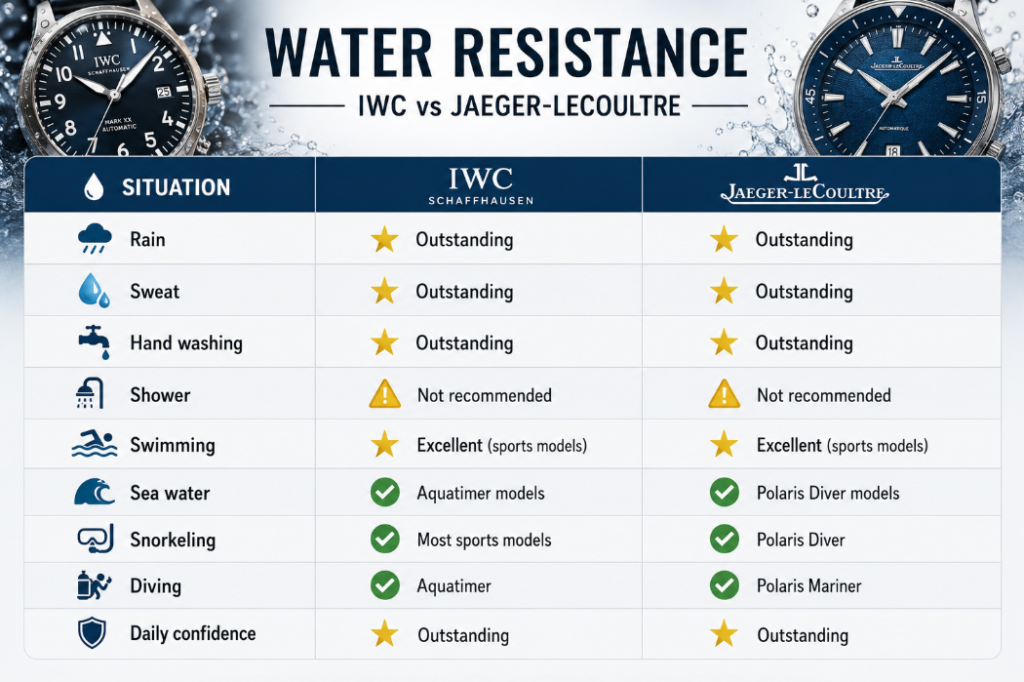
IWC has a slight advantage here. Many of its watches are genuinely designed to be worn every day without much concern. Pilot watches are famous for their durability.
Ingenieur models were built to resist magnetic fields. Aquatimer watches comfortably handle demanding environments. Jaeger-LeCoultre watches are also reliable but generally encourage slightly more careful ownership, especially thinner dress models.
Choosing IWC Over Jaeger-LeCoultre: My Final Call
Choose IWC if you: Choose Jaeger-LeCoultre if you:
Although their prices often overlap, IWC and Jaeger-LeCoultre appeal to different types of buyers. IWC builds luxury watches that are practical, durable, and exceptionally easy to live with. Its Pilot, Portugieser, and Ingenieur collections remain benchmarks in their respective categories.
Jaeger-LeCoultre, however, occupies a rarer position within Swiss watchmaking. Its technical innovation, movement expertise, and legendary designs like the Reverso place it among the industry’s true greats. If your goal is to own the stronger watchmaking brand, Jaeger-LeCoultre is the winner.
If your goal is to own the better everyday luxury watch, IWC remains one of the smartest choices available.
Awards
🏆 Overall Winner: Jaeger-LeCoultre ✈️ Best Everyday Luxury Watch: IWC 🕰️ Best Watchmaking Heritage: Jaeger-LeCoultre
💎 Best Dress Watches: Jaeger-LeCoultre