The common mistake is treating Miyota 8215 and Seiko NH35 as equal products with different logos. Their real strengths sit in different places.
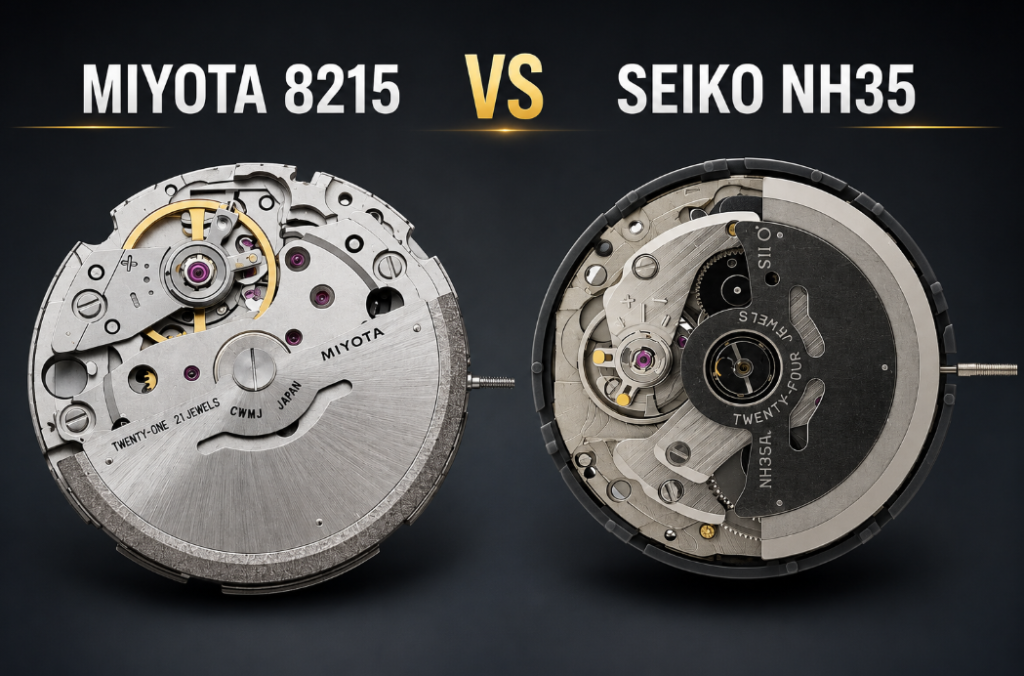
- The Practical Question Behind Miyota 8215 vs Seiko NH35
- What Owners Tend to Notice Later: Seiko NH35
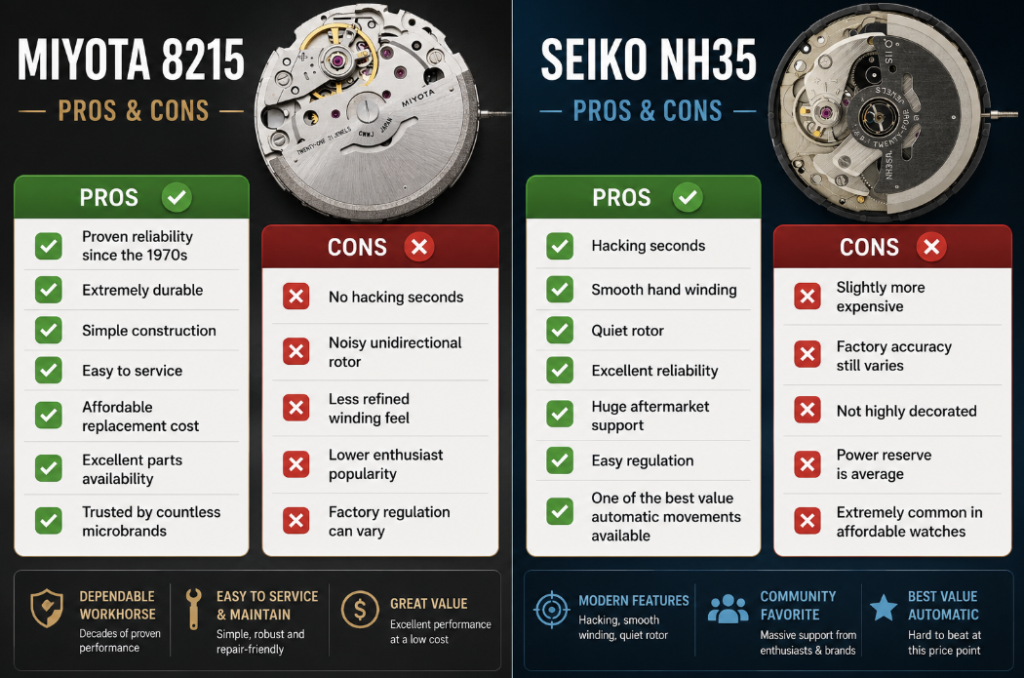
- Miyota 8215 Pros ✅
- Miyota 8215 Cons ❌
- Seiko NH35 Pros ✅
- Seiko NH35 Cons ❌
- Where Miyota 8215 Has the Edge—and Where Seiko NH35 Does
- The Ownership Details Hidden in the Finish: Seiko NH35
- A Detail Worth Separating From the Marketing: Miyota 8215
- NH35
- Beyond the Spec Sheet: My Recommendation on Miyota 8215 and Seiko NH35
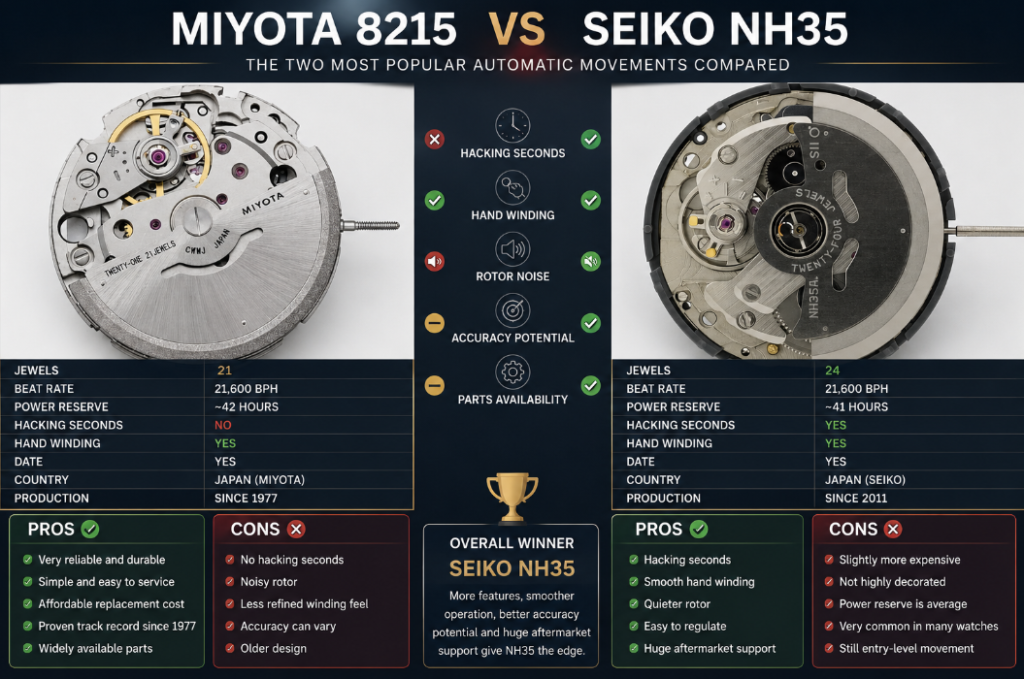
- Overall Winner: Seiko NH35 🏆
- Author
The Practical Question Behind Miyota 8215 vs Seiko NH35
Factory specifications often surprise buyers. On paper, they’re identical. In practice, things look different.
Many well-regulated NH35 movements run within:
- ±5 to ±10 seconds/day
Miyota and TMI both publish a broad -20 to +40 seconds-per-day standard for these movements. Regulation of the individual watch matters more than the name stamped on the rotor.
This category ends in a draw. The Miyota 8215 has been running for nearly fifty years.
Millions remain in service today. The NH35 has also earned an outstanding reputation.
Failures are rare when either movement is properly maintained. Both easily last decades.
Watchmakers enjoy working on both movements. Advantages include:
- Widely available spare parts
- Straightforward construction
- Low replacement cost
- Excellent documentation
In many cases, replacing the movement costs little more than servicing it. That’s one reason microbrands love both calibers.
The difference is almost nonexistent.
- Miyota 8215: approximately 42 hours
- NH35: approximately 41 hours
Neither has a meaningful advantage.
What Owners Tend to Notice Later: Seiko NH35
Many enthusiasts obsess over which movement is “better.” In reality, both are excellent. Neither movement is luxurious. Neither movement is highly decorated.
Neither movement is chronometer-certified. They’re designed to do one thing exceptionally well: Run reliably for years with minimal maintenance. The uncomfortable truth for NH35 owners is that many will never notice any practical advantage over a well-regulated Miyota 8215.
Current Miyota documentation lists a stop-seconds device, so hacking is no longer a sound reason to reject a newly produced 8215. Older watches should be checked individually.
Across Reddit, WatchUSeek, and various microbrand communities, a clear pattern appears. Collectors appreciate the NH35 for:
- Stop-seconds function
- Smooth winding
- Quiet rotor
- Easy regulation
- Excellent value
Miyota supporters praise: One opinion appears repeatedly: “I’d buy either without hesitation, but if the price is the same, I’d choose the NH35.”
That reflects today’s enthusiast consensus.
Miyota 8215 Pros ✅
- ✅ Proven reliability since the 1970s
- ✅ Extremely durable
- ✅ Simple construction
- ✅ Easy to service
- ✅ Affordable replacement cost
- ✅ Excellent parts availability
- ✅ Trusted by countless microbrands
Miyota 8215 Cons ❌
- ✅ Stop-seconds on current production
- ❌ Noisy unidirectional rotor
- ❌ Less refined winding feel
- ❌ Lower enthusiast popularity
- ❌ Factory regulation can vary
Seiko NH35 Pros ✅
- ✅ Hacking seconds
- ✅ Smooth hand winding
- ✅ Quiet rotor
- ✅ Excellent reliability
- ✅ Huge aftermarket support
- ✅ Easy regulation
- ✅ One of the best value automatic movements available
Seiko NH35 Cons ❌
- ❌ Slightly more expensive
- ❌ Factory accuracy still varies
- ❌ Not highly decorated
- ❌ Power reserve is average
- ❌ Extremely common in affordable watches
| Specification | Miyota 8215 | Seiko NH35 |
|---|---|---|
| Manufacturer | MIYOTA (Citizen group) | TMI / Time Module |
| Jewels | 21 | 24 |
| Beat Rate | 21,600 bph | 21,600 bph |
| Power Reserve | ~42 hours | ~41 hours |
| Stop-seconds | Yes on current specification; verify older stock | Yes |
| Hand Winding | ✅ Yes | ✅ Yes |
| Automatic Winding | ✅ Yes | ✅ Yes |
| Date | Yes | Yes |
| Day Display | No | No |
| Production | Since 1977 | Since 2011 |
Where Miyota 8215 Has the Edge—and Where Seiko NH35 Does
If you’re choosing between the Miyota 8215 and the Seiko NH35, the NH35 is the better movement for most people. Both calibers are among the most reliable and affordable automatic movements ever produced. You’ll find them inside hundreds of watches from brands like Invicta, Steeldive, San Martin, Spinnaker, Boldr, Islander, and many microbrands. The difference is that the NH35 feels more refined.
It hand-winds smoothly and its winding behaviour is generally quieter on the wrist.
And its accuracy is often easier to regulate. The Miyota 8215, however, shouldn’t be underestimated. It’s incredibly durable, remarkably simple to service, and has been running reliably in millions of watches for decades.
The Ownership Details Hidden in the Finish: Seiko NH35
Although both movements target the same market, they were designed differently. The Miyota 8215 prioritizes simplicity.
Citizen engineered it to be inexpensive, durable, and easy to manufacture. The NH35 was designed as a modern evolution of Seiko’s legendary 7S26.
It added two features enthusiasts had long requested:
- Stop-seconds function
- Hand winding
Those additions made the NH35 one of the most popular automatic movements in the world.
A Detail Worth Separating From the Marketing: Miyota 8215
This is one of the biggest differences. When you pull the crown, the seconds hand keeps moving. Setting the exact time is therefore more difficult.
NH35
The seconds hand stops completely. This allows precise synchronization.
For current production, both movements provide stop-seconds; older 8215 examples may differ.
One criticism follows the Miyota 8215 everywhere. The rotor. Its unidirectional winding system is efficient but noticeably louder than the NH35.
Some owners also notice a “rotor wobble” or spinning sensation on the wrist. This is completely normal. It’s simply how the movement is designed.
The NH35 winds more quietly and generally feels smoother.
Both movements are extremely robust. They’re designed for everyday wear rather than haute horlogerie. The NH35 benefits from Seiko’s Diashock system. Miyota uses Citizen’s own shock-protection design.
Real-world durability is virtually identical.
Not necessarily. A regulated Miyota can perform just as well.
False. The free-spinning rotor is completely normal. It’s part of the movement’s winding system.
There’s little evidence supporting that. Both movements have outstanding reliability records.
Technically yes. Practically no.
Its longevity proves how well the design works.
- Invicta Pro Diver (selected versions)
- Citizen Automatic models
- Boldr Venture
- Xeric
- Numerous microbrands
- Phoibos (older references)
- Invicta Pro Diver (many current versions)
- Steeldive SD1970
- Heimdallr
- San Martin
- Islander
- Spinnaker
- Addiesdive
- Tandorio
- Hundreds of microbrands
NH35 has become the default choice for affordable mechanical watches.
Beyond the Spec Sheet: My Recommendation on Miyota 8215 and Seiko NH35
The Miyota 8215 and Seiko NH35 have earned their reputations through decades of dependable performance rather than flashy specifications. The Miyota 8215 remains one of the toughest and simplest automatic movements ever made. Its longevity is proof of its excellent engineering. The NH35 builds on that formula with quieter winding behaviour and exceptionally broad aftermarket support. Those improvements make it feel like a more complete movement without sacrificing reliability.
If you’re choosing between two otherwise similar watches and the price difference is small, the NH35 is the movement to buy. If you already own a watch with the Miyota 8215, there’s no reason to feel you’re missing out. Properly regulated and maintained, it can provide decades of accurate, trouble-free service.