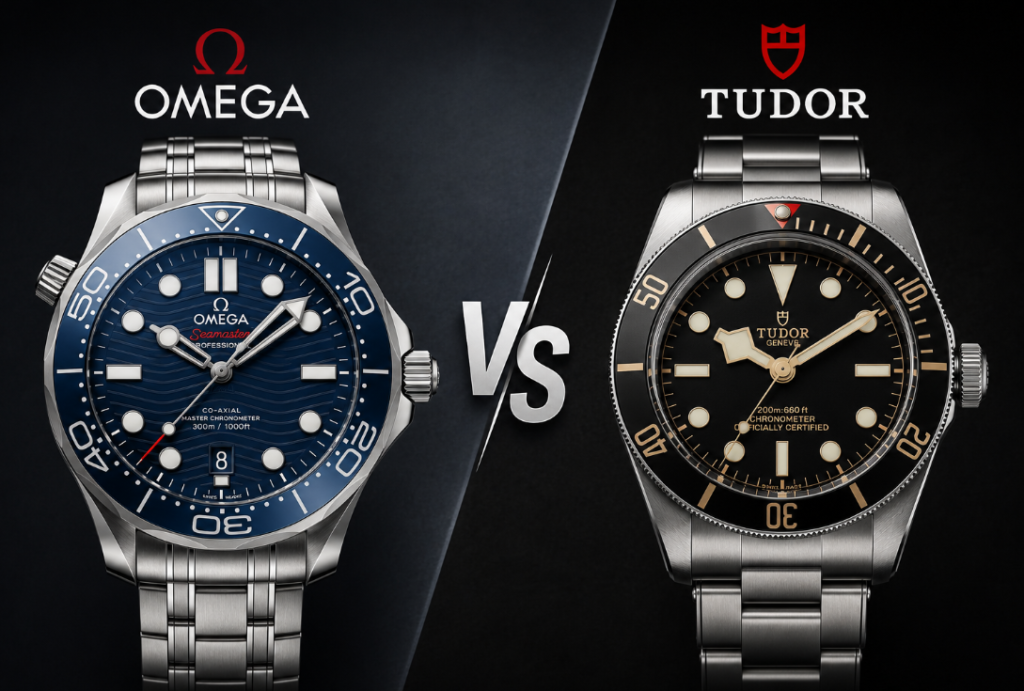
The modern choice between Omega and Tudor makes more sense after looking at why each product line exists at all.
Omega and Tudor are two of the strongest names in Swiss watchmaking, but they sit in different positions. Omega is a true luxury brand with deep history, advanced movements and global recognition. Tudor is a more accessible luxury brand that has built a serious enthusiast following by offering strong specifications, Rolex Group credibility and excellent value.
This comparison is interesting because Tudor often feels like the smarter purchase, while Omega usually feels like the more complete luxury watch brand. If you only care about value, Tudor is difficult to ignore. If you care about movement technology, brand prestige, finishing and historical importance, Omega has the advantage.
The short answer is simple: buy Tudor if you want maximum luxury-watch value. Buy Omega if you want the more advanced and prestigious watch.
- Why Omega and Tudor Divide Buyers
- Omega Pros ✅
- Omega Cons ❌
- Tudor Pros ✅
- Tudor Cons ❌
- Why Their Backstories Still Matter
- What Survives the First Impression: Omega
- The Mechanical Difference With Real Consequences: Omega
- Where Value Stops Being About the Price Tag
- The References That Clarify Omega Versus Tudor
- Omega Seamaster Diver 300M vs Tudor Pelagos
- Omega Speedmaster vs Tudor Black Bay Chrono
- Omega Aqua Terra vs Tudor Black Bay 39 / Ranger
- The Contrarian Case in the Omega and Tudor Debate
- Author
Why Omega and Tudor Divide Buyers
Omega is the better watch brand overall, but Tudor may be the better purchase for many people. That is the tension at the center of this comparison. Omega gives you more technology, more history and a higher level of global recognition. The Seamaster and Speedmaster are icons, and the brand’s modern Master Chronometer movements are genuinely impressive. Tudor cannot fully match that level of horological depth.
At the same time, Tudor delivers a huge amount of real-world watch quality for significantly less money. A Tudor Black Bay or Pelagos often gives you excellent finishing, strong water resistance, a manufacture movement and serious enthusiast credibility at a price where Omega usually costs thousands more. The uncomfortable truth for Omega fans is that Tudor gets surprisingly close in daily ownership. The uncomfortable truth for Tudor fans is that Omega still feels like the more complete luxury brand.
Omega fans often argue that the brand offers more horology for the money than Rolex and more technical sophistication than Tudor. They point to Co-Axial movements, METAS certification, the Speedmaster’s history and the Seamaster’s modern quality. Tudor fans usually focus on value, restraint and wearability. They like that Tudor feels less flashy and less hype-driven. For many collectors, Tudor represents the sweet spot between serious luxury and practical ownership.
The most balanced view is that Omega is the better brand, while Tudor is often the smarter buy. That distinction matters.
Omega Pros ✅
- Stronger brand prestige
- Better movement technology
- Master Chronometer certification
- More iconic models
- Speedmaster and Seamaster heritage
- More premium finishing
- Stronger resale than Tudor
Omega Cons ❌
- More expensive
- Too many model variations
- Some models depreciate noticeably
- Can feel less tool-like than Tudor
- Larger cases on some models may not suit everyone
Tudor Pros ✅
- Excellent value
- Strong manufacture movements
- Great dive watches
- Rolex Group credibility
- Easier to buy
- More understated
- Strong enthusiast appeal
Tudor Cons ❌
- Lower prestige than Omega
- Weaker resale value
- Some models wear thick
- Less advanced movement technology
- Often lives in Rolex’s shadow
| Feature | Omega | Tudor |
|---|---|---|
| Parent Group | Swatch Group | Rolex Group |
| Brand Position | Luxury Swiss brand | Accessible luxury Swiss brand |
| Typical Price Range | $5,000-$10,000+ | $3,000-$6,000 |
| Best Known For | Seamaster, Speedmaster, Co-Axial | Black Bay, Pelagos, Ranger |
| Movement Focus | Co-Axial Master Chronometer | Manufacture calibers, COSC |
| Prestige | Higher | Strong, but lower |
| Value | Good | Excellent |
| Availability | Generally available | Usually available |
Why Their Backstories Still Matter
Omega has the stronger history. The brand is tied to Olympic timekeeping, NASA, the Moonwatch, James Bond and decades of professional dive watches. The Speedmaster alone gives Omega one of the most powerful stories in the entire watch industry. Tudor’s heritage is also strong, especially in military and diving contexts, but it is more focused and less globally recognized. Tudor benefits from its Rolex connection, and that is both an advantage and a limitation. It gives the brand credibility, but it also means Tudor is constantly compared to Rolex. In recent years, Tudor has done an excellent job building its own identity. The Black Bay and Pelagos lines no longer feel like cheap Rolex substitutes. They feel like real Tudor watches. Still, Omega’s history is broader, deeper and more influential.
What Survives the First Impression: Omega
Omega offers more variety. The Seamaster Diver 300M, Speedmaster Professional, Aqua Terra and Planet Ocean all have distinct personalities. Omega is more willing to use bold dials, ceramic bezels, skeleton hands, wave patterns and modern case shapes. Tudor’s design language is more restrained and vintage-inspired. The Black Bay Fifty-Eight, Ranger and Black Bay Pro appeal to buyers who like simpler, tool-focused watches. Tudor is less flashy than Omega and often feels more grounded. The downside for Omega is that the lineup can sometimes feel messy. There are many versions, special editions and variations. Tudor’s catalog is easier to understand, but also less diverse. If you want variety, Omega wins. If you want clean tool-watch character, Tudor may be more appealing.
Omega has the edge in overall finishing and premium feel. Modern Omega cases, bracelets, bezels and dials are very strong, especially in the Seamaster and Speedmaster lines. The brand also uses advanced materials such as ceramic, titanium and precious metals across many collections. Tudor build quality is excellent for the money. The Pelagos in particular feels like a serious tool watch, and the Black Bay line has improved a lot over the years. However, Tudor bracelets and finishing still do not feel quite as refined as Omega’s best models.
The difference is not enormous, but it is noticeable. Omega feels more polished. Tudor feels more practical and tool-like.
The Mechanical Difference With Real Consequences: Omega
This is one of Omega’s clearest advantages. Omega’s Co-Axial Master Chronometer movements are technically impressive, with METAS certification, strong anti-magnetism and excellent real-world accuracy. Omega has spent years building its identity around advanced movement technology, and it shows. Tudor’s manufacture movements are very good. They offer strong power reserves, COSC certification and reliable performance. For most owners, they are more than enough. But Tudor movements are more practical than exciting. This does not mean Tudor movements are weak. They are actually one of the brand’s biggest strengths. Omega simply plays at a higher technical level.
Both brands perform very well in daily use. Omega’s Master Chronometer certification is more demanding than standard COSC testing because it includes testing after casing and resistance to strong magnetic fields. That gives Omega a technical advantage. Tudor’s COSC-certified manufacture movements are still highly reliable. Most owners will not notice a meaningful accuracy difference in normal life. If you wear the watch daily and service it properly, both brands should perform extremely well for many years. Omega wins on paper and in technology. Tudor remains more than good enough for real-world ownership.
This is the most interesting category in the comparison. Omega has the Seamaster Diver 300M and Planet Ocean. Tudor has the Black Bay and Pelagos. All of these watches are legitimate dive watches with strong reputations. The Seamaster Diver 300M feels more luxurious and technologically advanced. It has a ceramic bezel, wave dial, strong movement and a more premium overall presence. The Tudor Pelagos feels more like a pure tool watch, especially with its titanium case and professional dive-watch personality.
If you want the more luxurious dive watch, choose Omega. If you want the more no-nonsense tool watch, Tudor is extremely compelling. Omega wins this category easily. The Speedmaster Professional is one of the most important chronographs ever made. Its Moonwatch history gives it a level of cultural and horological significance that Tudor cannot match. Tudor’s Black Bay Chrono is a strong watch and offers excellent value. It has presence, strong specs and genuine appeal. But it is not a Speedmaster. The Speedmaster is a watch with a story that goes far beyond specifications.
This category depends on the model. The Omega Aqua Terra is one of the best everyday luxury watches on the market. It is versatile, refined and works with almost anything. The Seamaster is sportier but still easy to wear. The Speedmaster is iconic, although less water-focused than modern dive watches. Tudor’s Black Bay Fifty-Eight and Ranger are also excellent everyday watches. They feel less flashy than Omega and are often easier to wear without attracting attention. For some buyers, that is a major advantage. Omega feels more premium. Tudor feels more relaxed. Both can work beautifully as daily watches.
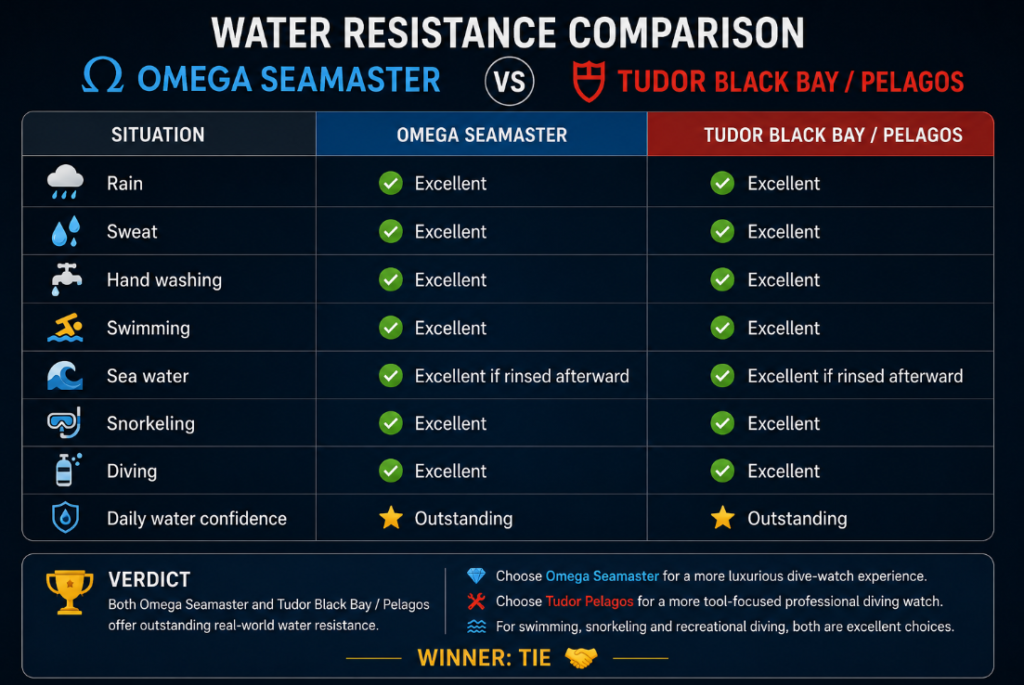
Both brands are very strong around water, but the answer depends on the model. A Seamaster or Pelagos is far more capable than a dressier model from either brand.
For real-world use, this category is effectively a draw between the main sports models.
Where Value Stops Being About the Price Tag
Tudor wins this category. This is the main reason the brand has become so popular with enthusiasts. A Tudor Black Bay, Pelagos or Ranger gives you serious Swiss watch quality without Omega pricing. The finishing is strong, the movements are good and the brand has real credibility. You are not buying a cheap watch. You are buying a well-made luxury watch without paying for Omega-level prestige. Omega is still good value compared with Rolex, but not compared with Tudor. The extra money buys better technology, stronger heritage and a more premium feel. Whether that is worth Omega usually holds value better than Tudor, but neither brand is Rolex. Omega’s strongest models, especially the Speedmaster Professional and certain Seamaster references, have solid long-term demand. Tudor resale is generally respectable, but many models still depreciate after purchase.
The gap is not always huge, and market conditions can change. Still, Omega has the stronger global recognition and more established collector demand.
The References That Clarify Omega Versus Tudor
Omega Seamaster Diver 300M vs Tudor Pelagos
Verdict: The Seamaster feels more luxurious. The Pelagos feels more purpose-built.
Omega Speedmaster vs Tudor Black Bay Chrono
Verdict: The Black Bay Chrono is excellent, but the Speedmaster is the more important watch.
Omega Aqua Terra vs Tudor Black Bay 39 / Ranger
Verdict: The Aqua Terra is more refined. Tudor is simpler and better value.
The Contrarian Case in the Omega and Tudor Debate
Omega is the better watch brand overall. It has stronger heritage, better movement technology, more iconic models and a more premium luxury identity. If you want the more complete brand, Omega is the stronger choice. Tudor is the smarter purchase for many buyers. It gives you a huge amount of real-world watch quality for less money, and its best models feel honest, capable and enthusiast-focused.
The decision comes down to what you value most. Choose Omega if you want the more prestigious, more technically advanced and more historically important watch.
Choose Tudor if you want maximum value, understated design and a serious Swiss watch you can wear without overthinking it. The honest conclusion is simple:
Omega is the better brand. Tudor is often the better deal.
And that is exactly why this comparison is so interesting.