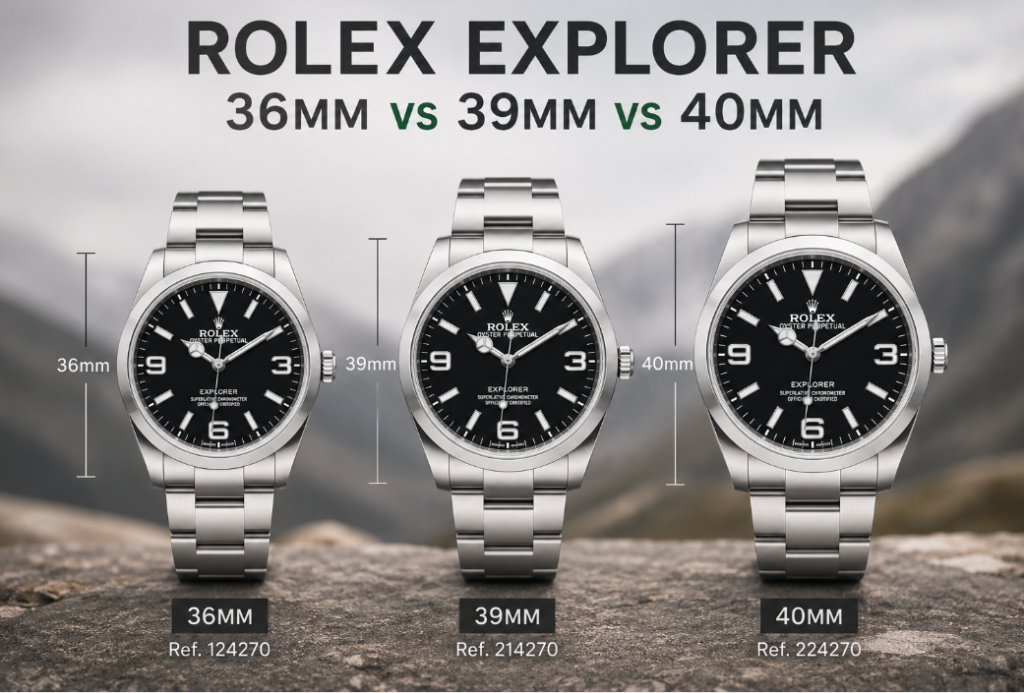
Rolex Explorer 36mm, 39mm and 40mm share one important attraction, but they deliver it through very different compromises.
The Rolex Explorer has never been about making a statement. Unlike the Submariner, GMT-Master II, or Daytona, it wasn’t designed around a specific profession or complication. Instead, it was built around three simple ideas: reliability, legibility, and durability.
That philosophy has barely changed since the Explorer first appeared in the early 1950s. Even after more than 70 years, it remains one of the cleanest and most versatile sports watches Rolex has ever produced.
Today’s buyers, however, face a choice previous generations never had. Instead of one Explorer, there are three important modern references to consider:
- Explorer 36 (Ref. 124270) – the modern version of the original classic.
- Explorer 39 (Ref. 214270) – the discontinued reference that many enthusiasts still consider the perfect Explorer.
- Explorer 40 (Ref. 224270) – the newest model, designed for buyers who prefer contemporary sports watch proportions.
At first glance, these watches seem almost identical. They share the same black dial, Mercedes hands, smooth bezel, Oyster bracelet, and unmistakable Explorer DNA.
Spend a few minutes wearing each one, though, and you’ll quickly realize they feel surprisingly different.
The Explorer 36 feels elegant and understated.
The Explorer 39 strikes a balance between vintage charm and modern sizing.
The Explorer 40 delivers the strongest wrist presence while remaining unmistakably an Explorer.
Choosing between them isn’t about finding the “best” Rolex.
It’s about finding the Explorer that feels right every time you look down at your wrist.
This guide compares all three sizes in detail, explains why the discontinued 39 mm has become one of Rolex’s modern cult favorites, and helps you decide which Explorer truly belongs on your wrist.
If you want the Explorer exactly as Rolex originally intended, buy the Explorer 36. It offers timeless proportions, exceptional comfort, and remains the closest modern interpretation of the watch that built the Explorer’s reputation. If your ideal sports watch sits between vintage and modern sizing, the Explorer 39 is incredibly compelling. Although discontinued, many collectors believe it represents the Explorer at its absolute best. If you prefer contemporary proportions or have a larger wrist, the Explorer 40 is the obvious choice. It combines Rolex’s latest movement with the biggest Explorer case ever produced without losing the model’s clean, understated character.
- Overall Winner: Explorer 36
- Best Collector Choice: Explorer 39
- Best for Larger Wrists: Explorer 40
- What a Fair Rolex Explorer 36mm vs 39mm vs 40mm Comparison Must Explain
- Comfort Winner
- The Scenario That Produces a Clear Winner: 39mm and 40mm
- Start With the Trade-off, Not the Spec Sheet: Rolex Explorer 36mm
- Where the Extra Money Actually Goes
- Value Verdict
- How the Past Shapes Today's Watches
- Explorer 36
- Explorer 39
- Explorer 40
- Which Design Is Best?
- Where the Usual Rolex Explorer 36mm, 39mm and 40mm Advice Breaks Down
- What Readers Still Want to Know About Rolex Explorer 36mm, 39mm and 40mm
- The Ownership Trade-offs: Rolex Explorer 36mm vs 39mm vs 40mm
- Awards
- Author
Overall Winner: Explorer 36
Its classic proportions, versatility, and historical authenticity make it the safest recommendation for most buyers.
Best Collector Choice: Explorer 39
A short production run, balanced design, and growing enthusiast demand have already made it one of the most sought-after modern Explorer references.
Best for Larger Wrists: Explorer 40
The newest Explorer feels completely at home alongside today’s larger sports watches while retaining everything people love about the collection.
What a Fair Rolex Explorer 36mm vs 39mm vs 40mm Comparison Must Explain
One reason the Explorer has remained popular for decades is that it’s incredibly easy to wear. Unlike many luxury sports watches, it isn’t excessively thick or top-heavy.
The differences between the three sizes are subtle but noticeable during everyday use. The Explorer 36 almost disappears on the wrist. It’s the watch you forget you’re wearing until someone compliments it.
The Explorer 39 adds a little more weight and presence while remaining exceptionally comfortable. For average wrist sizes, it strikes an excellent balance. The Explorer 40 feels more substantial. The wider bracelet distributes weight well, but you’ll always be aware that you’re wearing a modern sports watch.
Comfort Winner
🥇 Explorer 36 If comfort is your top priority, the smallest Explorer remains the easiest to wear all day.
The Scenario That Produces a Clear Winner: 39mm and 40mm
After the excitement of buying a new Rolex fades, one thing becomes surprisingly important: How does the watch feel after wearing it every day for months or even years? This is where the differences between the three Explorers become much more obvious than the specification sheet suggests.
The Explorer 36 almost disappears on the wrist. It’s light, perfectly balanced, and incredibly easy to wear from morning until night. It’s the type of watch you’ll forget you’re wearing until someone notices it. The Explorer 39 feels slightly more substantial but remains exceptionally comfortable. It offers enough wrist presence to feel special without ever becoming distracting. That’s one reason why so many long-term owners refuse to part with theirs. The Explorer 40 feels closest to a modern luxury sports watch. The larger case and wider bracelet constantly remind you that you’re wearing a Rolex. For buyers who enjoy a more noticeable watch, that’s part of the appeal.
There’s no wrong choice here. The Explorer 36 feels effortless. The Explorer 39 feels perfectly balanced.
The Explorer 40 feels modern and confident. That’s why the Explorer lineup continues to appeal to such a wide range of enthusiasts. The watches may look almost identical, but each one delivers a distinctly different ownership experience.
Mechanically, these three Explorers are more alike than different. The Explorer 36 and Explorer 40 both use Rolex’s latest Caliber 3230, featuring a 70-hour power reserve, the efficient Chronergy escapement, and Superlative Chronometer certification. The Explorer 39 uses the older Caliber 3132 with a 48-hour power reserve. While it’s one generation behind, it’s still regarded as one of Rolex’s most reliable time-only movements and has earned an outstanding reputation for long-term durability.
For everyday wear, you probably won’t notice a difference in accuracy. The biggest advantage of the newer movement is convenience. If you rotate several watches, the extra 22 hours of power reserve means the Explorer 36 and 40 are more likely to keep running when you return to them. One question appears constantly online: Does 1 mm really matter?
Between the 39 mm and 40 mm, not as much as people think. The additional millimeter is subtle. What you notice far more is the wider 21 mm bracelet, which gives the Explorer 40 a broader, more modern stance. The jump from 36 mm to 39 mm feels much larger. The dial opens up, the watch gains noticeably more wrist presence, and the overall character shifts from classic to contemporary.
Movement Winner: Explorer 36 & Explorer 40 Size Difference Verdict: The biggest visual change is 36 mm vs 39 mm, not 39 mm vs 40 mm.
Start With the Trade-off, Not the Spec Sheet: Rolex Explorer 36mm
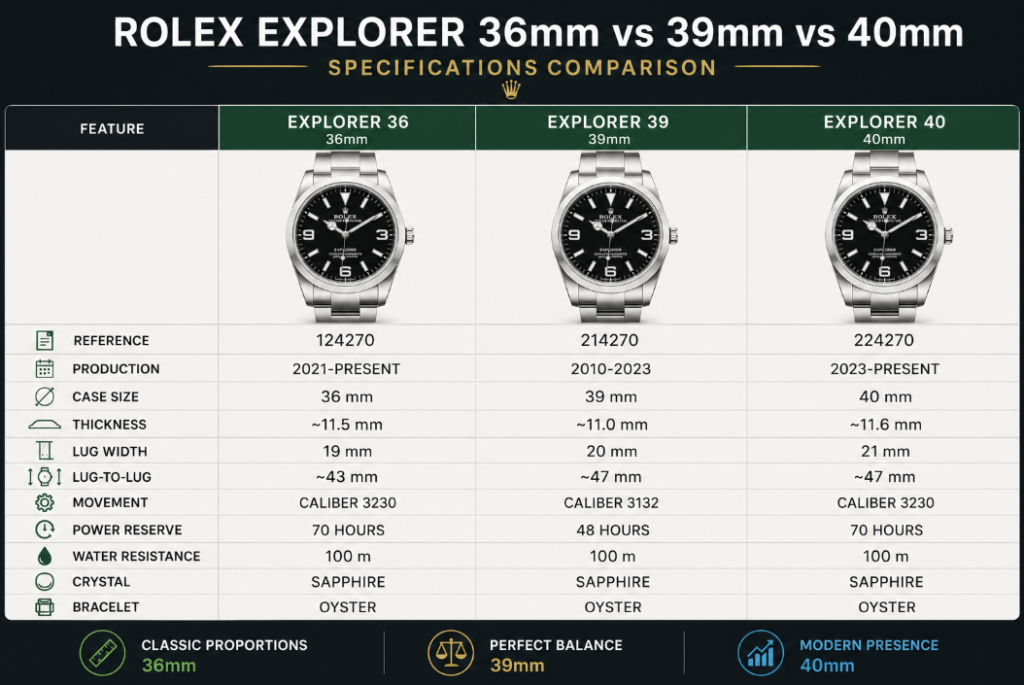
The specification sheet doesn’t tell the whole story. Mechanically, these watches are extremely similar. The differences that matter most aren’t found in the movement or water resistance rating – they’re found in how each watch wears, how it balances on the wrist, and how its proportions change the Explorer’s personality.
The Explorer lineup is unusual because you’re comparing three versions of the same watch rather than three completely different models. The movements, materials, and overall quality are all excellent, so the real decision comes down to proportions, wrist presence, and personal preference. Here’s how they compare in everyday ownership.
Explorer 36 vs Explorer 39 This is the comparison that divides enthusiasts the most. The Explorer 36 stays true to the original formula. It feels compact, elegant, and incredibly versatile. Whether you’re wearing a T-shirt or a business suit, it never looks out of place.
The Explorer 39 takes that same design and gives it more breathing room. The dial feels more open, the watch has stronger wrist presence, and it better suits buyers accustomed to modern sports watches. Mechanically, the 36 actually has the advantage thanks to the newer Caliber 3230 with its 70-hour power reserve. The 39 uses the older Caliber 3132, but it’s still exceptionally reliable and highly respected. The real question is simple:
Do you want classic proportions or a more modern fit? Choose the Explorer 36 if you:
- Prefer timeless sizing.
- Have a wrist under 7 inches.
- Want the closest link to Explorer history.
- Wear your watch with both casual and formal clothing.
Choose the Explorer 39 if you: Verdict: The Explorer 36 is the safer recommendation for most buyers, but the Explorer 39 offers arguably the best overall proportions. Explorer 39 vs Explorer 40 This comparison is much closer than the numbers suggest.
On paper, only one millimeter separates them. On the wrist, the difference comes mostly from the bracelet. The Explorer 40 uses a wider 21 mm bracelet that gives the entire watch a broader stance. It feels more substantial without becoming oversized. The Explorer 39 feels slimmer and slightly more refined. Many collectors actually prefer its proportions because they maintain the understated character that has always defined the Explorer. The biggest practical difference is the movement.
The Explorer 40 benefits from the newer Caliber 3230 with a 70-hour power reserve, while the Explorer 39 retains the older but proven Caliber 3132. If you’re buying purely for everyday use, the Explorer 40 has the edge. If you’re buying with your heart – or with future collectibility in mind – the Explorer 39 is difficult to ignore. Choose the Explorer 39 if you:
- Want the most balanced proportions.
- Like owning discontinued Rolex references.
- Value collector appeal.
Choose the Explorer 40 if you: Verdict: Explorer 40 for daily wear. Explorer 39 for enthusiasts and collectors.
Explorer 36 vs Explorer 40 This is the comparison most first-time buyers eventually make.
Despite sharing the same movement, bracelet design, and overall build quality, they wear like different watches. The Explorer 36 feels discreet.
It doesn’t demand attention. It’s a watch that quietly grows on you over time.
The Explorer 40 has a stronger personality. The wider bracelet and larger dial make it feel much closer to modern Rolex sports watches like the Submariner or GMT-Master II. Neither approach is better.
They’re simply aimed at different buyers. Explorer 36 is ideal if you:
- Appreciate vintage-inspired proportions.
- Want maximum versatility.
- Prefer smaller, understated watches.
Explorer 40 is ideal if you:
- Already wear 40-42 mm sports watches.
- Want greater wrist presence.
- Have a wrist above 7.25 inches.
Verdict: The Explorer 36 remains the timeless choice, while the Explorer 40 feels more contemporary.
Most buyers approach this comparison the wrong way. They compare movement generations.
They compare case diameters. They compare bracelet widths.
Then they spend weeks trying to decide which Explorer is objectively “better.” The reality is much simpler.
You’re not choosing a better watch. You’re choosing the Explorer that fits your wrist and your taste.
The Explorer 36 isn’t automatically better because it’s closer to the original. The Explorer 39 isn’t automatically better because collectors love it.
The Explorer 40 isn’t automatically better because it has the newest proportions. Each one succeeds for a different reason.
Someone with a 6.25-inch wrist may put on the Explorer 40 and immediately feel it’s too large. Someone with an 8-inch wrist may find the Explorer 36 a little too subtle.
Meanwhile, another buyer with a 7-inch wrist could genuinely love all three and struggle to choose between them. That’s what makes this comparison so interesting.
Unlike comparing an Explorer with a Submariner or GMT-Master II, you’re not deciding between different functions or lifestyles. You’re deciding how you want the same watch to feel.
Do you want it to disappear under a shirt cuff? Do you want balanced, modern proportions?
Or do you want the strongest possible wrist presence without leaving the Explorer family? Once you stop looking for the “best” Explorer and start thinking about the Explorer that best suits you, the decision becomes much easier.
That’s also why so many experienced collectors own more than one Explorer. Each size offers a slightly different experience while remaining unmistakably true to the model’s original purpose. The Explorer has never been about chasing trends.
It’s about finding the size you’ll still enjoy wearing ten or twenty years from now. And that’s a far more important decision than choosing between 36, 39, or 40 millimeters alone.
Where the Extra Money Actually Goes
Buying an Explorer today isn’t just about choosing a size. It’s also about deciding whether you want a current-production model or a discontinued reference. The Explorer 36 is the most accessible option. It has the newest movement, the lowest retail price of the three, and decades of history behind it. It’s the easiest Explorer to recommend because it combines modern technology with classic proportions.
The Explorer 39 is only available on the pre-owned market, and that’s part of its appeal. Since Rolex discontinued it, demand has steadily increased. Well-kept examples with the original box and papers often command a premium because collectors specifically seek this reference. The Explorer 40 is Rolex’s current flagship Explorer. It costs slightly more than the 36 mm version but offers the latest movement and proportions that appeal to buyers accustomed to modern sports watches.
Collector Perspective Collectors don’t always buy the newest watch.
Instead, they look for references that tell an interesting story. The Explorer 36 remains the spiritual successor to the original Explorer and will likely always be considered the benchmark.
The Explorer 39 has become a cult favorite because of its relatively short production run and what many enthusiasts believe are perfect proportions. It’s one of the few modern Rolex watches where demand has continued growing long after production ended. The Explorer 40 is still too new to judge from a collector’s perspective. Its long-term desirability will largely depend on how long Rolex keeps it in production.
Value Verdict
- Best Overall Value: 🏆 Explorer 36
- Best Collector Value: 🏆 Explorer 39
- Best Modern Choice: 🏆 Explorer 40
How the Past Shapes Today's Watches
On paper, the difference between a 36 mm, 39 mm, and 40 mm case doesn’t seem significant. In reality, each Explorer has a completely different personality. This isn’t because Rolex changed the dial or added new features. It’s because even small changes in diameter, bracelet width, and proportions dramatically affect how the watch looks and feels.
Explorer 36
The Explorer 36 is the closest thing you can buy today to the original Explorer. Everything feels perfectly balanced. The dial is compact, the bezel frames it beautifully, and the watch never looks oversized. It slips effortlessly under a shirt cuff, feels surprisingly light, and works just as well with a suit as it does with hiking gear.
Its biggest strength is versatility. Whether you’re 25 or 65, wearing jeans or business attire, the Explorer 36 never feels out of place. Some buyers worry that 36 mm sounds too small by modern standards. In reality, once it’s on the wrist, those concerns usually disappear. The watch was designed around these proportions, and that’s immediately obvious.
Explorer 39
If the Explorer 36 represents tradition, the Explorer 39 represents evolution. Rolex didn’t redesign the watch – it simply gave the dial a little more room to breathe. The result is subtle but noticeable. The numerals appear slightly farther apart, the hands feel more proportional on larger wrists, and the watch gains just enough presence to satisfy buyers who find 36 mm a little conservative. What makes the Explorer 39 special is its balance.
It doesn’t wear like a large sports watch, yet it doesn’t feel vintage either. For many enthusiasts, it’s the Explorer that feels “just right.”
Explorer 40
The Explorer 40 is unmistakably modern. The wider bracelet and larger case give it noticeably more wrist presence, even though the increase over the 39 mm is only one millimeter. Rolex resisted the temptation to make it flashy. The dial remains clean, the smooth bezel keeps the design understated, and the Explorer’s identity is fully intact. If you’ve spent years wearing watches like the Submariner, GMT-Master II, or Seamaster Diver 300M, the Explorer 40 will probably feel immediately familiar.
For buyers coming from smaller watches, however, it may feel more substantial than expected.
Which Design Is Best?
This depends entirely on what you expect from an Explorer. The 36 mm looks timeless.
The 39 mm feels perfectly balanced. The 40 mm offers the strongest modern presence.
None of them looks outdated. They simply reflect three different eras of Rolex design.
Where the Usual Rolex Explorer 36mm, 39mm and 40mm Advice Breaks Down
No modern Explorer generates more discussion than the 39 mm. Ironically, that wasn’t the case when it first launched. When Rolex introduced the Explorer 39 in 2010, many enthusiasts complained that it was too large. At the time, the Explorer had spent decades as a 36 mm watch, so increasing the case size felt like a major departure from tradition.
Fast forward to today, and opinions have changed dramatically. Many collectors now consider the Explorer 39 one of the best modern Rolex sports watches ever made. Why?
It arrived at exactly the right moment. It offered modern proportions before luxury sports watches became excessively large. It wasn’t produced for very long.
Unlike references that remain in production for decades, the Explorer 39 had a relatively short lifespan. Limited production naturally increased its appeal once it was discontinued. Its proportions are exceptionally balanced. Many enthusiasts believe 39 mm is the ideal size for a sports watch. It offers more wrist presence than the 36 mm while avoiding the bulkier feel of many modern 40-42 mm watches.
It represents a transitional era for Rolex. The Explorer 39 bridges two generations. It still feels like a traditional Explorer but introduces the larger proportions that would later influence the Explorer 40. Spend a few minutes reading discussions on Reddit, WatchCrunch, or Rolex Forums, and one opinion appears repeatedly:
“The 39 mm was the sweet spot.” Not because it has the best movement. Not because it’s the rarest Rolex.
Simply because many owners believe Rolex accidentally found the perfect proportions. That doesn’t automatically make it the best Explorer. But it does explain why demand remains remarkably strong years after production ended.
Specifications don’t always reflect how a watch looks in real life. The Explorer lineup is a perfect example.
The Explorer 36 is subtle and understated. It’s ideal for buyers who don’t want their watch to dominate their wrist. The Explorer 39 is the middle ground. It feels sporty without becoming bold, which explains why so many collectors consider it perfectly proportioned.
The Explorer 40 has the strongest visual impact. It still looks restrained compared to most modern sports watches, but it carries noticeably more presence than either of its predecessors. If your goal is understated elegance, choose the 36.
If you want balance, choose the 39. If you enjoy a more confident sports watch look, the 40 is the clear winner.
Your wrist size should influence the decision, but it shouldn’t make it for you. Some collectors with 7.5-inch wrists still prefer the Explorer 36 because they love its classic proportions, while others with smaller wrists enjoy the bolder appearance of the Explorer 40. Still, these recommendations work well for most buyers.
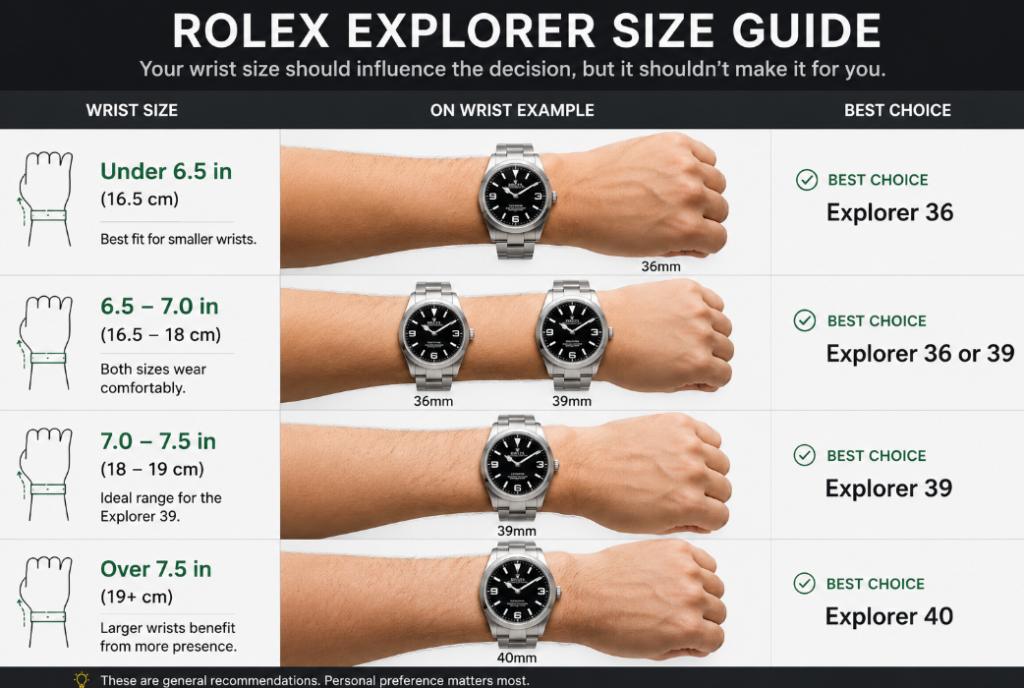
If you’re buying your first Explorer and fall between two sizes, don’t focus on the measurements alone. Ask yourself one simple question: Do you want your Explorer to disappear on your wrist or make a subtle statement? If the answer is “disappear,” choose the 36 mm.
If it’s “somewhere in the middle,” choose the 39 mm. If you prefer a stronger modern presence, the 40 mm is the better fit.
Although wrist size isn’t everything, it’s still one of the best starting points. Remember that these aren’t strict rules.
Many experienced collectors intentionally wear the Explorer 36 on wrists larger than 7.5 inches because they appreciate its traditional proportions. Likewise, plenty of buyers with average wrists simply enjoy the stronger presence of the Explorer 40. Comfort matters, but personal taste matters even more.
What Readers Still Want to Know About Rolex Explorer 36mm, 39mm and 40mm
Is the Explorer 39 discontinued?
Yes. Rolex discontinued Reference 214270 in 2023 when it introduced the Explorer 40.
Which Explorer has the best movement?
The Explorer 36 and Explorer 40 both use the modern Caliber 3230 with a 70-hour power reserve. The Explorer 39 uses the older but still excellent Caliber 3132.
Is the Explorer 36 too small today?
No. Watch trends have shifted back toward more traditional sizing, and many enthusiasts specifically choose the 36 mm because of its timeless proportions.
Which Explorer is best for a 7-inch wrist?
For most buyers, the Explorer 39 offers the best balance. However, both the Explorer 36 and Explorer 40 can work depending on whether you prefer a more classic or modern look.
Which Explorer holds its value best?
All three perform well, but the discontinued Explorer 39 currently has the strongest collector appeal and long-term appreciation potential.
The Ownership Trade-offs: Rolex Explorer 36mm vs 39mm vs 40mm
Choose the Explorer 36 if… You want the Explorer in its purest form. It’s ideal for buyers who appreciate classic proportions, exceptional comfort, and a watch that works equally well with casual clothes or formal wear. If you’re buying your first Explorer, this is the safest recommendation.
Choose the Explorer 39 if… You believe 39 mm is the perfect sports watch size and don’t mind shopping on the secondary market. Its balanced proportions, discontinued status, and growing collector demand make it especially appealing to enthusiasts.
Choose the Explorer 40 if… You have a larger wrist or simply prefer contemporary sports watches. It offers the latest movement, stronger wrist presence, and feels immediately familiar if you’re used to modern Rolex models like the Submariner or GMT-Master II.
Choosing between the Explorer 36, 39, and 40 isn’t about finding the best watch – it’s about finding the Explorer that feels right on your wrist. The Explorer 36 remains the benchmark. Its proportions have stood the test of time, it offers Rolex’s latest movement, and it’s versatile enough to be your only watch. If you’re unsure which Explorer to buy, this is the one most people will never regret. The Explorer 39 occupies a unique place in the collection’s history. It combines modern sizing with classic restraint, and its relatively short production run has already made it one of the most desirable modern Explorer references. If you don’t mind buying pre-owned, it’s easy to understand why so many enthusiasts call it the “sweet spot.”
The Explorer 40 brings the Explorer into the modern era. It wears larger, feels more substantial, and suits buyers who prefer contemporary sports watches without sacrificing the Explorer’s clean, functional design.
Awards
🏆 Overall Winner: Rolex Explorer 36 The best all-around choice thanks to its timeless proportions, outstanding comfort, modern movement, and historical authenticity. 🥇 Best Collector Choice: Rolex Explorer 39 A discontinued reference with exceptional proportions and growing collector demand.
💪 Best for Larger Wrists: Rolex Explorer 40 The ideal Explorer for buyers who prefer modern sizing and stronger wrist presence. No matter which reference you choose, you’re getting one of the finest three-hand sports watches ever made. The differences between them are surprisingly subtle on paper, yet remarkably noticeable on the wrist – which is exactly why trying them on, if possible, is still the best way to make your final decision.