Enthusiast reputation and mainstream demand pull the Rolex Jubilee versus Oyster Bracelet comparison in different directions.
Choosing between the Rolex Jubilee and Rolex Oyster bracelet seems simple until you actually try both. The watch itself may stay exactly the same, yet changing the bracelet can completely transform how a Rolex looks, feels, and even how often you wear it.
That’s why many buyers spend just as much time deciding between the two bracelets as they do choosing the watch.
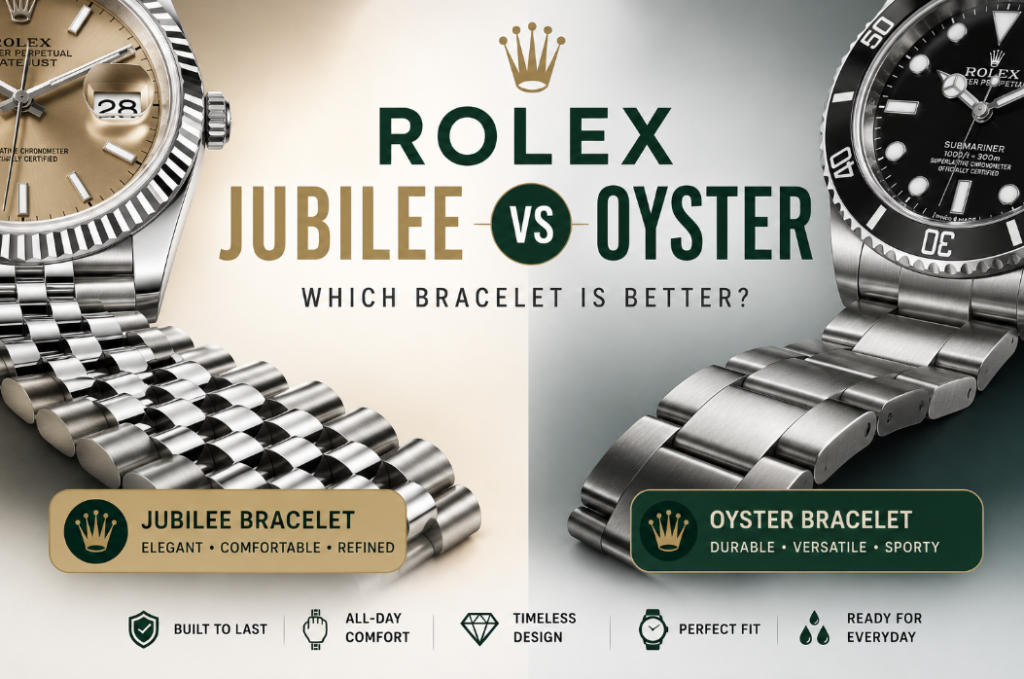
The Oyster bracelet has become synonymous with Rolex sports watches. Its clean three-link construction is simple, durable, and instantly recognizable. It’s the bracelet found on icons like the Submariner, Explorer, Sea-Dweller, Oyster Perpetual, and many GMT-Master II references.
The Jubilee bracelet tells a different story. Introduced in 1945 alongside the original Datejust, it was designed to celebrate Rolex’s 40th anniversary. Its elegant five-link construction offers greater flexibility, a more refined appearance, and what many owners consider the most comfortable bracelet Rolex has ever produced.
So which one is actually better?
The answer depends less on specifications and more on how you plan to wear your watch.
This guide compares the Jubilee and Oyster bracelets in terms of comfort, durability, maintenance, appearance, aging, and everyday ownership to help you decide which bracelet is right for you.
- The Practical Question Behind Rolex Jubilee vs Oyster Bracelet
- Ownership trade-offs: Jubilee Bracelet
- What works in practice
- Where the compromise appears
- Ownership trade-offs: Oyster Bracelet
- What works in practice
- Where the compromise appears
- What You Notice Before Reading the Specs
- Jubilee Bracelet
- Oyster Bracelet
- Which Looks Better?
- Comfort Rating
- Aging Comparison
- Datejust
- GMT-Master II
- Explorer
- Oyster Perpetual
- Sky-Dweller
- The Right Lens for Comparing Rolex Jubilee and Oyster Bracelet
- The Part of the Comparison That Needs Context: Oyster Bracelet
- Durability Winner
- Maintenance Winner
- When Oyster Bracelet Makes More Sense Than Rolex Jubilee
- Awards
- Author
The Practical Question Behind Rolex Jubilee vs Oyster Bracelet
One of the biggest myths in the watch world is that the Jubilee is a dress bracelet while the Oyster is a sports bracelet. That might have been true decades ago. Today, it isn’t.
Look at the current GMT-Master II Pepsi on a Jubilee bracelet. It’s one of the most desirable sports watches in the world. Likewise, the Datejust on an Oyster bracelet becomes noticeably sportier while still looking perfectly appropriate with business attire. The bracelet doesn’t determine whether a Rolex is sporty or elegant.
Instead, it changes the personality of the watch. An Oyster bracelet makes almost every Rolex feel more purposeful and tool-like. A Jubilee bracelet makes almost every Rolex feel more refined and luxurious.
Neither approach is better. They’re simply aimed at different tastes. That’s why so many experienced collectors eventually own both.
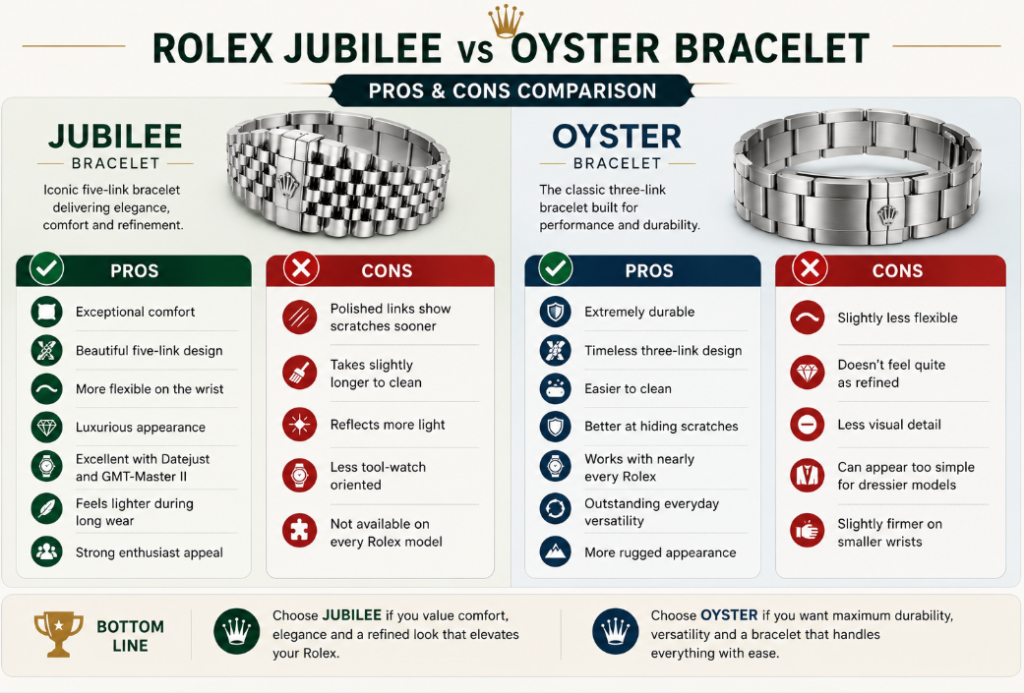
Ownership trade-offs: Jubilee Bracelet
What works in practice
- Exceptional comfort
- Beautiful five-link design
- More flexible on the wrist
- Luxurious appearance
- Excellent with Datejust and GMT-Master II
- Feels lighter during long wear
- Strong enthusiast appeal
Where the compromise appears
- Polished links show scratches sooner
- Takes slightly longer to clean
- Reflects more light
- Less tool-watch oriented
- Not available on every Rolex model
Ownership trade-offs: Oyster Bracelet
What works in practice
- Extremely durable
- Timeless three-link design
- Easier to clean
- Better at hiding scratches
- Works with nearly every Rolex
- Outstanding everyday versatility
- More rugged appearance
Where the compromise appears
- Slightly less flexible
- Doesn’t feel quite as refined
- Less visual detail
- Can appear too simple for dressier models
- Slightly firmer on smaller wrists
Retail pricing rarely changes dramatically because of the bracelet. The differences become more noticeable on the secondary market.
GMT-Master II models fitted with Jubilee bracelets often sell for slightly higher prices because demand is particularly strong. Datejust models on Jubilee bracelets also remain highly desirable, especially when paired with a fluted bezel.
The Oyster bracelet, however, appeals to a broader audience. Its versatility means it usually sells quickly regardless of the Rolex model.
Neither bracelet should be purchased purely as an investment. Choose the one you’ll enjoy wearing.
Resale Winner: 🤝 Tie
What You Notice Before Reading the Specs
The first thing you’ll notice isn’t comfort. It’s how dramatically the bracelet changes the appearance of the watch.
Jubilee Bracelet
The Jubilee immediately attracts attention. Its five-link construction creates dozens of small polished surfaces that reflect light from almost every angle. Even on stainless steel models, the bracelet appears noticeably more luxurious than the Oyster. This extra detail makes watches feel slightly more expensive, even when both versions cost exactly the same. On models like the Datejust, the Jubilee almost completes the design. Many enthusiasts believe the Datejust simply looks “correct” on a Jubilee.
It also pairs exceptionally well with fluted bezels, creating one of the most recognizable combinations in luxury watchmaking.
Oyster Bracelet
The Oyster takes the opposite approach. Everything is simpler.
The larger three-link construction gives the bracelet a clean, solid appearance. Most sports models use brushed outer surfaces that reduce reflections and make the watch appear more purposeful. The design has barely changed for decades because it simply works.
Whether it’s fitted to an Explorer, Submariner, Oyster Perpetual, or GMT-Master II, the Oyster always looks balanced. Instead of drawing attention to itself, it lets the watch head remain the focus.
Which Looks Better?
This comes down entirely to personal taste. If you appreciate jewelry-like finishing and elegant details, you’ll probably prefer the Jubilee. If you like clean, understated designs, the Oyster is difficult to beat.
Neither bracelet looks outdated. They’re simply different interpretations of classic Rolex design.
| Feature | Jubilee | Oyster |
|---|---|---|
| Introduced | 1945 | Late 1930s |
| Link Design | Five-link | Three-link |
| Appearance | Elegant | Sporty |
| Comfort | Excellent | Excellent |
| Flexibility | Higher | Moderate |
| Scratch Visibility | Higher | Lower |
| Cleaning | Moderate | Easy |
| Best For | Dress & Everyday | Sports & Everyday |
Comfort is where the Jubilee has earned its legendary reputation. Many Rolex owners describe it as the most comfortable bracelet they’ve ever worn.
That’s not marketing. There’s a practical reason behind it.
Because the Jubilee uses five smaller links instead of three larger ones, it bends more naturally around the wrist. Rather than resting against the wrist in larger sections, the bracelet distributes pressure across many smaller contact points.
The result is immediately noticeable. The bracelet feels softer, more flexible, and adapts to wrist movement with very little effort.
This becomes especially noticeable during long workdays or hot summer weather when your wrist naturally expands. Many owners say the Jubilee almost disappears after a few minutes.
The Oyster bracelet delivers comfort differently. Instead of flexibility, it emphasizes stability.
The larger links create a more solid connection between the bracelet and wrist. Some people actually prefer this feeling because the watch feels more planted and secure.
During physical activities, the Oyster often shifts less than the Jubilee, which explains why it’s the standard choice for Rolex’s professional sports watches. Neither bracelet is uncomfortable.
Both are among the finest bracelets available in the luxury watch market. The Jubilee simply feels a little softer.
The Oyster feels a little more substantial.
Comfort Rating
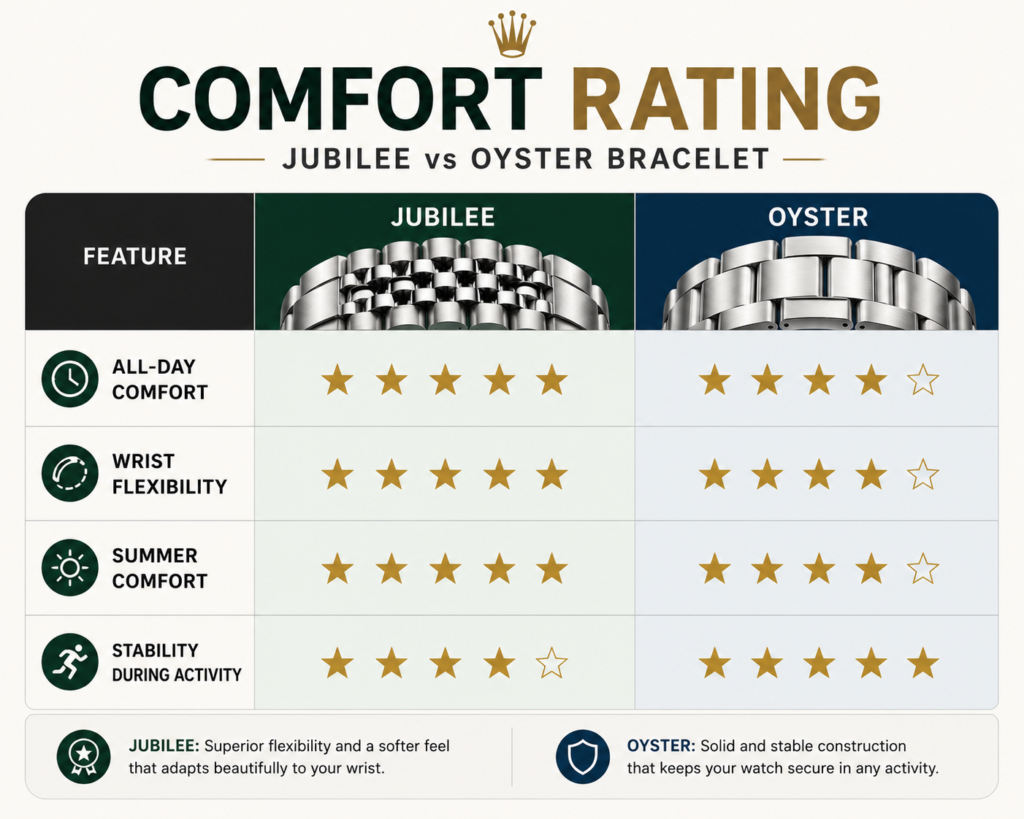
| Feature | Jubilee | Oyster |
|---|---|---|
| All-Day Comfort | ⭐⭐⭐⭐⭐ | ⭐⭐⭐⭐☆ |
| Wrist Flexibility | ⭐⭐⭐⭐⭐ | ⭐⭐⭐⭐☆ |
| Summer Comfort | ⭐⭐⭐⭐⭐ | ⭐⭐⭐⭐☆ |
| Stability During Activity | ⭐⭐⭐⭐☆ | ⭐⭐⭐⭐⭐ |
Comfort Winner: 🏆 Jubilee One of the most common concerns among Rolex buyers is how the bracelet will look after years of daily wear. This is an area where both bracelets perform exceptionally well, but they age differently.
The Oyster bracelet tends to develop a subtle tool-watch character over time. Its brushed outer links disguise small scratches remarkably well, and even after years of regular wear, the bracelet often continues to look clean with only minimal refinishing. The Jubilee bracelet tells a different story. Because many Jubilee bracelets feature polished center links, they collect hairline scratches much sooner. Under bright light, these marks become visible long before similar wear would be noticeable on an Oyster bracelet.
Fortunately, these scratches are almost entirely cosmetic. They don’t affect comfort, durability, or structural integrity. Historically, buyers also worried about bracelet stretch. Older folded-link Jubilee bracelets from the 1970s and 1980s could develop noticeable stretch after decades of wear because dirt and friction gradually wore the pins and links.
Modern Rolex bracelets are completely different. Today’s solid-link Jubilee bracelets have dramatically improved tolerances and materials. Under normal ownership, stretch is no longer a meaningful concern. If maintained properly, both bracelets should last for decades.
Aging Comparison
🏆 Oyster Not every Rolex works equally well on both bracelets. Some models have become inseparable from a particular bracelet, while others look fantastic either way.
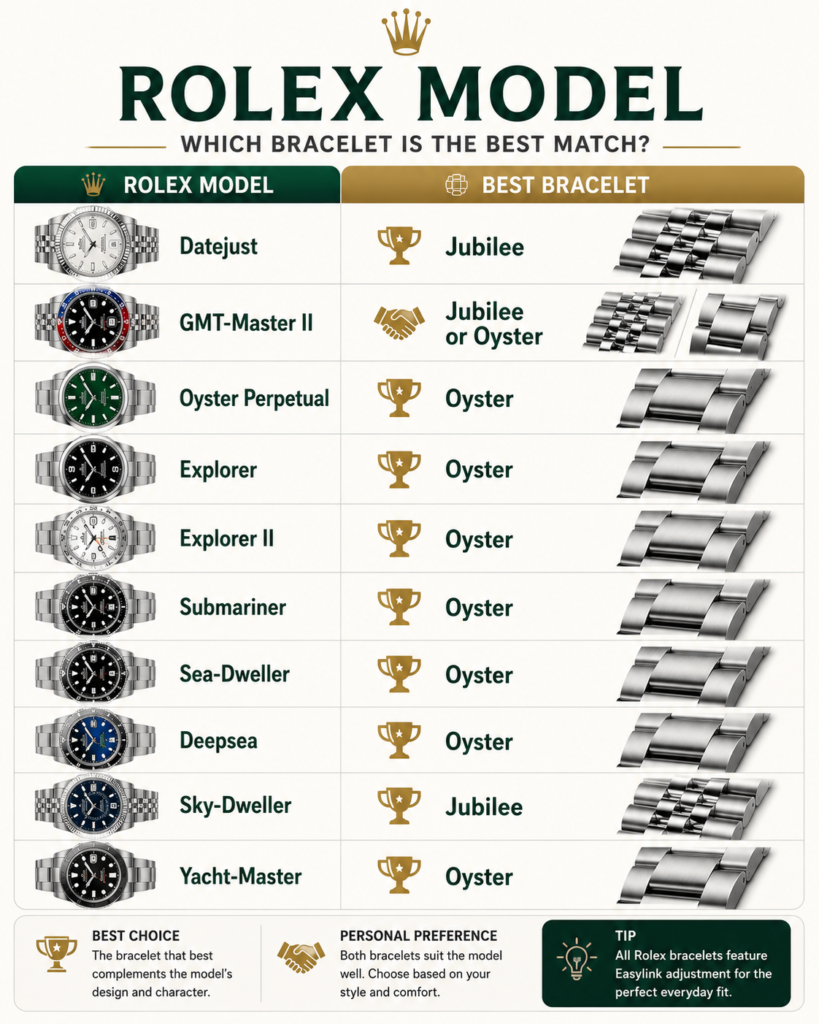
Datejust
If there is one watch that defines the Jubilee bracelet, it’s the Datejust. The five-link bracelet complements the fluted bezel perfectly and creates one of the most iconic Rolex combinations ever produced.
The Oyster version is excellent, but most enthusiasts still associate the Datejust with the Jubilee.
GMT-Master II
This is where opinions become divided. The Pepsi on a Jubilee has become incredibly popular, while the Batman is available on either bracelet. If you prefer a more vintage-inspired appearance, choose the Jubilee.
If you want a sportier GMT, choose the Oyster. Neither is objectively better.
Explorer
The Explorer belongs on an Oyster bracelet. Its history as a mountaineering tool watch makes the simpler three-link design feel completely natural. A Jubilee-equipped Explorer would simply lose part of its identity.
Oyster Perpetual
The Oyster Perpetual is built around simplicity. The Oyster bracelet reinforces that philosophy perfectly.
Adding a Jubilee would fundamentally change the watch’s character.
Sky-Dweller
Although available with Oyster bracelets, many collectors believe the Sky-Dweller looks more balanced on a Jubilee because it softens the visual weight of the large case.
The Right Lens for Comparing Rolex Jubilee and Oyster Bracelet
If you’re looking for one bracelet that can handle virtually anything, the Oyster bracelet is the better overall choice. It’s more durable, hides scratches better, requires less maintenance, and suits nearly every Rolex model. If comfort is your highest priority, it’s difficult to beat the Jubilee bracelet. Its flexible five-link construction wraps around the wrist beautifully and feels noticeably softer during long days of wear. Overall Winner: 🏆 Oyster Bracelet
Comfort Winner: 🏆 Jubilee Bracelet
The Part of the Comparison That Needs Context: Oyster Bracelet
Comfort is the Jubilee’s strength. Durability is where the Oyster fights back. The Oyster bracelet uses fewer moving parts.
Its larger three-link construction means fewer joints, fewer friction points, and a slightly simpler overall design. While modern Rolex bracelets are engineered to extremely high standards, simpler construction generally translates into greater long-term robustness. The Oyster also hides daily wear better.
Because most Oyster bracelets feature predominantly brushed surfaces, small scratches tend to blend into the finish. On the Jubilee, polished center links reflect light much more easily, making hairline scratches visible sooner. This doesn’t mean the Jubilee scratches more.
It simply shows scratches more clearly. Another topic often discussed is bracelet stretch. Vintage Rolex owners remember that older Jubilee bracelets developed stretch faster than Oyster bracelets after decades of wear.
That reputation still follows the Jubilee today. However, it no longer reflects reality. Modern Rolex bracelets use solid links instead of the folded-link construction found on many vintage models.
As a result, bracelet stretch has become far less common on both designs. If properly maintained, either bracelet should provide decades of reliable service.
Durability Winner
🏆 Oyster Bracelet It isn’t dramatically stronger, but its simpler construction and brushed finish make it slightly better suited to heavy everyday wear.
One area that’s rarely discussed before buying a Rolex is maintenance. Yet after wearing the watch every day for several months, it’s something every owner notices.
The Oyster bracelet is easier to keep clean. Its larger gaps between links make it simple to rinse away dust, sweat, sunscreen, and soap residue.
A soft toothbrush, warm water, and mild dish soap are usually enough to restore its original appearance. The Jubilee requires slightly more attention.
Because it uses five smaller links, dirt and skin oils can accumulate between the additional joints more easily. Cleaning isn’t difficult, but it usually takes a little longer.
The polished center links also reveal fingerprints more readily than the brushed surfaces of an Oyster bracelet. Neither bracelet requires special products or professional maintenance.
Regular cleaning every few weeks is enough to keep either looking excellent.
Maintenance Winner
🏆 Oyster Bracelet It’s quicker to clean, easier to maintain, and does a better job of hiding the signs of everyday use.
When Oyster Bracelet Makes More Sense Than Rolex Jubilee
Choosing between the Jubilee and Oyster bracelet isn’t about deciding which one is higher quality. Both are exceptionally well made and represent the best bracelet engineering in the luxury watch industry. The real question is what you expect from your Rolex.
Choose the Jubilee if comfort is your highest priority. Its flexible five-link construction, refined appearance, and luxurious wrist feel make it one of the most comfortable bracelets ever produced by Rolex. It’s the perfect match for watches like the Datejust and looks equally at home on modern GMT-Master II models. Choose the Oyster if you want maximum versatility. It’s tougher, easier to maintain, hides scratches more effectively, and complements nearly every Rolex sports watch. Whether you’re wearing an Explorer, Submariner, Oyster Perpetual, or Sea-Dweller, the Oyster simply feels right.
Awards
🏆 Overall Winner: Oyster Bracelet 🥇 Most Comfortable: Jubilee Bracelet 💪 Best for Everyday Wear: Oyster Bracelet ✨ Best Luxury Feel: Jubilee Bracelet
If you only plan to own one Rolex, the Oyster bracelet is the safer all-around choice because it adapts effortlessly to almost any situation. But if you’ve ever worn a Jubilee for an entire day, you’ll quickly understand why so many collectors consider it the most comfortable bracelet Rolex has ever made.