A ten-minute try-on can make Rolex, Omega and Breitling look close; a full week of ordinary wear usually does not.
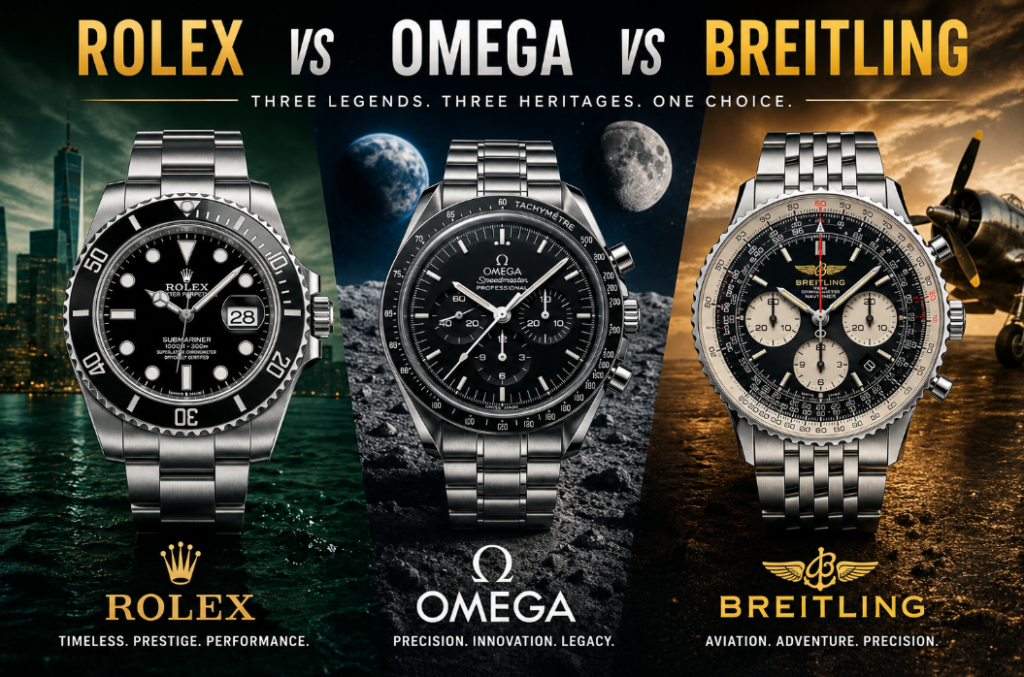
Choosing between Rolex, Omega, and Breitling is one of the biggest decisions in luxury watch collecting. All three brands produce exceptional Swiss watches, have rich histories spanning more than a century, and are respected around the world.
However, they don’t compete in exactly the same way.
Rolex focuses on timeless design, unmatched reliability, and exceptional long-term value.
Omega emphasizes innovation, cutting-edge movement technology, and incredible versatility across its collections.
Breitling is built around aviation, professional chronographs, and bold sports watches with distinctive wrist presence.
So which brand deserves your investment?
The answer depends on what you value most.
This guide compares Rolex, Omega, and Breitling across heritage, movements, durability, design, resale value, and overall ownership experience.
- What a Fair Rolex vs Omega vs Breitling Comparison Must Explain
- Ownership trade-offs: Rolex
- What works in practice
- Where the compromise appears
- Ownership trade-offs: Omega
- What works in practice
- Where the compromise appears
- Ownership trade-offs: Breitling
- What works in practice
- Where the compromise appears
- Submariner vs Seamaster vs Superocean
- Daytona vs Speedmaster vs Navitimer
- GMT-Master II vs Aqua Terra GMT vs Chronomat GMT
- Rolex vs Omega vs Breitling in One Paragraph
- How the Past Shapes Today's Watches
- Why They Feel More Different Than They Look: Rolex
- Why the Calibre Changes the Comparison: Omega and Breitling
- One Question Changes the Answer
- What Readers Still Want to Know About Rolex, Omega and Breitling
- Which brand is more prestigious: Rolex, Omega, or Breitling?
- Choosing Rolex Over Omega and Breitling: My Final Call
- Awards
- Author
What a Fair Rolex vs Omega vs Breitling Comparison Must Explain
Many buyers assume Rolex is automatically better than Omega and Breitling. The reality is more nuanced.
Rolex doesn’t necessarily produce the most technically advanced movements. Omega arguably does.
Breitling arguably builds the best aviation chronographs. Rolex simply delivers the best overall ownership experience.
Its watches are versatile, reliable, easy to service, and exceptionally desirable on the secondary market. You’re not choosing the “best” watch.
You’re choosing which philosophy fits you best.
Rolex owners often say: “Buy the Rolex once and never look back.” Omega enthusiasts usually say:
“Omega gives you more watch for the money.” Breitling collectors often say: “Nothing wears like a Navitimer.”
Each statement reflects the brand’s greatest strength.
Ownership trade-offs: Rolex
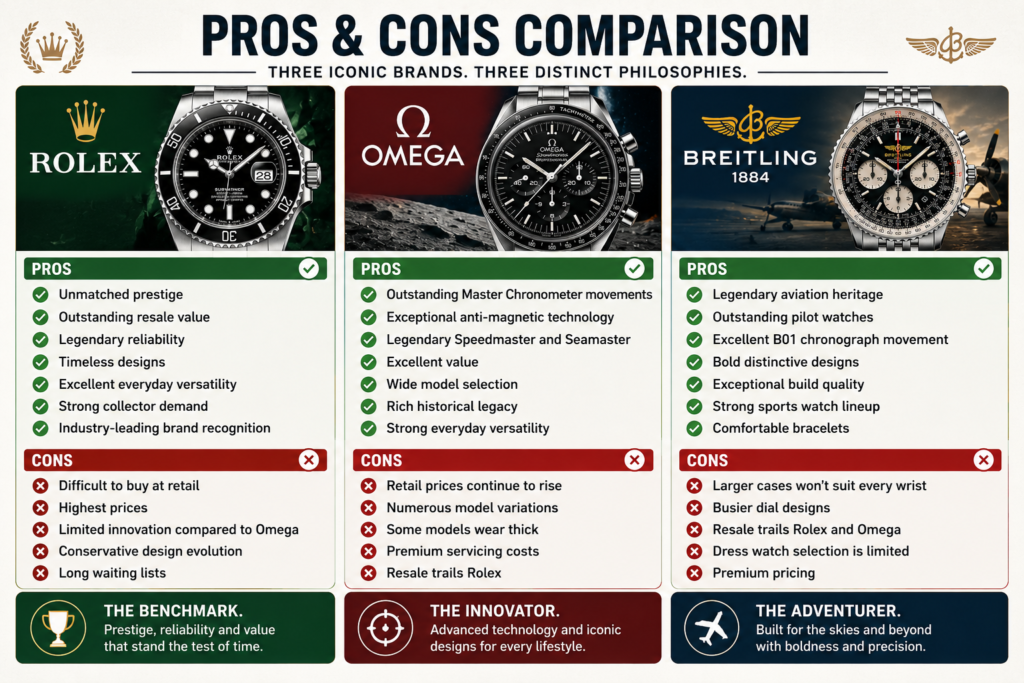
What works in practice
- Unmatched prestige
- Outstanding resale value
- Legendary reliability
- Timeless designs
- Excellent everyday versatility
- Strong collector demand
- Industry-leading brand recognition
Where the compromise appears
- Difficult to buy at retail
- Highest prices
- Limited innovation compared to Omega
- Conservative design evolution
- Long waiting lists
Ownership trade-offs: Omega
What works in practice
- Outstanding Master Chronometer movements
- Exceptional anti-magnetic technology
- Legendary Speedmaster and Seamaster
- Excellent value
- Wide model selection
- Rich historical legacy
- Strong everyday versatility
Where the compromise appears
- Retail prices continue to rise
- Numerous model variations
- Some models wear thick
- Premium servicing costs
- Resale trails Rolex
Ownership trade-offs: Breitling
What works in practice
- Legendary aviation heritage
- Outstanding pilot watches
- Excellent B01 chronograph movement
- Bold distinctive designs
- Exceptional build quality
- Strong sports watch lineup
- Comfortable bracelets
Where the compromise appears
- Larger cases won’t suit every wrist
- Busier dial designs
- Resale trails Rolex and Omega
- Dress watch selection is limited
- Premium pricing
| Feature | Rolex | Omega | Breitling |
|---|---|---|---|
| Founded | 1905 | 1848 | 1884 |
| Country | Switzerland | Switzerland | Switzerland |
| Famous Collections | Submariner, GMT-Master II, Datejust, Daytona | Speedmaster, Seamaster, Aqua Terra, Constellation | Navitimer, Chronomat, Superocean, Avenger |
| In-House Movements | Yes | Yes | Yes |
| COSC Certified | Yes | Yes | Most models |
| METAS Certified | No | Most modern collections | Selected models |
| Power Reserve | 70 Hours | 55-72 Hours | 70-78 Hours |
| Primary Focus | Everyday luxury | Innovation | Aviation |
Submariner vs Seamaster vs Superocean
- Best resale: Rolex Submariner
- Best technology: Omega Seamaster
- Best value: Breitling Superocean
Daytona vs Speedmaster vs Navitimer
- Most iconic: Speedmaster
- Most collectible: Daytona
- Best aviation chronograph: Navitimer
GMT-Master II vs Aqua Terra GMT vs Chronomat GMT
Rolex offers the strongest resale. Omega delivers superior movement technology. Breitling provides bold pilot styling.
Rolex typically commands the highest retail and secondary-market prices. Omega often offers the best value relative to movement technology. Breitling usually sits slightly below Rolex in pricing while competing closely with Omega. If price alone matters, Omega generally delivers the strongest package.
Few luxury brands retain value like Rolex. Demand consistently exceeds supply for many references, resulting in exceptional resale performance.
Omega performs well, particularly for the Speedmaster Professional. Breitling has improved significantly in recent years but still depreciates more than Rolex.
Rolex vs Omega vs Breitling in One Paragraph
If you’re looking for the best overall luxury watch brand, Rolex remains the benchmark. Its combination of reliability, prestige, resale value, and timeless design is difficult to match. If movement technology and technical innovation matter most, Omega comes remarkably close.
If you’re passionate about aviation-inspired sports watches and bold chronographs, Breitling offers something neither Rolex nor Omega can fully replicate. Overall Winner: Rolex
Best Technology: Omega Best Pilot Watches: Breitling
How the Past Shapes Today's Watches
All three brands have extraordinary histories. Rolex transformed the wristwatch by pioneering waterproof cases, automatic winding, and professional tool watches like the Submariner and GMT-Master. Omega became the first watch worn on the Moon and has served as the official Olympic timekeeper for decades while also becoming synonymous with James Bond.
Breitling established itself as one of aviation’s greatest watchmakers through legendary models like the Navitimer and Chronomat. Each brand has earned its place in horological history, but Rolex’s global influence remains unmatched.
Why They Feel More Different Than They Look: Rolex
The design philosophy differs dramatically between these brands. Rolex focuses on timeless consistency. A modern Submariner still looks unmistakably like a Submariner from decades ago. Omega embraces greater variety. The Speedmaster, Seamaster, Aqua Terra, and Constellation each have distinct personalities. Breitling prefers bold cases, detailed dials, and commanding wrist presence.
If you want one luxury watch that never looks out of place, Rolex has the advantage.
There is remarkably little separating these manufacturers. Rolex’s Oystersteel remains among the finest stainless steels in the industry.
Omega combines outstanding finishing with ceramic bezels, titanium, and advanced alloys. Breitling produces equally impressive sports watch construction.
All three are built to an exceptionally high standard.
Why the Calibre Changes the Comparison: Omega and Breitling
This is Omega’s strongest category. Modern Omega movements feature:
- Co-Axial escapements
- Silicon balance springs
- METAS Master Chronometer certification
- Resistance to magnetic fields up to 15,000 gauss
Rolex movements focus on simplicity, reliability, and outstanding long-term performance rather than chasing specifications. Breitling’s B01 chronograph movement is among the industry’s best automatic chronographs. Technically, Omega leads.
All three brands deliver excellent real-world accuracy. Rolex regulates its watches to Superlative Chronometer standards of approximately -2/+2 seconds per day after casing.
Omega’s Master Chronometer testing combines COSC certification with rigorous real-world performance and magnetic resistance. Breitling’s COSC-certified calibers also perform exceptionally well.
Overall, Omega offers the most demanding certification process.
One Question Changes the Answer
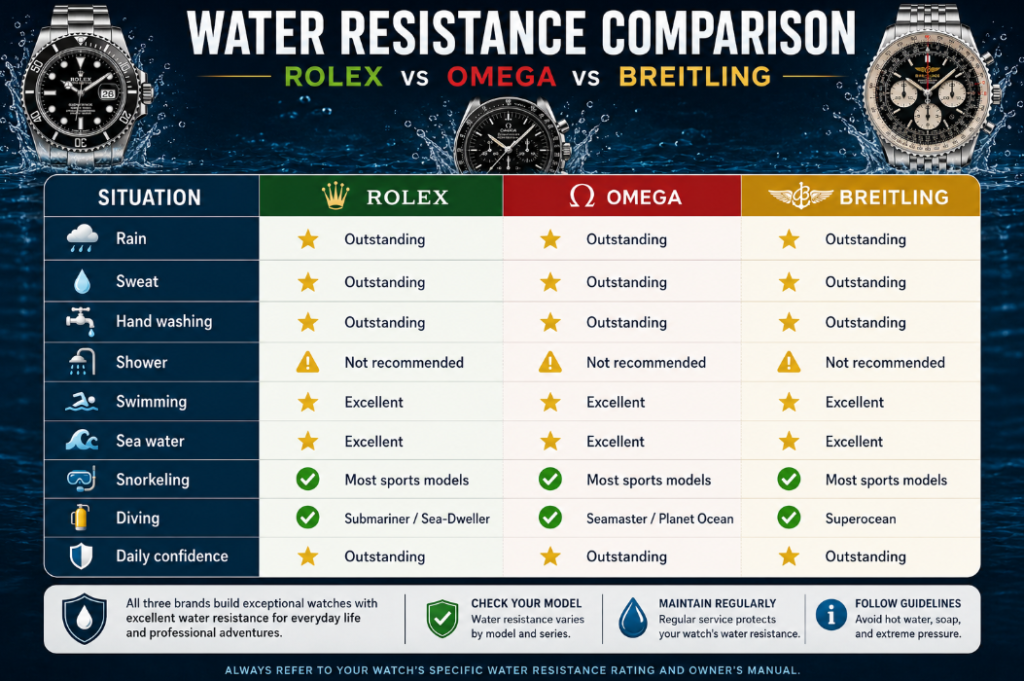
Rolex’s professional watches have earned legendary status for reliability. Omega’s Seamaster and Planet Ocean collections are equally capable in demanding environments. Breitling’s Superocean and Avenger models are built for extreme sports and professional use.
Rolex gains a slight advantage through decades of proven reliability.
What Readers Still Want to Know About Rolex, Omega and Breitling
Which brand is more prestigious: Rolex, Omega, or Breitling?
Rolex is generally regarded as the most prestigious thanks to its global recognition, exclusivity, and exceptional resale value. Omega follows closely, while Breitling is especially respected for its aviation heritage.
Choosing Rolex Over Omega and Breitling: My Final Call
Choose Rolex if you: Choose Omega if you:
Choose Breitling if you: Rolex, Omega, and Breitling each represent a different philosophy of Swiss watchmaking.
Breitling excels in aviation-inspired sports watches and produces some of the finest chronographs in the industry. Omega offers exceptional movement technology, remarkable innovation, and one of the most diverse luxury collections available today.
Rolex, however, remains the benchmark. Its unmatched combination of prestige, reliability, timeless design, and outstanding resale value continues to make it the brand against which every other luxury watch manufacturer is measured. If you’re buying just one luxury watch, Rolex remains the strongest overall recommendation.
Awards
🏆 Overall Winner: Rolex ⚙️ Best Movement Technology: Omega ✈️ Best Pilot Watches: Breitling
🌊 Best Dive Watches: Rolex 💰 Best Long-Term Value: Rolex