One technical distinction does more work in the Seiko Solar versus Citizen Eco-Drive decision than the rest of the specification sheet combined.
Seiko Solar and Citizen Eco-Drive solve the same problem: you get quartz accuracy without regular battery changes. Both charge from light, both are easy to own, and both are better choices than many cheap automatic watches if you simply want a reliable daily watch.
The simple answer is this:
Buy Citizen Eco-Drive if you want the best solar technology and lowest-maintenance ownership.
Buy Seiko Solar if you want Seiko design, Prospex divers, Speedtimer chronographs or a solar watch that still feels more like a traditional Seiko.
- The Practical Question Behind Seiko Solar vs Citizen Eco-Drive
- Seiko Solar Pros ✅
- Seiko Solar Cons ❌
- Citizen Eco-Drive Pros ✅
- Citizen Eco-Drive Cons ❌
- The Point of Diminishing Returns: Seiko Solar
- Why They Feel More Different Than They Look: Seiko Solar
- The Practical Test Most Buyers Overlook: Seiko Solar
- The Overlooked Question in Seiko Solar Versus Citizen Eco-Drive
- Specific Questions About Owning Seiko Solar or Citizen Eco-Drive
- Is Seiko Solar better than Citizen Eco-Drive?
- Which lasts longer, Seiko Solar or Citizen Eco-Drive?
- Do Seiko Solar watches need battery replacement?
- Does Citizen Eco-Drive need sunlight?
- The Budget Case for Seiko Solar—and the Upgrade Case for Citizen Eco-Drive
- Author
The Practical Question Behind Seiko Solar vs Citizen Eco-Drive
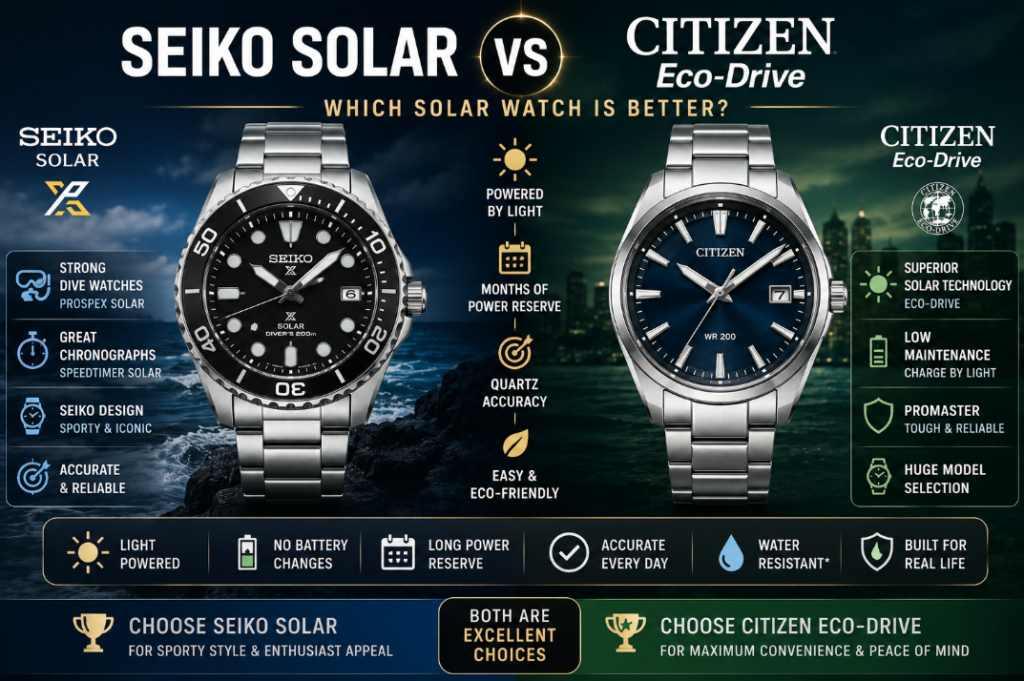
Seiko Solar Pros ✅
- Strong Seiko sports-watch design
- Excellent Prospex Solar options
- Great Speedtimer Solar chronographs
- Quartz accuracy
- Low maintenance
- Good alternative to automatic Seiko watches
- Better enthusiast appeal than many basic solar watches
Seiko Solar Cons ❌
- Eco-Drive has stronger brand identity
- Some models are more expensive
- Smaller solar ecosystem than Citizen
- Power reserve varies by movement
- Not as romantic as Seiko automatic watches
Citizen Eco-Drive Pros ✅
- Excellent light-powered technology
- Huge model range
- Very low maintenance
- Great everyday accuracy
- Strong Promaster options
- Easy to recommend as a gift
- One of the best practical watch systems
Citizen Eco-Drive Cons ❌
- Some designs feel more practical than exciting
- Less mechanical charm
- Enthusiast appeal is weaker than Seiko automatics
- Eco-Drive cell still needs light and care
- Model quality varies by collection
The Point of Diminishing Returns: Seiko Solar
Citizen Eco-Drive usually gives better practical value because the technology is available across a huge range of watches. You can find simple Eco-Drive dress watches, field watches, divers and chronographs at reasonable prices. Seiko Solar can be better if you specifically want a Seiko Prospex or Speedtimer. You may pay more, but you get Seiko design and stronger enthusiast appeal.
Why They Feel More Different Than They Look: Seiko Solar
Seiko Solar often feels more appealing to traditional watch fans. Seiko uses solar movements in watches that still feel like proper Seiko sports watches: divers, chronographs and everyday analog watches. The Prospex Solar and Speedtimer Solar lines are especially strong. Citizen Eco-Drive design varies more. Some models look excellent, especially Promaster and Super Titanium watches. But many Eco-Drive models are designed more around practicality than enthusiast charm. Seiko usually has the stronger emotional pull.
Citizen usually has the stronger practical identity.
The Practical Test Most Buyers Overlook: Seiko Solar
This is close, but Seiko Solar has a slight edge if you want a more enthusiast-focused dive watch. Seiko Prospex Solar divers often feel like real sports watches first and solar watches second. They are easy to recommend if you want a tough, accurate, low-maintenance diver-style watch.
Citizen Promaster Eco-Drive divers are also excellent and may be the better practical choice for many buyers. They are rugged, solar-powered and easy to live with. The practical verdict:
Seiko Solar for Seiko dive-watch character. Citizen Promaster Eco-Drive for worry-free daily water use.
Seiko Solar is especially strong here. The Seiko Prospex Speedtimer Solar line uses solar chronograph movements such as V192, with a 60-minute chronograph, 24-hour sub-dial and power reserve indicator.
Citizen also makes Eco-Drive chronographs, but Seiko Speedtimer Solar has stronger enthusiast appeal because of the Speedtimer design heritage and sporty dial layouts. Both brands offer strong water-resistant models, but always check the exact watch.
Old gaskets, damaged crowns and opened case backs can reduce water resistance on both watches.
Both are quartz-based, so both are much more accurate than standard automatic watches. For normal daily use, accuracy should not be the deciding factor. A typical Seiko Solar or Citizen Eco-Drive will be accurate enough for almost everyone. Citizen does have a stronger reputation for solar quartz technology overall, especially because Eco-Drive is central to the brand. Some higher-end Citizen models push accuracy much further, but for regular affordable models, the difference is usually not huge.
Citizen Eco-Drive has the advantage here because Citizen has built its modern identity around light-powered watches. Eco-Drive models are especially good if you want a watch you can wear, leave near light and not think about. Citizen’s range includes simple dress watches, Promaster divers, radio-controlled models and higher-end accuracy-focused watches. Seiko Solar is also reliable, but it feels more like one movement option inside Seiko’s wider catalog. Seiko Solar watches are excellent, especially in Prospex and Speedtimer lines, but Citizen Eco-Drive feels more mature as a full ecosystem.
The Overlooked Question in Seiko Solar Versus Citizen Eco-Drive
Both systems use light to charge an internal rechargeable cell. That means you do not need to replace a normal disposable battery every few years. Seiko describes its Solar watches as powered by light through a light-transmitting dial, with an energy reserve of at least six months on its official solar collection page. Citizen describes Eco-Drive as technology that converts any type of light into energy and stores excess energy in a power cell, allowing the watch to run for months on a full charge even in darkness. Both are very low-maintenance, but Citizen Eco-Drive wins slightly.
With either brand, the most important advice is simple: do not store the watch in a dark drawer for months. Keep it near light when you are not wearing it. Eco-Drive is one of the easiest watch systems to recommend to non-watch people because it removes most ownership stress. No winding, no frequent time setting, no regular battery swaps.
Specific Questions About Owning Seiko Solar or Citizen Eco-Drive
Is Seiko Solar better than Citizen Eco-Drive?
Usually no. Citizen Eco-Drive is the stronger solar system overall. Seiko Solar is better if you specifically want Seiko design, Prospex divers or Speedtimer chronographs.
Which lasts longer, Seiko Solar or Citizen Eco-Drive?
Both can last many years if kept charged and serviced properly. Citizen has the stronger reputation for light-powered watch technology.
Do Seiko Solar watches need battery replacement?
They use a rechargeable cell rather than a normal disposable battery. It can last many years, but it is not something you should treat as a regular short-life battery.
Does Citizen Eco-Drive need sunlight?
No. Eco-Drive can charge from many types of light, not only direct sunlight. Strong light charges it faster.
The Budget Case for Seiko Solar—and the Upgrade Case for Citizen Eco-Drive
Citizen Eco-Drive is the better solar watch system overall. It is easier to recommend, available in more styles and built around low-maintenance ownership. Seiko Solar is the better choice if you want Seiko design, Prospex sports-watch character or a Speedtimer Solar chronograph. The final answer is simple: Citizen Eco-Drive for maximum convenience and everyday practicality.
Seiko Solar for sportier Seiko character and enthusiast appeal. If you are buying with your head, Citizen Eco-Drive is usually the safer choice. If you are buying with your heart and like Seiko design, Seiko Solar is more satisfying.