Timex vs Tissot: Which Watch Brand Is Better?
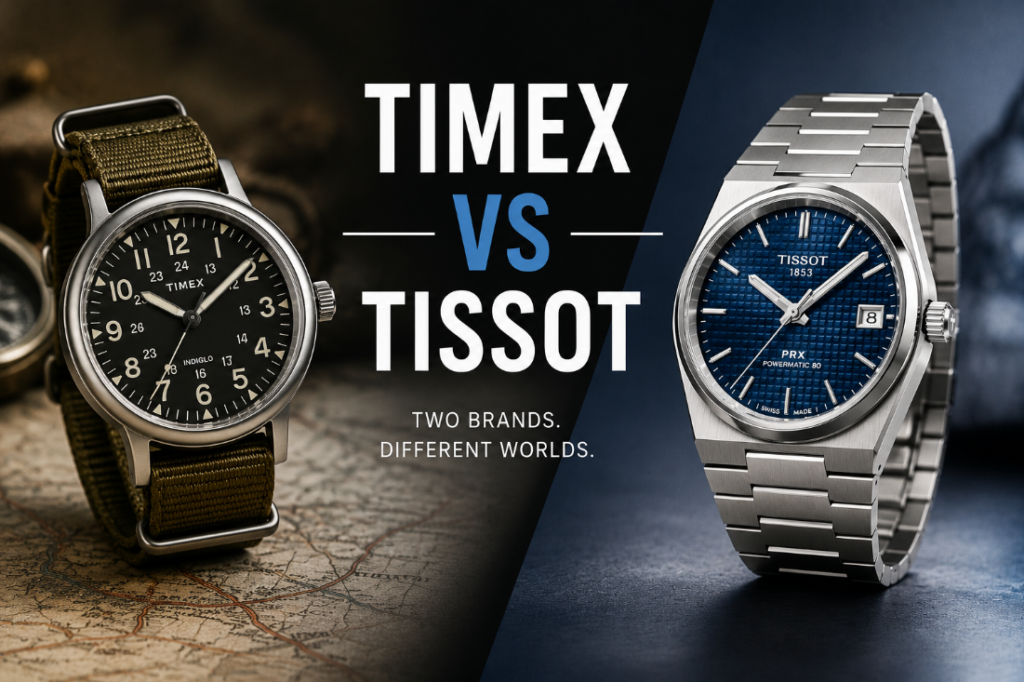
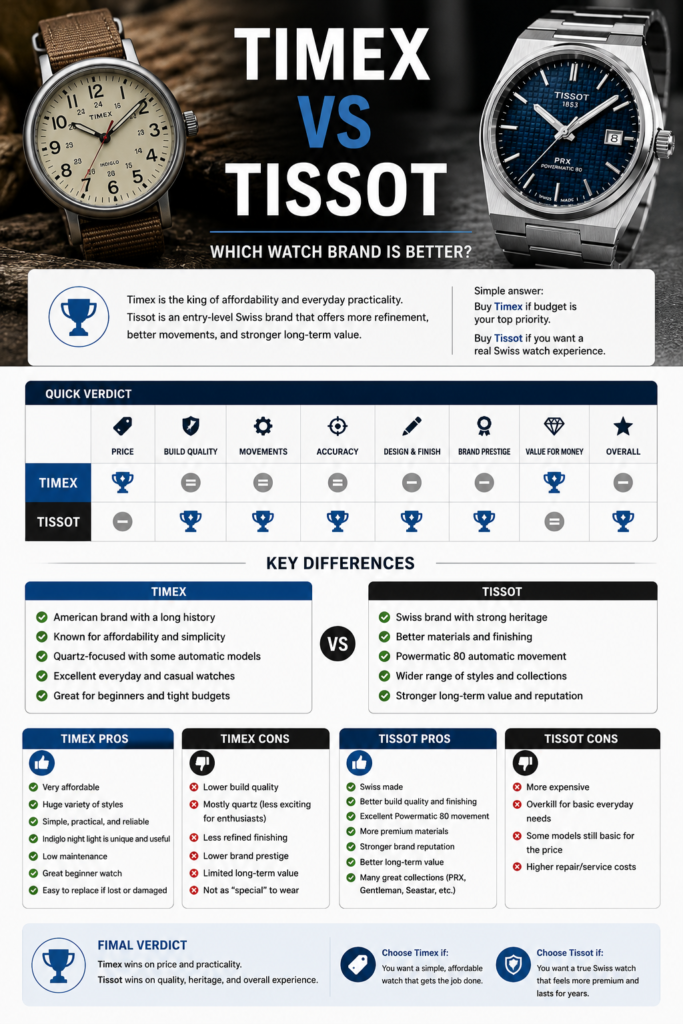
Comparing these two head-to-head is a little misleading, because they’re not really fighting for the same customer. Timex built its whole identity around making a watch accessible — cheap, honest, easy to replace. Tissot exists to give people an actual Swiss watch experience without asking for luxury-brand money. Put them side by side and the real question isn’t “which brand wins” — it’s “which price bracket are you actually shopping in.”
Where budget draws the real line
Under about $100, Tissot barely enters the conversation at all — Timex owns this territory outright, with genuinely solid quartz accuracy and options like the Weekender or Expedition that do exactly what a casual daily watch needs to do. Push into the $100-250 range and Timex still tends to make more sense; you’re paying for practicality rather than refinement at this level either way.
Cross into $300-800 territory, though, and the calculation flips hard. This is where Tissot’s Powermatic 80 automatic movement and better case finishing start to justify the price gap, backed by genuine Swiss-made materials that a Timex at the same cost simply can’t match. A Timex that creeps up toward Tissot money becomes a much harder sell — you’re paying premium prices for a watch that’s still fundamentally built to a budget.
What you’re actually buying beyond the price tag
Tissot’s advantage isn’t subtle once you handle both brands side by side. A PRX, Gentleman, Seastar, or Le Locle feels noticeably more substantial — better case finishing, more solid bracelets, crystals that hold up better over years of wear. Timex build quality is perfectly fine for what it costs, but it’s basic: some models tick noisily, cases feel light, straps wear in ways that remind you what you paid.
Movements tell a similar story. Timex leans almost entirely on quartz, which is cheap, accurate, and genuinely all most people need day to day. Tissot’s Powermatic 80 changes the conversation entirely for anyone who wants an automatic — long power reserve, real mechanical engineering, a level of seriousness Timex’s own mechanical Marlin line doesn’t quite reach even though it’s charming in its own right.
Accuracy is actually the one spot where the usual hierarchy inverts: a basic Timex quartz watch will genuinely out-accuracy most Tissot automatics, simply because quartz beats mechanical movements on raw precision. It’s a rare category where the cheaper brand has a real, measurable edge.
Picking a lane by what you actually do with a watch
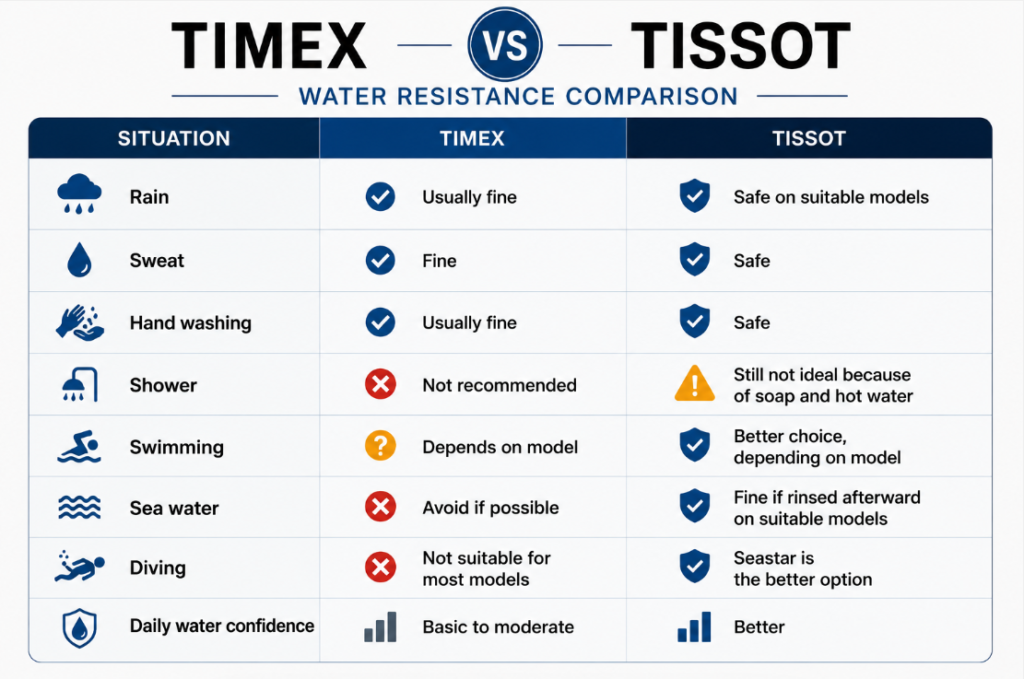
Field and outdoor use plays to Timex’s strengths — the Expedition line in particular is affordable and legible, built specifically around exactly this use case, and there’s no real Tissot equivalent at a similar price (Hamilton’s Khaki Field is the closer Swiss alternative if that’s what you’re after). Dress and office wear tips the other way: Tissot’s Gentleman and Le Locle lines simply look and feel more appropriate in a suit or formal setting than anything in Timex’s catalog. Serious water use and diving belong to Tissot too — the Seastar is a genuinely capable sports watch in a way Timex’s water-resistant models generally aren’t.
Who ends up with which
Someone shopping under $250, wanting a reliable field watch, or just needing something cheap and easily replaceable tends to land on Timex without much agonizing. A real Swiss-made experience, an automatic movement worth respecting, or a watch meant to stay in rotation for years is a different set of priorities entirely — and that’s exactly the territory where Tissot earns the extra money it costs.
A few nearby options worth knowing
If Timex’s field-watch formula appeals to you but you want it in genuine Swiss mechanical form, Hamilton’s Khaki Field is the natural step up. If you like the idea of an affordable automatic without going full Tissot money, Seiko 5 covers similar ground from a different angle. And if low-maintenance is the actual priority over either brand’s core appeal, Citizen’s Eco-Drive lineup solves that problem in a way neither Timex nor Tissot really addresses.
Bottom line
Neither brand is trying to beat the other at its own game. Price and pure practicality belong to Timex — it’s the correct answer any time the goal is simply a watch that works without asking much of your wallet. Once budget stops being the actual constraint, though, that’s where Tissot pulls ahead: movement quality and materials, backed by a genuine claim to being a real Swiss watch.