- What a Fair Tissot PRX vs Audemars Piguet Royal Oak Comparison Must Explain
- What the Marketing Around Tissot PRX and Audemars Piguet Royal Oak Leaves Out
- The Point of Diminishing Returns: Audemars Piguet Royal Oak
- Where Engineering Becomes Practical
- The Practical Test Most Buyers Overlook
- A More Useful Way to Compare Them
- What You Gain and Give Up With Tissot PRX or Audemars Piguet Royal Oak
- Tissot PRX Pros ✅
- Tissot PRX Cons ❌
- Audemars Piguet Royal Oak Pros ✅
- Audemars Piguet Royal Oak Cons ❌
- The Contrarian Case in the Tissot PRX and Audemars Piguet Royal Oak Debate
- Author
What a Fair Tissot PRX vs Audemars Piguet Royal Oak Comparison Must Explain
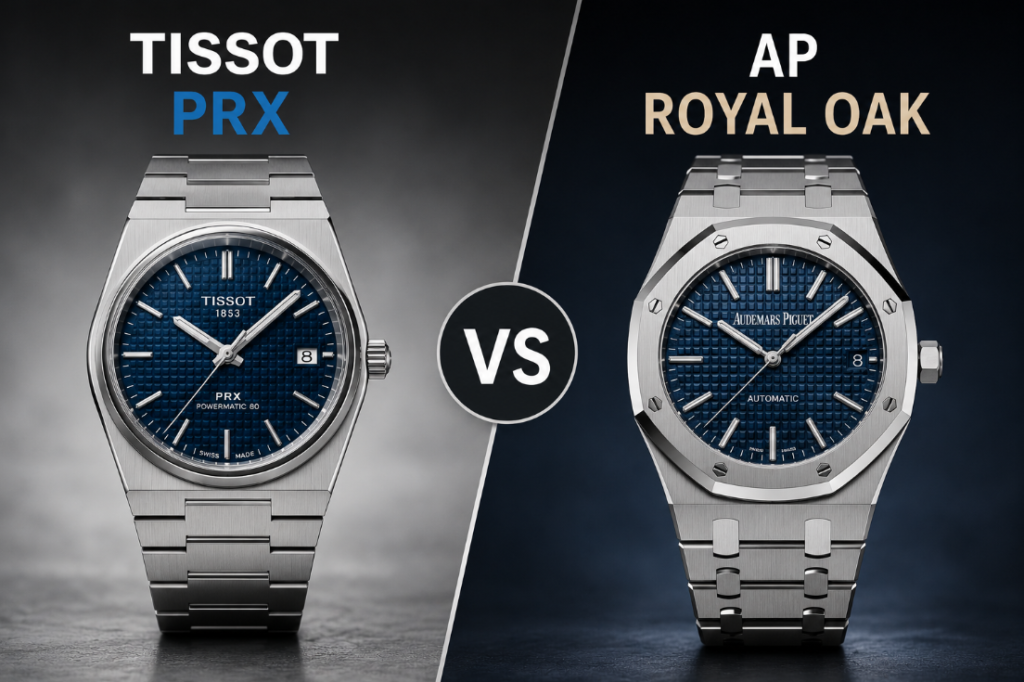
At first glance, comparing the Tissot PRX and the Audemars Piguet Royal Oak seems ridiculous.
One is a Swiss watch that can often be purchased for under $1,000.
The other starts around $25,000-$30,000 at retail, is often much more expensive on the secondary market, and is considered one of the most important luxury watches ever created.
We completely understand that these watches are not direct competitors.
However, this comparison has been requested repeatedly by our readers because the PRX is often described as “the affordable Royal Oak alternative.” Many buyers want to understand how much of the Royal Oak experience the PRX actually delivers and where the similarities end.
The goal of this article is not to declare a winner. The goal is to explain what each watch does well, where the comparisons are fair, and where they become unrealistic.
This is where the PRX performs remarkably well. The integrated bracelet looks fantastic.
The proportions are modern. The waffle-pattern dial adds visual interest.
The brushed surfaces create far more presence than most watches in its price range. In isolation, the PRX looks expensive.
The problem begins when it sits next to a Royal Oak. The Royal Oak has an incredible amount of detail that photographs often fail to capture:
- Sharper transitions
- More complex case geometry
- Superior brushing
- Better polishing
- More sophisticated dial finishing
- More precise bracelet construction
The PRX captures the vibe. The Royal Oak delivers the masterpiece.
This is where the largest gap appears. Many buyers think they are paying for the AP logo. They are not. They are paying for some of the best case and bracelet finishing in the watch industry.
The Royal Oak bracelet remains one of the benchmarks for luxury sports watches. The taper, articulation, finishing and comfort are on another level. The PRX bracelet is excellent for its price. It is not remotely on the same level as the Royal Oak.
That is not criticism of the PRX. That is simply reality.
What the Marketing Around Tissot PRX and Audemars Piguet Royal Oak Leaves Out
Let’s be honest. A large percentage of Royal Oak demand today is driven by hype, exclusivity and social status. The Royal Oak deserves respect because of its history and craftsmanship.
But many buyers are purchasing the logo, scarcity and prestige as much as the watch itself. Likewise, PRX owners sometimes exaggerate how close the PRX is to a Royal Oak. It isn’t.
The PRX captures some of the aesthetic. It does not replicate the craftsmanship, exclusivity or finishing. Both sides occasionally overstate their case.
PRX supporters often say:
- “90% of the look for 3% of the price.”
- “Best value integrated-bracelet watch.”
- “Makes luxury alternatives difficult to justify.”
Royal Oak owners often say:
- “You need to handle one in person.”
- “Photos don’t show the finishing.”
- “The bracelet alone explains the difference.”
Interestingly, both groups are partly correct.
The Point of Diminishing Returns: Audemars Piguet Royal Oak
Now the tables turn. The PRX is arguably one of the strongest value propositions in modern Swiss watchmaking.
You receive:
- Swiss Made quality
- Excellent design
- Great bracelet
- Strong movement
- Affordable pricing
The Royal Oak is a luxury object. Its value proposition is emotional rather than rational. Nobody buys a Royal Oak because it is the smartest financial decision.
They buy it because they want a Royal Oak. From a pure value perspective, the PRX wins by a huge margin.
Where Engineering Becomes Practical
The Powermatic 80 deserves praise. It offers:
- 80-hour power reserve
- Reliable operation
- Affordable servicing
- Strong value
For a watch under $1,000, it is excellent. However, it is an industrial movement designed for affordability and scale.
Audemars Piguet movements are built for an entirely different market. The finishing, decoration and engineering standards are significantly higher.
The criticism here is actually aimed at AP. Some modern Royal Oak buyers barely care about the movement because the watch has become such a status symbol.
Ironically, many PRX owners are more interested in the movement itself than some Royal Oak owners. Still, from a technical standpoint, AP wins comfortably.
The Practical Test Most Buyers Overlook
This category is closer than many enthusiasts want to admit. The PRX wears extremely well.
The bracelet drapes nicely. The case sits flat.
The watch feels balanced. The Royal Oak is still better, but not twenty or thirty times better.
This is where diminishing returns become obvious. A Royal Oak is unquestionably superior.
But it does not feel thirty times more enjoyable on the wrist than a PRX. That is one reason the PRX has become so successful.
A More Useful Way to Compare Them
The comparison exists because both watches share several visual characteristics: The PRX clearly draws inspiration from the same design era that made the Royal Oak famous. However, saying the PRX is a “Royal Oak clone” oversimplifies the story.
Integrated bracelet watches existed before and after the Royal Oak. The PRX is heavily inspired by Tissot’s own late-1970s designs, which appeared during the integrated-bracelet boom that followed the Royal Oak’s success. The visual connection is real. The ownership experience is not.
This category is not competitive. Tissot is respected. Audemars Piguet is one of the “Holy Trinity” names in Swiss watchmaking alongside Patek Philippe and Vacheron Constantin.
A Royal Oak immediately occupies a different level of luxury perception. Whether that matters depends on the buyer. For some people it matters a lot.
For others it matters not at all.
What You Gain and Give Up With Tissot PRX or Audemars Piguet Royal Oak
Tissot PRX Pros ✅
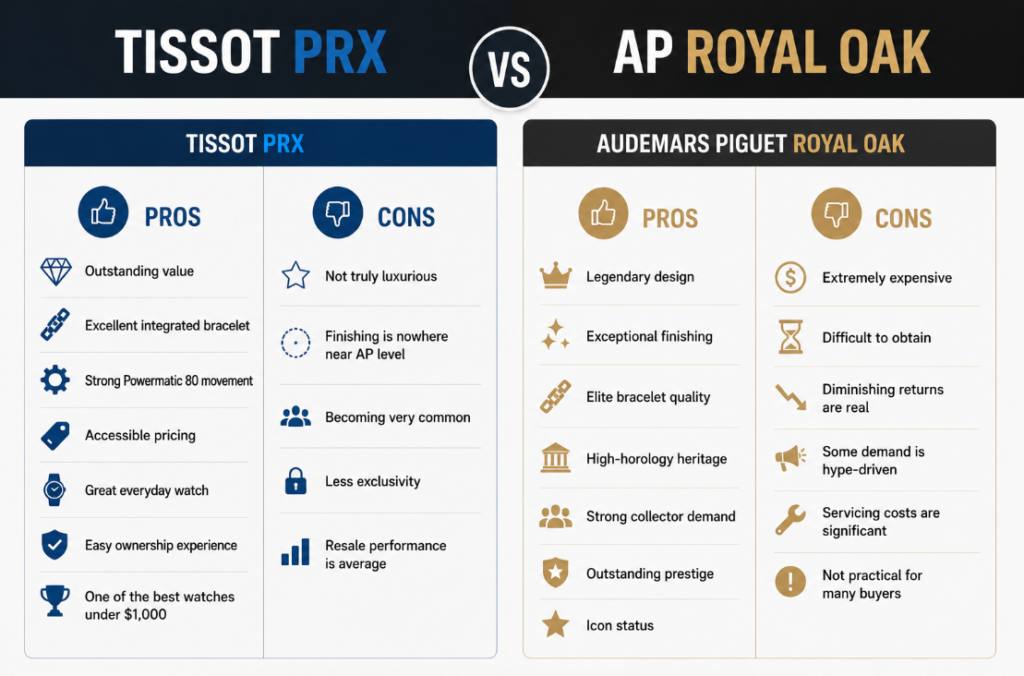
- Outstanding value
- Excellent integrated bracelet
- Strong Powermatic 80 movement
- Accessible pricing
- Great everyday watch
- Easy ownership experience
- One of the best watches under $1,000
Tissot PRX Cons ❌
- Not truly luxurious
- Finishing is nowhere near AP level
- Becoming very common
- Less exclusivity
- Resale performance is average
Audemars Piguet Royal Oak Pros ✅
- Legendary design
- Exceptional finishing
- Elite bracelet quality
- High-horology heritage
- Strong collector demand
- Outstanding prestige
- Icon status
Audemars Piguet Royal Oak Cons ❌
- Extremely expensive
- Difficult to obtain
- Diminishing returns are real
- Some demand is hype-driven
- Servicing costs are significant
- Not practical for many buyers
The Contrarian Case in the Tissot PRX and Audemars Piguet Royal Oak Debate
Buy the PRX if: For many buyers, this is the smarter purchase.
Buy the Royal Oak if:
- You can comfortably afford it
- You appreciate elite finishing
- You value horological history
- You want one of the most iconic luxury watches ever made
- You understand what makes high-end watchmaking special
For enthusiasts with the budget, the Royal Oak remains extraordinary. The Tissot PRX is not a Royal Oak killer. The Royal Oak is not thirty times better than the PRX.
Both statements can be true simultaneously. If we judge pure watchmaking, finishing, prestige and craftsmanship, the Royal Oak wins easily. If we judge value, accessibility and practical ownership, the PRX wins just as easily.
The honest conclusion is that these watches are not competitors. They simply happen to satisfy a similar aesthetic desire at completely different price points. The Royal Oak is the dream.
The PRX is the realistic recommendation. And for most buyers, the realistic recommendation is the one that actually matters.