- Tudor vs Rolex: Is Tudor the Smarter Buy or Is Rolex Still Worth the Premium?
- The nearest Tudor equivalent to each Rolex icon
- The uncomfortable truth about the price gap
- Heritage, and the surprising twist in design philosophy
- Build, movements, and where the gap actually lives
- Living with one versus the other
- Value, resale, and the honest math
- A couple of specific matchups worth knowing
- The bottom line
- Author
Tudor vs Rolex: Is Tudor the Smarter Buy or Is Rolex Still Worth the Premium?
These two brands share more history than almost any other pairing in watches — Tudor was founded by the same man who founded Rolex, still shares part of its manufacturing world, and has spent the last decade building a genuinely distinct identity of its own. That closeness raises an obvious question: if Tudor gets you so much of the same DNA for a fraction of the money, why does anyone still pay Rolex prices? The honest answer is that both things are true at once. Rolex remains the stronger overall watch brand. Tudor is arguably the smartest purchase in the entire luxury watch world. Neither claim cancels the other out.
The nearest Tudor equivalent to each Rolex icon
| Rolex model | Closest Tudor alternative |
|---|---|
| Submariner | Black Bay 58 |
| Sea-Dweller | Pelagos |
| Explorer | Ranger |
| Explorer II | Black Bay Pro |
| Daytona | Black Bay Chrono |
| GMT-Master II | Black Bay GMT |
The uncomfortable truth about the price gap
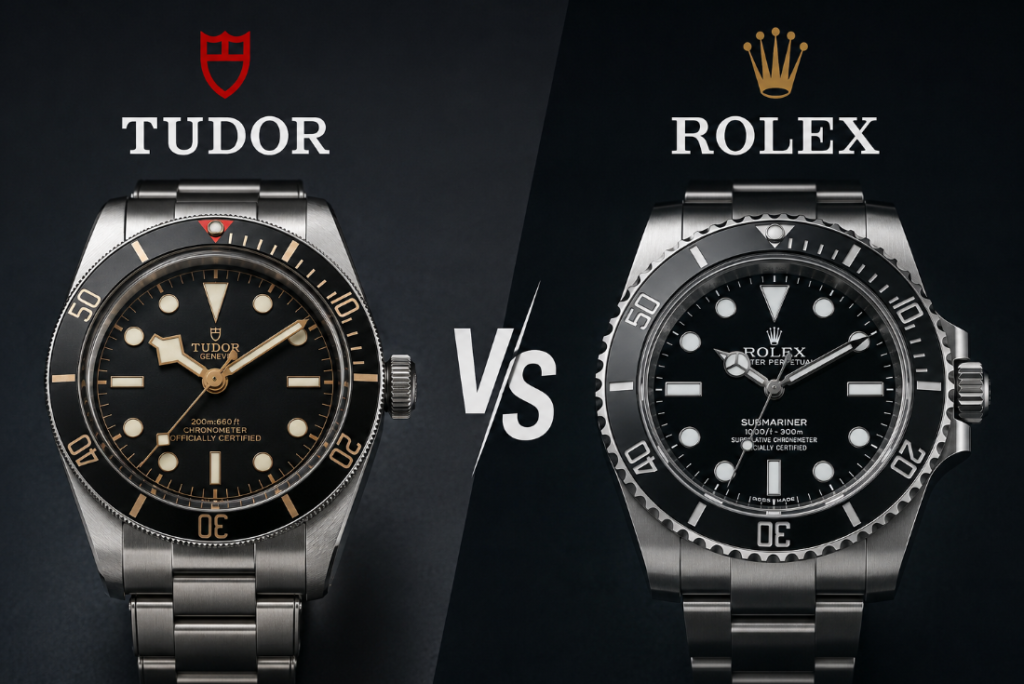
Put a Black Bay 58 next to a Submariner and the quality difference is genuinely small — most people without deep watch knowledge would struggle to point at where the extra thousands of dollars actually went. A meaningful chunk of what you’re paying for with Rolex isn’t watchmaking at all. It’s brand recognition and scarcity, resale strength, the weight of being one of the most desirable names on the planet. At the same time, Tudor fans sometimes oversell how close the two really are — the details do add up, and Rolex still handles plenty of them a notch better. The truth sits in the middle of both exaggerations.
Heritage, and the surprising twist in design philosophy
Rolex simply has more cultural weight. The Submariner, GMT-Master, Explorer, and Daytona didn’t just sell well — they helped define what a modern luxury sports watch even looks like, recognized by people who couldn’t name another watch brand if pressed. Tudor’s own history runs deep too, especially through military dive-watch heritage that the modern Black Bay line leans on constantly. That story has simply always run in Rolex’s shadow, never quite stepping fully into its own light.
Here’s the twist, though: on pure design philosophy, a lot of enthusiasts currently find Tudor more interesting. Rolex evolves its icons so slowly that a modern Submariner is still instantly a Submariner, decade after decade — safe, proven, deliberately unchanging. Tudor takes real risks by comparison; the Black Bay Fifty-Eight, the Pelagos FXD, the Black Bay Pro — all of them show a brand willing to experiment, and while not every experiment lands, the willingness to try is exactly what makes the current Tudor catalog feel like the more adventurous of the two.
Build, movements, and where the gap actually lives
Rolex bracelets remain genuinely best-in-class — the Oyster bracelet and Glidelock clasp are executed at a level that’s hard to overstate, and case finishing is remarkably consistent across the lineup. Tudor has closed a huge amount of ground here over the past decade; modern Black Bay and Pelagos pieces feel shockingly premium for what they cost, close enough that Rolex’s remaining edge is real but no longer dramatic.
Movements tell a similar story. Tudor’s in-house calibers are genuinely excellent — strong power reserves, COSC certification, reliability that gives most owners no practical reason to want more. Rolex’s own movements are still slightly better regulated with an even stronger long-term reputation, but the day-to-day difference is more measurable on paper than noticeable on the wrist.
Living with one versus the other
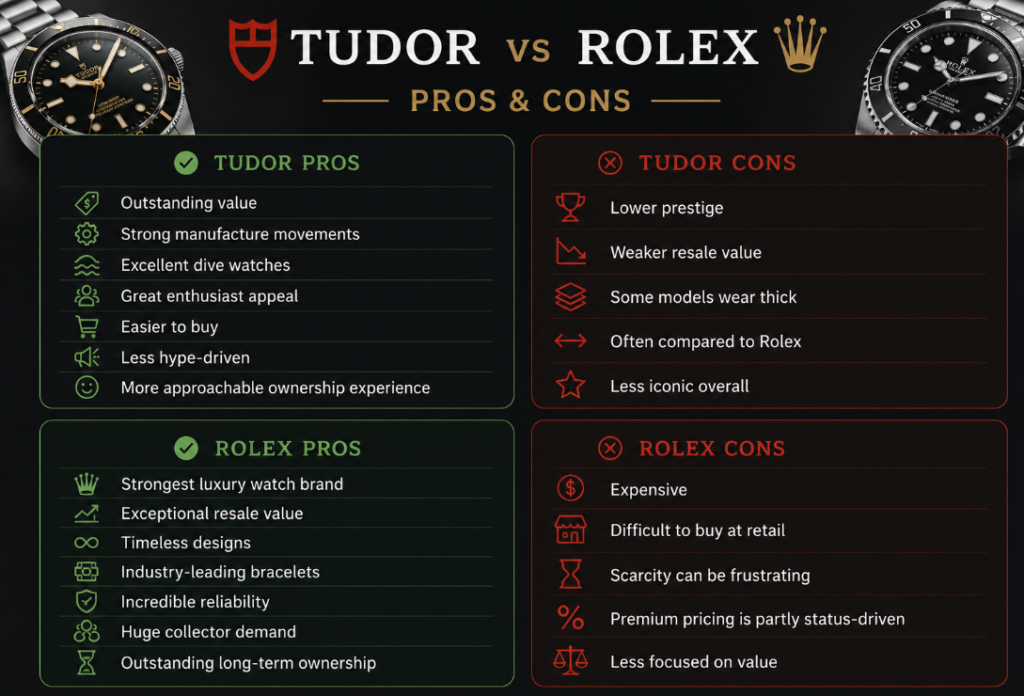
This is where Tudor quietly becomes the more compelling everyday object. A Tudor draws far less attention than a Rolex, which means a lot of owners feel genuinely comfortable wearing it daily, taking it traveling, or just putting it through the paces it was actually designed for. Rolex ownership carries real extra weight that has nothing to do with the watch itself — waitlists and dealer relationships on one side, a level of visible wealth signaling on the other that not everyone actually wants attached to their wrist. Walking into a shop, buying the Tudor you want, and just wearing it is a genuinely simpler experience, and that simplicity has real value of its own.
Value, resale, and the honest math
Dollar for dollar, nothing in Rolex’s lineup competes with what a Black Bay Fifty-Eight delivers — luxury-level finishing, a genuine manufacture movement, real enthusiast credibility, all at a fraction of Submariner money. Rolex isn’t really trying to win this argument, though, because it isn’t selling on value in the first place; it’s selling prestige and desirability as part of the package. Resale flips the picture entirely back toward Rolex — certain models hold value so well they occasionally appreciate, while most Tudors depreciate like a normal luxury good, respectably but nowhere near Rolex territory.
A couple of specific matchups worth knowing
The Black Bay 58 against the Submariner is the classic version of this whole debate — the Submariner remains the more complete, more prestigious watch, while the Black Bay 58 delivers enough of the same experience that plenty of serious collectors genuinely prefer it as the smarter buy. The Pelagos against the Submariner is a different conversation entirely: the Pelagos is Tudor’s serious modern tool watch, built around titanium and genuine dive capability with none of the vintage charm the Black Bay leans on, and more than a few enthusiasts pick it over the Submariner specifically for that reason, even setting prestige aside.
The bottom line
If the question is simply which brand is better, Rolex still takes it — the heritage, the resale strength, the sheer cultural weight are things Tudor genuinely can’t match yet. But “better brand” and “smarter purchase” aren’t the same question, and a huge number of experienced collectors who could easily afford either one still reach for Tudor specifically because it sits at the point where genuine quality and real value actually overlap. Rolex is the watch most people spend years dreaming about. Reaching for a Tudor instead tends to be a decision made later, by someone who already knows exactly what they’re buying and why.