- Casio vs Citizen vs Seiko: Which Watch Brand Is Best?
- If durability is non-negotiable
- If you never want to think about a battery again
- If you actually care about mechanical watchmaking
- Accuracy and everyday reliability
- Where the money actually goes
- A few specific matchups
- Who ends up buying what
- Bottom line
- Author
Casio vs Citizen vs Seiko: Which Watch Brand Is Best?
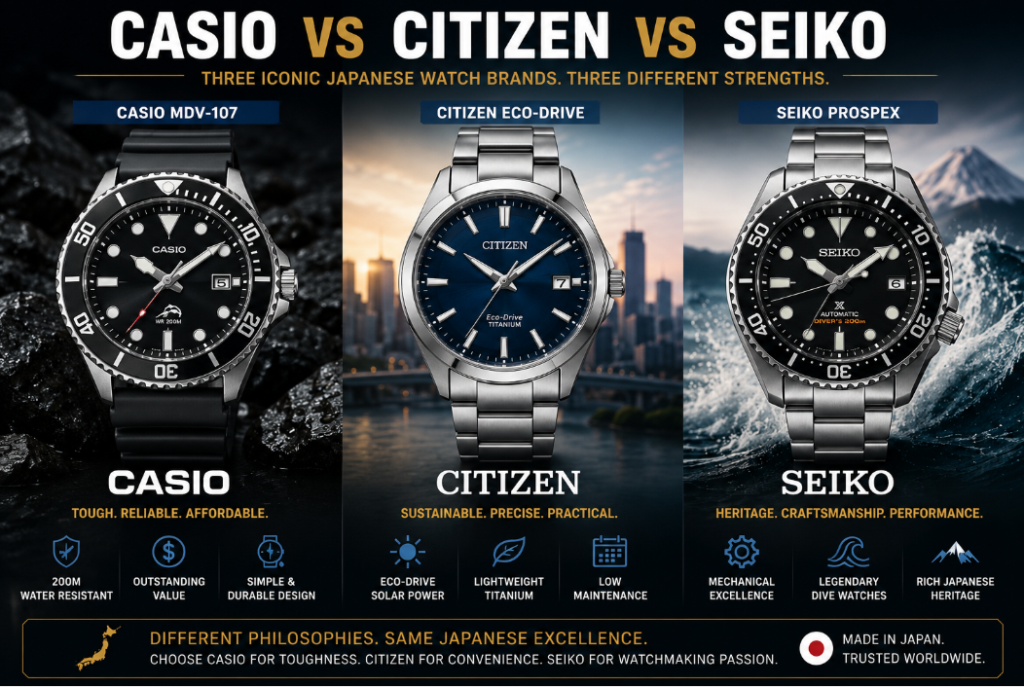
Three Japanese watchmakers, three completely different bets on what a watch is actually for, and somehow the same “which one should I buy” question keeps coming up regardless. The honest answer isn’t a ranking. It’s closer to matching your own priorities against three very different specialties that happen to have grown up in the same country.
If durability is non-negotiable
There’s not much debate here. Casio’s G-Shock line has spent four decades becoming the reference point every other “tough watch” gets measured against, and that reputation runs all the way down to the cheapest digital models in the catalog too. Citizen’s Promaster series holds up genuinely well too, built for outdoor and dive use without much fuss. Seiko’s Prospex divers have their own strong track record in real-world abuse, particularly the automatic models people actually take diving rather than just wearing to the office. If toughness is the entire decision, though, Casio still owns it outright.
If you never want to think about a battery again
This is where Citizen quietly wins an argument most people don’t even realize they’re having. Eco-Drive turns ordinary light into charge, which means routine battery swaps become something you basically stop thinking about. Casio’s Tough Solar does something similar on plenty of its own models, so it’s not a Citizen exclusive by any means, but Citizen built its entire identity around this one idea decades ago and it shows in how thoroughly the tech gets applied across the lineup. Seiko offers solar and kinetic options here and there, but the brand’s real strength lives somewhere else entirely.
If you actually care about mechanical watchmaking
Here the conversation shifts almost entirely toward Seiko. Nobody in this trio comes close to matching the sheer range Seiko covers — cheap, genuinely respected Seiko 5 automatics at the entry level, all the way up through Grand Seiko’s Spring Drive movements, a genuinely unusual hybrid technology that blends mechanical and quartz engineering. Citizen dabbles in automatics too, and does it competently, but it’s clearly not the brand’s main focus. Casio barely plays in this space at all — a handful of mechanical experiments exist, but nobody’s buying a Casio for the movement inside it.
Accuracy and everyday reliability
Quartz technology levels the field considerably. Casio and Citizen’s quartz movements are both excellent and require almost no attention from the owner. Seiko’s quartz performs just as well, though the brand’s mechanical side naturally gives up a bit of that precision in exchange for the appeal of watching an actual movement work through a case-back. In practice, day-to-day timekeeping is close enough across all three that this rarely decides anything on its own.
Where the money actually goes
Casio dominates the entry-level end of the market by a wide margin, packing genuine features into watches that cost very little. Citizen occupies a comfortable middle ground, and its combination of solid build quality with essentially zero ongoing maintenance cost tends to edge it ahead on pure value for money. Seiko’s range is the widest of the three, running from budget-friendly automatics up into serious luxury territory with Grand Seiko, though the brand has gotten noticeably pricier in recent years even at the entry level.
A few specific matchups
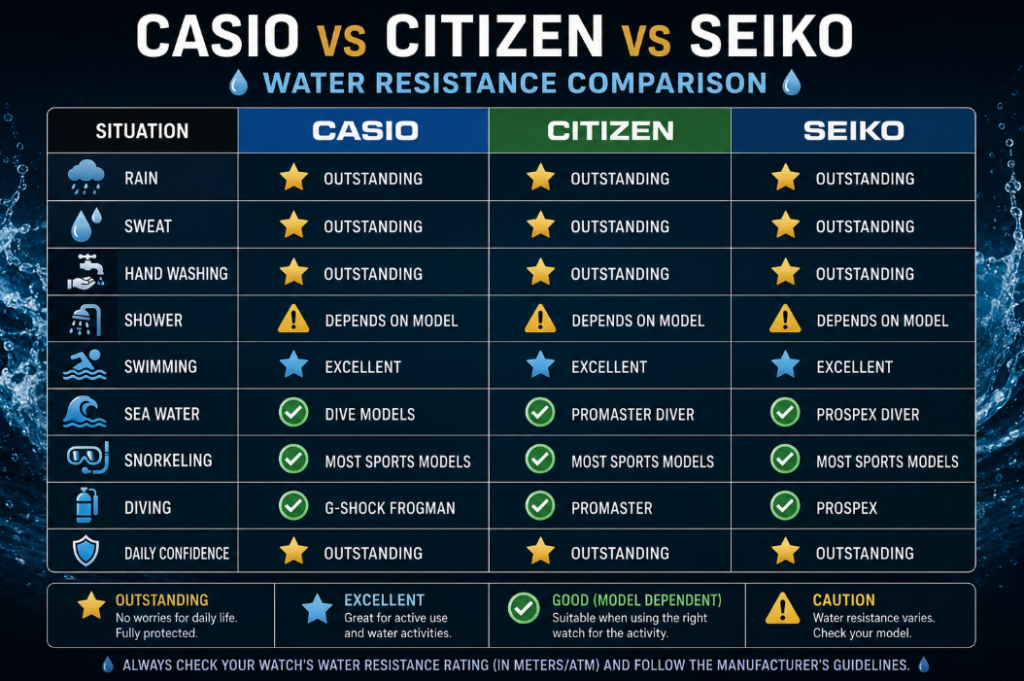
G-Shock, Citizen Promaster, and Seiko Prospex all compete for outdoor and dive attention, and each one wins a slightly different argument depending on what you actually need — raw toughness from the G-Shock, genuine dive-watch heritage from Prospex, low-fuss everyday capability from Promaster.
Down at the budget-diver level, the Casio Duro remains the value pick almost by default, the Citizen Promaster Diver adds solar convenience most Duro owners eventually wish they had, and Seiko’s “Turtle” line is really there for people who specifically want a mechanical diver without spending Grand Seiko money to get one.
Who ends up buying what
People chasing maximum toughness on a tight budget, or anyone who spends real time outdoors and just wants a watch that won’t complain, tend to land on Casio. Citizen picks up a different crowd entirely — the people who value low-maintenance ownership above almost everything else, who like the idea of never buying a battery again and want a watch that works equally well with a suit or hiking boots. Seiko, meanwhile, pulls in the ones who genuinely care about how a watch works: people who read about movements for fun, or who can already picture themselves owning a Grand Seiko someday even if that’s still a few watches away.
Bottom line
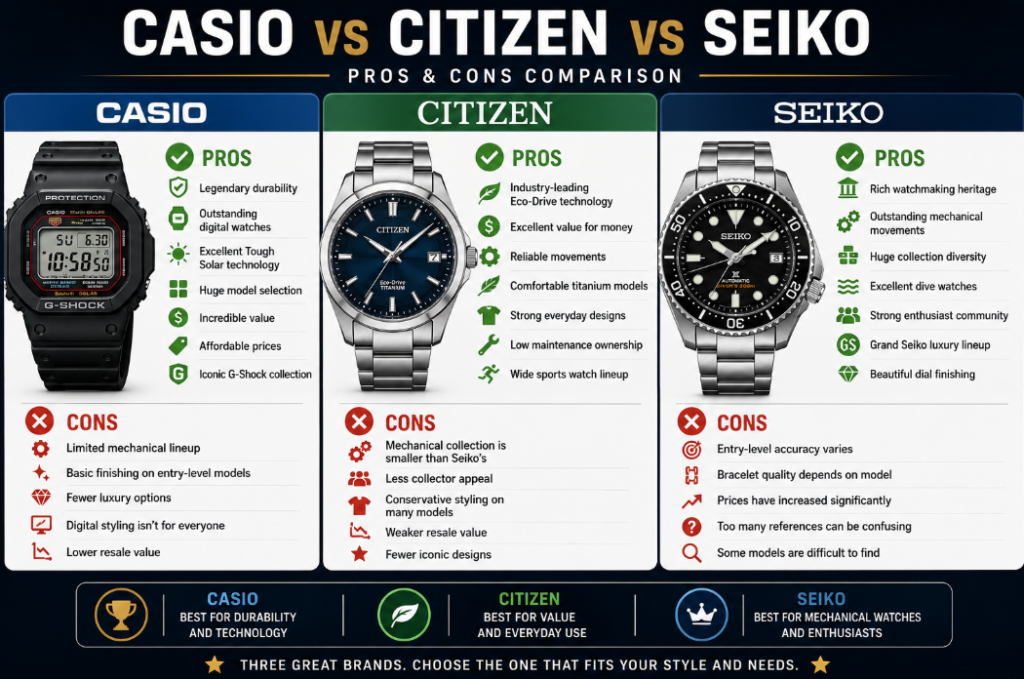
None of these three brands is trying to beat the other two at their own game, which is exactly why the “best” question never really resolves cleanly. Casio has toughness and price locked down. Citizen has quietly made maintenance a non-issue. And Seiko just goes deeper than either of them into the actual craft of watchmaking, with the history and mechanical range to back it up. It’s entirely normal, and pretty common in practice, to end up owning one from each and never feeling like any of them overlaps with the others.