People rarely leave Garmin because the watches cannot record a run. They leave because the model ladder is confusing, the price jumped, Garmin Connect feels crowded, a favorite metric seems untrustworthy, or years of features have become more distracting than useful.
That reason should choose the replacement.
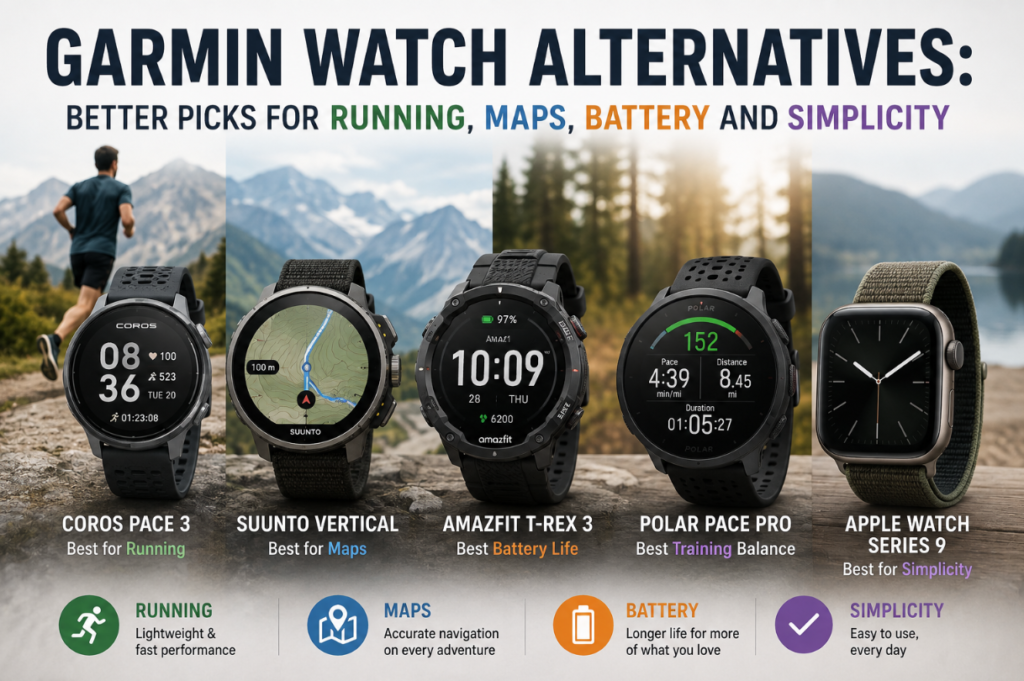
COROS is the clearest alternative for a runner who wants battery life and straightforward training at a lower price. Suunto makes the strongest case for attractive hardware and map presentation. Polar remains compelling for athletes who prefer its interpretation of training load and recovery. Apple Watch Ultra 3 is the move when smartwatch behavior matters more than Garmin’s outdoor ecosystem.
None is a free upgrade. Leaving Garmin also means leaving its data history, Connect IQ apps, safety tools, payment support and broad accessory compatibility.
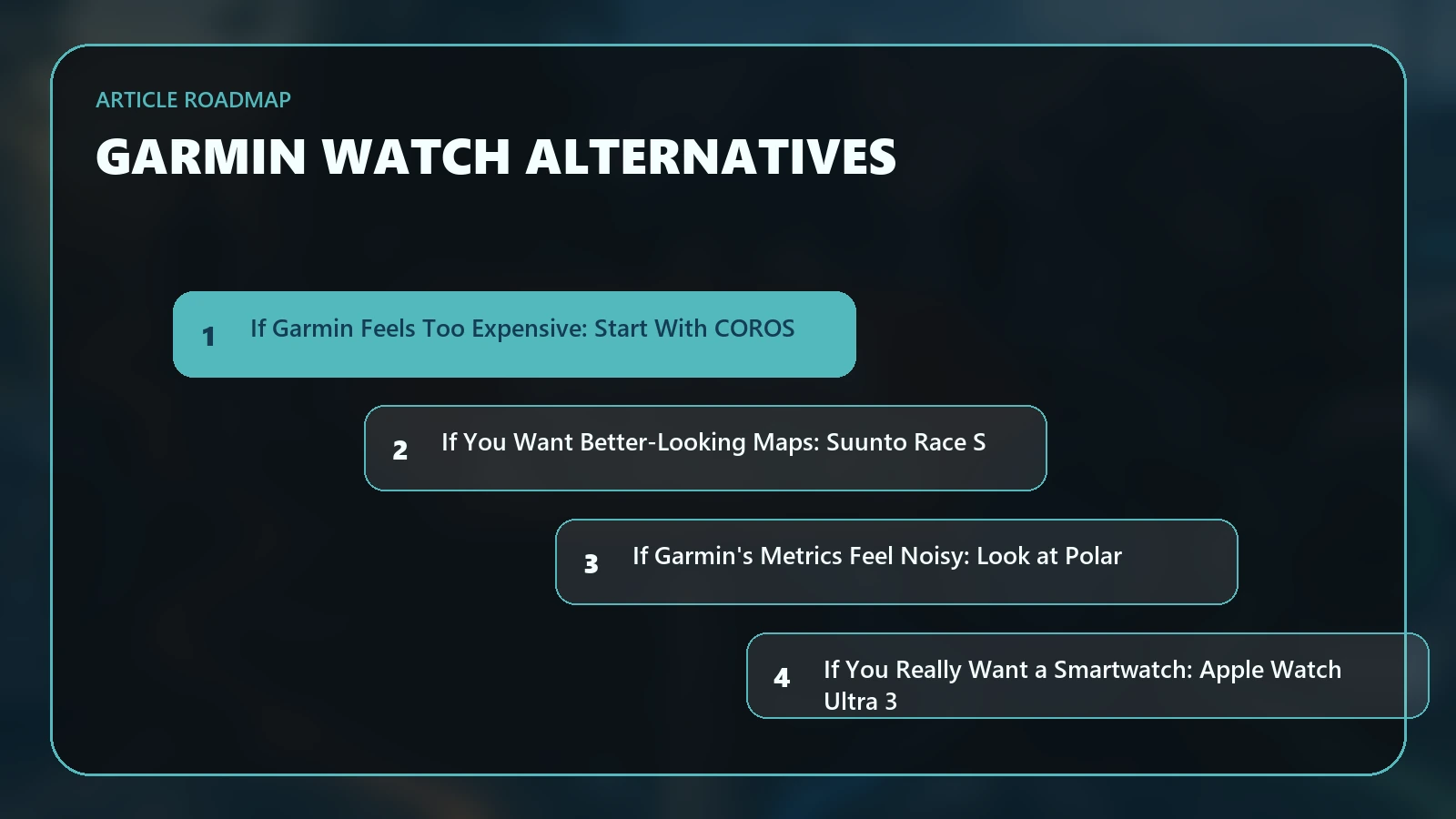
- If Garmin Feels Too Expensive: Start With COROS
- COROS PACE Pro
- COROS APEX line
- If You Want Better-Looking Maps: Suunto Race S
- If Garmin’s Metrics Feel Noisy: Look at Polar
- If You Really Want a Smartwatch: Apple Watch Ultra 3
- For Battery Above Everything Else
- The Cost Nobody Puts on the Product Page: Migration
- What You Give Up With Each Alternative
- Switch or Stay?
- Sources checked
- Author
If Garmin Feels Too Expensive: Start With COROS
The COROS PACE Pro packages an AMOLED screen, offline maps and long battery claims into a lighter, less expensive running watch than Garmin’s top Forerunner models. COROS rates it for up to 38 hours of GPS use and up to 20 days in standard use.
That does not mean it duplicates every Garmin feature. Garmin still offers a wider device family, more lifestyle functions and deeper integration with cycling computers, sensors and accessories. COROS wins when your real list is shorter: accurate pace and distance, structured workouts, maps, recovery guidance and infrequent charging.
Runner discussions repeatedly describe COROS as simpler and better value. Complaints also recur around customer support, display preferences and occasional firmware problems. Community opinion is useful here because those issues appear after purchase, but it is not a laboratory verdict. Buy from a retailer with a sane return policy and test the workflow you actually use.
COROS PACE Pro
Best for road runners and marathon training. The AMOLED display is easier indoors and in dim weather than older memory-in-pixel screens, while the low weight is welcome on long sessions. It lacks some of Garmin’s smartwatch polish.
COROS APEX line
Better for trail users who want more durable materials and longer adventures. Pricing climbs, reducing the value gap that made COROS attractive in the first place.
If You Want Better-Looking Maps: Suunto Race S
The Suunto Race S provides downloadable offline maps, route navigation, multi-band GNSS and a compact AMOLED case. Suunto rates it for up to nine days of normal smartwatch use and 30 hours in its highest-accuracy multi-band training mode.
Its map interface is the feature I would pay for. Routes are easy to understand at a glance, and the hardware looks less like industrial equipment than many outdoor watches. The watch is also comfortable for smaller wrists than a large Fenix.
The warnings are equally specific. Suunto’s app and training ecosystem are not as broad as Garmin’s. Owner reviews mention sync problems and strap comfort, and recent community threads include reports of software bugs on newer Suunto releases. That does not prove every unit is unreliable; it does mean you should update the watch and test intervals, maps and syncing during the return window.
Pick Suunto when: route presentation and design matter more than owning the largest feature library.
If Garmin’s Metrics Feel Noisy: Look at Polar
Polar’s appeal is not a longer spec sheet. It is the way Polar Flow presents training load, heart-rate zones and recovery over time. Athletes who dislike Garmin’s abundance of scores often find Polar’s framework calmer and easier to interpret.
The Vantage V3 and Vantage M3 are the obvious current alternatives. They cover multisport training, dual-frequency GPS on supported models, maps and recovery tools. Polar’s smartwatch functions and third-party ecosystem are thinner, and community reports still mention syncing quirks.
For my money, Polar makes sense only when you actively prefer Polar Flow. Hardware alone is not enough reason to migrate years of training data.
If You Really Want a Smartwatch: Apple Watch Ultra 3
The Ultra 3 is not a cheaper Garmin. It is a better iPhone companion with serious sports features layered on top. Calls, messages, Apple Pay, apps and cellular operation are far ahead of any Garmin paired to an iPhone. Apple’s current battery claim reaches up to 42 hours in normal use and up to 72 hours in Low Power Mode—better than a standard Apple Watch, still far shorter than many Garmin, COROS or Suunto models.
Mapping and training apps can fill many gaps, but those apps add decisions and sometimes subscriptions. Ultra 3 is the right alternative when your complaint about Garmin is that it behaves too much like sports equipment. It is the wrong alternative when your complaint is charging.
Android users should consider Pixel Watch 4 or Galaxy Watch8 for the smartwatch route, but neither replaces Garmin’s endurance battery or outdoor focus. Our Apple Watch alternatives guide covers that broader field.
For Battery Above Everything Else
Garmin is already difficult to beat here, especially with solar and large-case outdoor models. COROS often offers more battery per dollar. Suunto’s Vertical family is built for long GPS sessions and expedition use. Neither creates energy from marketing: display mode, satellite configuration, navigation, heart-rate sampling, cold weather and music all change the result.
Compare the mode you will use, not the largest number on the box. A “60-day” watch can become a much shorter-lived device with an always-on AMOLED screen and daily multi-band GPS.
My pick for a 100-mile event: prioritize the published high-accuracy GPS mode, course navigation with the map active, and charging during an activity. General smartwatch battery is nearly irrelevant on race day.
The Cost Nobody Puts on the Product Page: Migration
Garmin Connect may hold years of personal records, training load, routes and equipment mileage. Export tools can move activities to Strava or another platform, but proprietary scores do not travel neatly. Badges, trends and comparisons may stay behind.
There is also hardware baggage: chest straps, bike sensors, inReach devices and Edge computers. ANT+ and Bluetooth compatibility helps, but a replacement watch may not reproduce every multi-device workflow.
Before switching, list the five Garmin screens or reports you opened during the last month. If three are proprietary, trial the competitor’s app before selling your watch.
What You Give Up With Each Alternative
- COROS: fewer lifestyle features, smaller app ecosystem and less mature device breadth.
- Suunto: fewer connected features and a less comprehensive training platform.
- Polar: thinner smartwatch functions and fewer hardware categories.
- Apple Watch Ultra 3: dramatically shorter battery life and an iPhone requirement.
- Amazfit: lower confidence in long-term platform depth and serious training analysis.
Garmin’s weakness is complexity. Its strength is that the complexity covers many different athletes.
Switch or Stay?
Switch to COROS PACE Pro if you are primarily a runner and Garmin’s price or clutter is wearing you down. Move to Suunto Race S if maps, route presentation and case design are the attraction. Choose Polar Vantage if Polar Flow’s training interpretation makes more sense to you. Buy Apple Watch Ultra 3 if communication and apps matter as much as workouts.
Stay with Garmin if you use several Garmin devices, rely on Connect IQ or safety features, have years of data you regularly review, or cannot name a specific improvement the new platform will deliver.
Boredom is an expensive migration plan. A real workflow problem is a good one.
Sources checked
- COROS PACE Pro official specifications
- Suunto Race S official specifications
- Suunto Race S offline maps guide
- Apple Watch model comparison
- DC Rainmaker COROS PACE Pro review