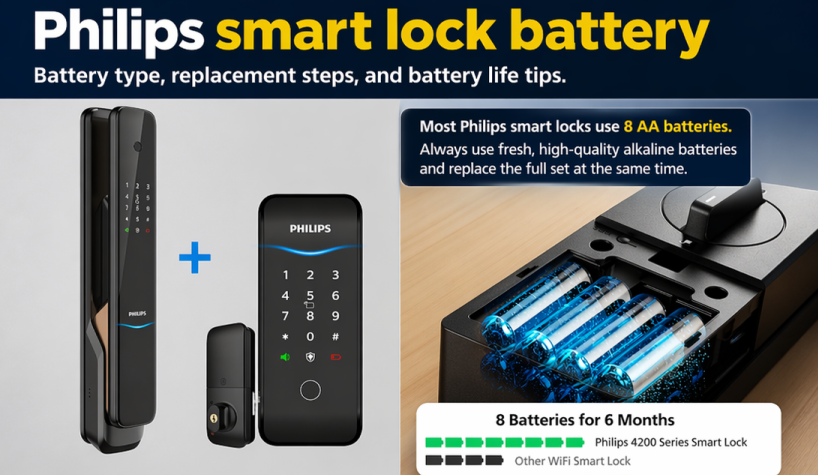
A Philips smart lock battery issue usually starts with small signs. The keypad may respond more slowly, the lock may beep, the motor may sound weaker, or the app may show a low battery warning. In many cases, the fix is simple – replace the batteries before the lock goes fully dead.
If you are searching for a Philips smart lock battery replacement, the main questions are usually the same: what battery type the lock uses, how to change it, how long it lasts, and what to do if the lock stops working after a battery swap. This guide covers those points in a simple, practical format.
- What battery does a Philips smart lock use?
- Philips smart lock battery table
- How to change the battery on a Philips door lock
- Tips for a smooth battery replacement
- Philips smart lock battery life
- Why Philips smart lock batteries drain faster than expected
- Philips smart lock not working after battery change
- Philips door lock battery low warning signs
- What happens if the Philips smart lock battery dies?
- Philips Alpha smart lock battery and Philips 9300 smart lock notes
- Does battery replacement affect settings?
- Philips smart lock installation and battery performance
- Final thoughts
- Author
What battery does a Philips smart lock use?
The Philips smart lock battery type depends on the exact model, but many residential Philips door lock systems use an interior battery compartment with standard replaceable batteries. In daily use, the most important thing is to check the battery tray inside the lock rather than guessing based on the product name.
If you are comparing search terms like smart lock Philips, Philip smart lock, or Philips door lock battery, they all usually point to the same practical task – opening the inside cover, checking the battery holder, and replacing the full set with fresh batteries of the correct size.
Philips smart lock battery table
| Model or type | Typical battery setup | Notes |
|---|---|---|
| Philips smart lock standard models | Replaceable batteries | Most common setup for routine battery service |
| Philips door lock keypad models | Interior battery compartment | Battery access is usually from the indoor side |
| Philips WiFi smart lock | Replaceable batteries | Battery life may be shorter because of connected features |
| Philips Alpha smart lock | Model-dependent battery setup | Best to confirm battery tray layout before replacing |
| Philips 9300 smart lock | Model-dependent battery setup | Often searched as Philips smart door lock 9300 |
| Philips smart lock premium models | Replaceable batteries | Battery life depends on usage, alignment, and features |
This keeps the model mentions useful without stuffing them awkwardly into the article.
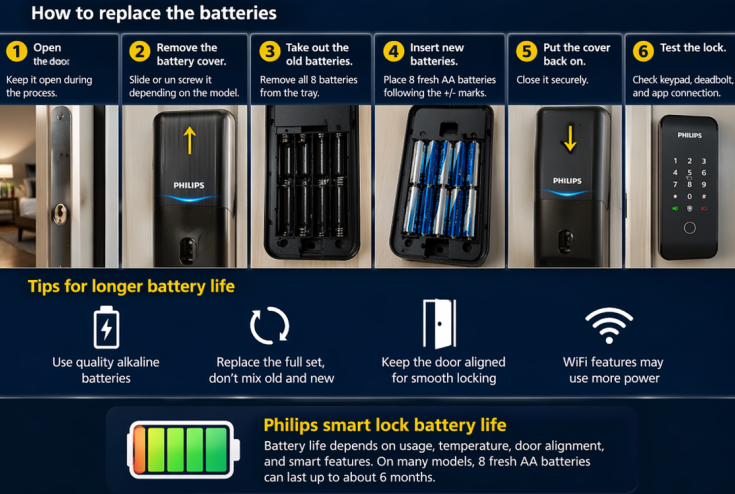
How to change the battery on a Philips door lock
A Philips door lock battery change is usually straightforward.
- Open the door and keep it open during the whole process.
- Go to the interior side of the lock.
- Remove the battery cover.
- Take out the old batteries or battery holder.
- Insert the new batteries in the correct direction.
- Reattach the battery holder or cover securely.
- Test the lock before closing the door.
That basic process covers Philips door lock battery change, Philips door lock battery replacement, and Philips smart lock battery replacement in a natural way.
Tips for a smooth battery replacement
A battery change is simple, but a few small mistakes can create problems right away.
Replace the full set. Do not mix old and new batteries.
Check polarity carefully. One battery installed backward can stop the lock from working.
Make sure the cover fits firmly. A loose cover can lead to poor battery contact.
Test with the door open. This helps avoid lockouts while checking the lock.
Use quality batteries. Weak batteries often cause unstable keypad or motor performance.
These small steps help prevent many common battery complaints.
Philips smart lock battery life
Philips smart lock battery life depends on several real-world factors:
- how often the door is used
- whether the lock has WiFi or app-based features
- door alignment
- weather and temperature
- battery quality
- how often the motor has to work against resistance
A basic keypad lock often lasts longer than a Philips WiFi smart lock because connected features usually use more power. That is why Philips smart lock battery life can vary a lot from one home to another.
Why Philips smart lock batteries drain faster than expected
If your lock seems to go through batteries too quickly, there is usually a practical reason.
Poor door alignment. If the deadbolt rubs against the strike plate, the motor needs more power every time it moves.
Heavy daily use. A front door used many times per day will drain batteries faster.
Connected features. App access, WiFi communication, and smart notifications can increase battery usage.
Low-quality batteries. Cheap batteries may lose strength early.
Loose battery contact. If the holder or cover does not sit firmly, the lock may act like the batteries are failing even when they are not fully drained.
This is especially relevant if you are trying to understand Philips WiFi smart lock battery life or sudden battery drops after installation.
Philips smart lock not working after battery change
If the lock still does not work after installing fresh batteries, the problem is not always serious. In many cases, it comes down to a simple setup issue.
Check the battery direction. One reversed battery is enough to stop the lock.
Remove and reinstall the batteries. A quick clean reinstall often fixes contact issues.
Inspect the cover and holder. A loose connection can interrupt power.
Test with the door open. This makes it easier to see whether the bolt is moving freely.
Check bolt resistance. If the deadbolt binds against the frame, the lock may appear faulty even with new batteries.
These are the first things to check before assuming there is a larger hardware problem.
Philips door lock battery low warning signs
A low battery warning does not always look the same on every model, but the most common signs include:
- slower keypad response
- warning beeps
- flashing indicator lights
- delayed locking and unlocking
- weaker motor sound
- app notifications on connected models
If you notice any of these, it is better to replace the batteries early rather than wait for a full shutdown.
What happens if the Philips smart lock battery dies?
If the battery becomes completely flat, the lock may stop responding from the keypad or app. That is why early replacement matters. A smart lock rarely chooses a convenient moment to die.
The exact backup method depends on the model. Some locks include a physical key option, while others may have a temporary emergency power method. The smartest move is to know your lock’s backup entry method before the batteries get critically low.
Philips Alpha smart lock battery and Philips 9300 smart lock notes
People often search for model-specific help, especially for the Philips Alpha smart lock battery and Philips 9300 smart lock. The main rule stays the same: battery replacement should be based on the actual battery compartment inside your model, not assumptions from another Philips lock.
Even within the same brand, battery layout and battery life can differ depending on whether the lock is a basic keypad model, a fingerprint lock, or a WiFi-enabled version.
Does battery replacement affect settings?
Usually no. A normal battery swap should not erase your everyday settings. In most cases, the lock keeps its main functions and stored access settings after fresh batteries are installed.
Still, after changing batteries, it is smart to test the basics:
- keypad response
- lock and unlock action
- fingerprint response if supported
- app connection if supported
- auto-lock if enabled
That quick check helps catch small issues before they turn into bigger ones.
Philips smart lock installation and battery performance
Battery life is often tied to installation quality. During Philips smart lock installation, the deadbolt should slide smoothly and the lock should sit square on the door. If the lock was installed under tension or the strike plate is slightly off, the motor may work harder than normal on every cycle.
That can shorten battery life even when the batteries themselves are fine.
Final thoughts
A Philips smart lock battery replacement is usually a simple job once you know where the battery compartment is and use the correct battery type for your model. The most important things are replacing the full set, checking battery direction carefully, and testing the lock with the door open before finishing.
If the lock still behaves oddly after the battery change, the cause is often something small like poor battery contact, a loose cover, or door alignment – not a major lock failure.
