This page answers one practical question about Genie Garage Door Opener Remote Batteries first, then explains only the checks that can change that answer.
Genie remotes are designed to provide long-lasting, reliable transmission, but like any battery-powered device, they eventually need a fresh power source. When a Genie remote begins losing range, working only at close distance, or stops responding completely, the problem is almost always the battery — not the opener and not the remote’s programming.
Because Genie has released a wide range of remotes over the years, identifying the correct Genie garage door opener remote battery size is essential. Most modern Genie remotes use a 3-volt lithium coin cell, while older ACSCTG models may require different battery types depending on whether they are Type 1 or Type 3.
This guide covers all major Genie remote battery types, the correct size for each model, and common troubleshooting steps.
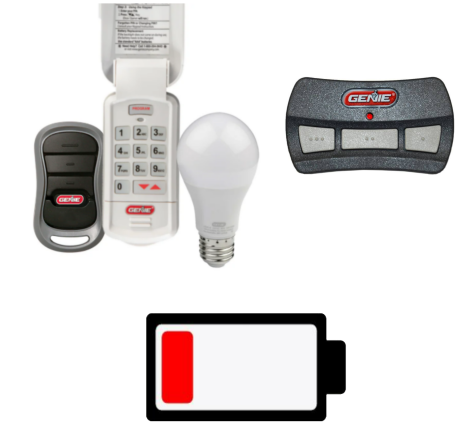
- Look Here Before Opening the Motor Unit
- CR2032 — the most common Genie remote battery
- CR2025 / CR2016 — used in older or slim Genie remotes
- Specialty cells in certain legacy models
- Open the Remote, Keypad, or Backup Compartment
- Short Note on Battery Replacement
- Genie Remote Backup Guide (Troubleshooting After Battery Change)
- Device Types That Use Different Cells: Genie Garage Door Opener Remote Batteries
- Author
Look Here Before Opening the Motor Unit
CR2032 — the most common Genie remote battery
This is the standard battery for most modern Genie remotes. If you are searching for “genie garage door opener remote batteries,” “battery for Genie remote,” or “genie garage door opener remote battery type,” the CR2032 is almost always the correct replacement.
CR2025 / CR2016 — used in older or slim Genie remotes
Some legacy Genie IntelliCode remotes — especially ACSCTG Type 1 — use thinner coin cells such as CR2025 or CR2016. They deliver the same 3V output but fit remote housings with less internal space.
Specialty cells in certain legacy models
A few older Genie remotes require specific coin cell formats because of casing thickness or contact spacing. This is especially relevant for searches like “genie garage door opener remote battery ACSCTG type 1 / type 3.”
Open the Remote, Keypad, or Backup Compartment
Short Note on Battery Replacement
Replacing a Genie remote battery is simple: open the case using the small side slot or rear cover, remove the old coin cell, and insert a new one with the positive (+) side facing up. Once the case is closed, the remote should immediately regain its normal range.
Genie Remote Backup Guide (Troubleshooting After Battery Change)

Even with a fresh battery installed, some remotes may still not respond. These are the most common fixes:
1. The LED lights up but the opener does not respond
The battery may not be fully seated or polarity may be reversed.
2. Lost programming after battery change
Older remotes may require reprogramming:
– Press the Program/Learn button on the opener,
– Press and hold the remote button until the opener light blinks.
3. Weak or inconsistent range
Cheap coin cells often provide unstable voltage. Switching to a high-quality CR2032 usually restores reliability.
4. Remote works indoors but not outdoors
Interference from LED bulbs, metal structures, or signal reflections can weaken transmission.
5. Intermittent operation
Dust or oxidation inside the battery tray can disrupt contact. Cleaning the contacts usually resolves the issue.
Device Types That Use Different Cells: Genie Garage Door Opener Remote Batteries
| Remote Model | Device Type | Battery Type | Voltage | Notes |
|---|---|---|---|---|
| GICT390 | 3-button remote | CR2032 | 3V | One of Genie’s most common IntelliCode remotes. |
| G1T / G2T / G3T Series | Modern 1-/2-/3-button remotes | CR2032 | 3V | Current Genie lineup; compact and efficient. |
| ACSCTG Type 1 | Classic IntelliCode remote | CR2025 or CR2016 | 3V | Slim housing requires a thinner coin cell. |
| ACSCTG Type 3 | Updated IntelliCode remote | CR2032 | 3V | Later version accepts the thicker CR2032 cell. |
| GM3T Mini-Remote | Keychain remote | CR2032 | 3V | Small form factor with IntelliCode support. |
This table naturally covers user queries such as:
genie garage door opener remote battery size, genie remote garage door opener battery, genie garage door opener remote battery gict390.
